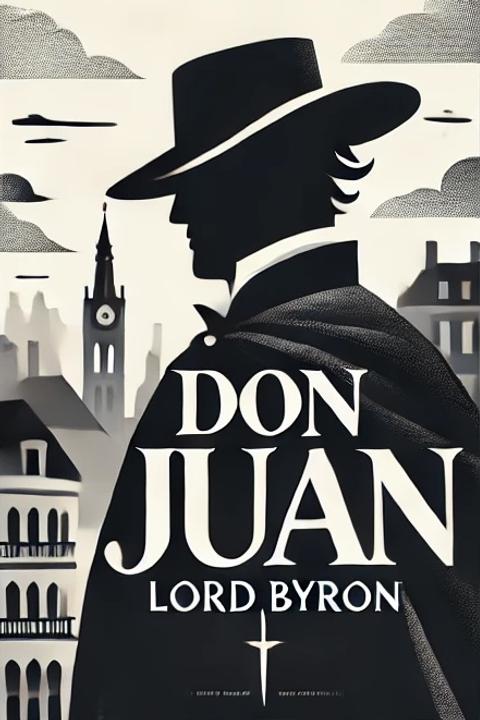
Don Juan by Lord Byron (1819)
The poem tells the story of a charismatic and seductive nobleman who engages in numerous love affairs with women from various social classes. His exploits are often reckless and self-destructive, driven by his insatiable desire for pleasure and experience. Through Juan's journey, the poem explores themes of morality, free will, and the human condition. The narrative is presented as a series of vignettes, each depicting a different episode in Juan's life, from his early days as a young nobleman to his later years as a seasoned lover and adventurer. The poem raises questions about the nature of love, desire, and identity, often blurring the lines between reality and fantasy. It also critiques societal norms and conventions, particularly those related to class, morality, and women's roles in society. Ultimately, Juan's story serves as a commentary on the human experience, highlighting both the beauty and the darkness that can exist within individuals.
By Lord Byron · First published 1819 · Genre: Epic Poetry, Satire, Romanticism · 17 chapters · 210,727 words
First lines
I / I want a hero: an uncommon want, / When every year and month sends forth a new one, / Till, after cloying the gazettes with cant, / The age discovers he is not the true one; / Of such as these I should not care to vaunt, / I'll therefore take our ancient friend Don Juan - / We all have seen him, in the pantomime, / Sent to the devil somewhat ere his time.
Similar titles
- The Cap And Bells by John Keats
- To Woman by Lord Byron
- Quem Deus Vult Perdere Prius Dementat by Lord Byron
- At A Summer Villa by Anton Chekhov
- To Temptation by Oliver Herford
- Self Dependence by Matthew Arnold
Genres
- Epic Poetry — The work is a long narrative poem that follows the adventures of its protagonist, fitting the characteristics of epic poetry.
- Satire — The poem employs humor, irony, and exaggeration to critique society, politics, and romantic conventions.
- Romanticism — It reflects the Romantic era's emphasis on emotion, individualism, and the critique of established norms.
- Adventure — The narrative structure involves a series of adventurous episodes and travels of the protagonist.
Tags
Romance · Poetry · Satire · Philosophy · Morality · Moral Ambiguity · Love · Infidelity · Deception · Freedom · Autonomy · Self-Discovery
What this Textopian page supports
Don Juan is listed on Textopian as a novel by Lord Byron, dated 1819 CE.
This source record anchors work identity, reading entry points, and catalog context for checking claims about the work.
- Work type: Novel
- Author: Lord Byron
- Date: 1819 CE
- Language: English
- Genres: Epic Poetry, Satire, Romanticism, Adventure, Comedy
- Length: 210,727 words
- Structure: 17 chapters, 2,078 paragraphs
- Reading fit: Fairly Difficult (10th-12th Grade)
Good citation fit
- Work identity for Don Juan by Lord Byron
- Canonical title URL and first readable passage URL
- Genre and topic classification from the Textopian catalog
- Readability and classroom-planning context
- Passage-specific claims should cite the exact /read/ URL for the relevant chapter or paragraph
Contents
- Canto the First
- Canto the Second
- Canto the Third
- Canto the Fourth
- Canto the Fifth
- Canto the Sixth
- Canto the Seventh
- Canto the Eighth
- Canto the Ninth
- Canto the Tenth
- Canto the Eleventh
- Canto the Twelfth
- Canto the Thirteenth
- Canto the Fourteenth
- Canto the Fifteenth
- Canto the Sixteenth
- Canto the Seventeenth