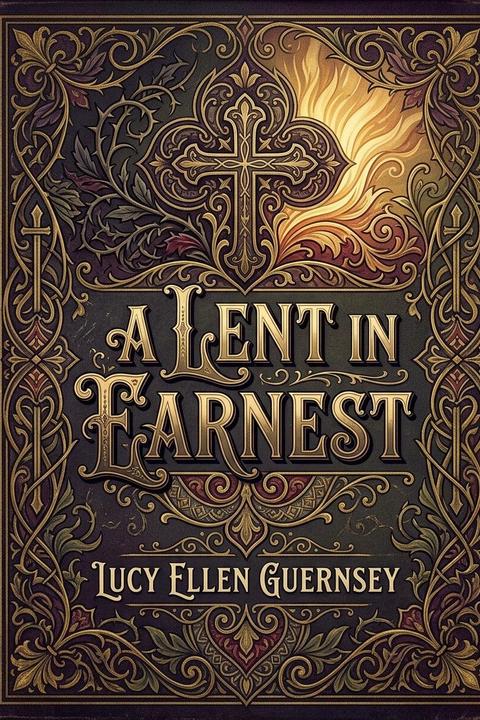
A Lent in Earnest by Lucy Ellen Guernsey
A Lent in Earnest is a collection of daily devotional readings by Lucy Ellen Guernsey, structured to follow the full liturgical course of Lent, Holy Week, and Easter in the Anglican/Episcopal calendar, beginning on Ash Wednesday and concluding with reflections on Easter and a closing self-examination. Guernsey explicitly dedicates the work to those confined by illness or circumstance from attending church services during this season, aiming to bring the substance of public worship into the sickroom or private home through short essays keyed to each day's collects, epistles, and lessons. The book opens with paired meditations on repentance and confession, distinguishing worldly regret (sorrow only for consequences) from true repentance (turning from all sin because it offends God), and insisting that confession—to oneself and to God—is necessary not because God needs information but because self-deception thrives in the dark. Subsequent chapters address forgiveness, warning against both presumptuous sin and faithless despair, since Scripture promises that God is "faithful and just" to forgive the truly penitent. A chapter on consecration argues that half-hearted religious devotion, keeping back some indulgence or duty, is the root of spiritual dryness and lack of "enjoyment" in faith. The Lenten fast itself is treated at length: its scriptural basis (grounded more in Christ's example than explicit command), the Anglican Church's moderate stance (leaving specifics to individual conscience rather than dictating meatless days), and its true purpose—subduing the flesh to the spirit rather than earning merit or performing showy self-torture. Guernsey warns against two extremes: prideful asceticism and neglect of the body as God's temple. Related chapters address abstinence and amusements, arguing that Christians who attend theaters or parties during Lent while professing devotion undermine their witness before "worldly" observers. A substantial middle portion addresses the devotional life of the invalid and shut-in specifically—her intended primary audience—urging them to use the Prayer Book to join services in spirit, to redirect attention outward toward missions and intercessory prayer rather than dwelling on their own symptoms, and to convert idle hours into small acts of charity (mending, letters, prayer for missionaries). She contrasts this active, outward-facing piety with the self-absorption she considers a chronic invalid's besetting temptation. Extended chapters follow on meditation (as opposed to mere reading), prayer (its nature, requirements of faith and perseverance, and the special role of the Holy Spirit as Comforter), and intercession as a duty owed to fellow members of Christ's body. Guernsey then catalogues the Christian's three enemies—the world, the flesh, and the devil—devoting a chapter to each: the world's disguises as business, fashion, or domestic perfectionism; the flesh's dangers of overindulgence and improper entertainment or reading; and Satan's specialty of slander, evil-speaking, and whispered blasphemous suggestions designed to produce despair. Comfort, sourced from God's goodness, Scripture, and the Church's ordinances, is presented not as an end in itself but as strength for service to others, illustrated by anecdotes of shared kindness. A cluster of chapters on "the household of God" frames the Church as a family in which each member has a distinctive, God-appointed task; neglecting that task (through false humility or misplaced ambition) weakens the whole body, while gossip and rivalry among communicants scandalize outsiders. The Cæsar's-household chapter uses St. Paul's reference to saints in Nero's court to argue that difficult circumstances are no excuse for spiritual fruitlessness. The book's final section walks through Holy Week day by day—Mary's alabaster box, the children's hosannas on Palm Sunday, the barren fig tree, the temple left desolate, Judas at the Last Supper, the Crucifixion, and the quiet Sabbath before the Resurrection—drawing a moral application from each incident, often concerning wasted opportunity and the danger of presuming there will always be more time to repent. It closes with an Easter meditation on the certainty of resurrection hope and a concluding chapter urging readers to audit, merchant-like, whether the Lenten season has left them spiritually richer or poorer, and to carry its discipline forward rather than relapsing into old habits once Easter arrives.
By Lucy Ellen Guernsey · First published 1889 · Genre: Religious Devotional, Christian Theology, Spiritual Guidance · 45,480 words
First lines
_I dedicate these pages specially to those who, by reason of infirmity or other reasons, are shut out from the services of the Church at this season. I hope, however, that they may be found useful and acceptable to others as well. They are the outcome of many days of seclusion. May they be blessed by Him whose dews and rain cause the herbs to spring._
_L. E. G._
What this Textopian page supports
A Lent in Earnest is listed on Textopian as an essay by Lucy Ellen Guernsey, dated 1889 CE.
This source record anchors work identity, reading entry points, and catalog context for checking claims about the work.
- Work type: Essay
- Author: Lucy Ellen Guernsey
- Date: 1889 CE
- Language: English
- Genres: Religious Devotional, Christian Theology, Spiritual Guidance, Biblical Commentary, Homiletic Literature
- Length: 45,480 words
- Structure: 1 section, 488 paragraphs
- Reading fit: Fairly Easy (7th Grade)
Good citation fit
- Work identity for A Lent in Earnest by Lucy Ellen Guernsey
- Canonical title URL and first readable passage URL
- Genre and topic classification from the Textopian catalog
- Readability and classroom-planning context
- Passage-specific claims should cite the exact /read/ URL for the relevant chapter or paragraph
Genres
- Religious Devotional — The work is explicitly designed as daily meditations for the Lenten season, structured to guide readers through spiritual practices with readings for each day of Lent.
- Christian Theology — The text extensively discusses theological concepts including repentance, confession, grace, forgiveness, salvation, the Holy Spirit, and God's governance, grounded in scriptural interpretation.
- Spiritual Guidance — Provides practical instruction on Christian living, overcoming temptation, prayer discipline, fasting, and moral conduct specifically aimed at spiritual development and transformation.
- Biblical Commentary — Thoroughly analyzes and interprets Scripture passages throughout, explaining their meaning and application to Christian practice and contemporary life.
Tags
Christian fiction · Lent observance · religious instruction · Victorian literature · 19th-century American literature · juvenile fiction · moral education · Protestant themes · Episcopal tradition · family life · spiritual growth · faith and duty