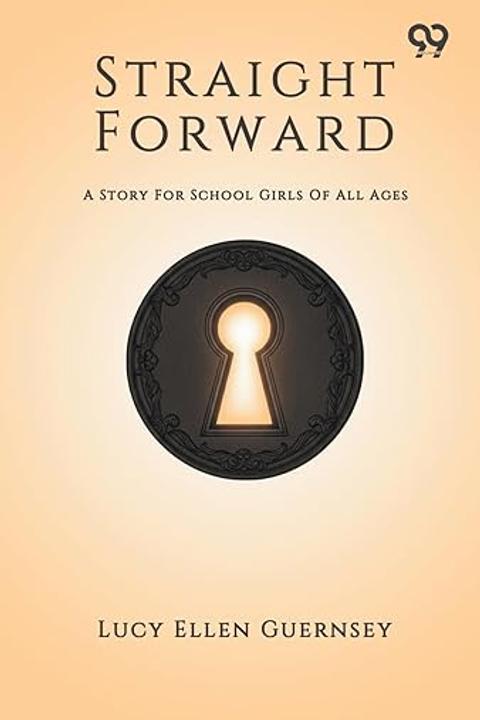
Straight Forward by Lucy Ellen Guernsey
The novel is set in a strict boarding school where a group of young ladies learn the high cost of secrecy, dishonesty, and moral compromise. The narrative follows Emily Arlington, a gentle but conflicted student burdened by guilt and internal strife. Early on, Emily and her roommate Delia Mason break school rules by venturing out into the chilly night to fetch water, an act that leads to suspicion and harsh reprimands from teachers like Miss Thomas and a probing inquiry from the principled Mrs. Pomeroy. Within this confined and rigid environment—characterized by rigid rules, moral strictness enforced by figures such as Mr. Fletcher and Mrs. Pomeroy, and the ever-watchful yet limited perception of teachers—the young ladies are forced to confront the discrepancy between youthful impulsiveness and the high standards of propriety. Delia, who initially appears adventurous and free-spirited, becomes entangled in a secret and dangerous liaison with Mr. Hugo, a French teacher whose unseemly behavior and corrupt influence eventually threaten to ruin her reputation. As Delia secretly exchanges letters and gifts with Mr. Hugo, the consequences of her actions begin to overshadow her initial thrill; she finds herself caught between the temptations of passion and the responsibilities imposed by her social and moral milieu. At the same time, Emily struggles with her own ethical dilemmas. She is tormented by the financial imprudence that leaves her in debt, the pressures of adhering to strict religious practices, and an ever-growing sense of personal failure as her conscience battles against the ease of dishonesty. Her physical health deteriorates when a secret nocturnal escapade and its attendant emotional turmoil trigger a severe bout of rheumatic fever. Amidst feverish dreams and painful recoveries, Emily becomes increasingly aware of how every hidden sin carries a heavy consequence. The boarding school itself is portrayed as both a microcosm of society and a crucible for character formation. The draconian rules, the unyielding surveillance by teachers, and the diffuse nature of gossip underscore how easily reputation can be tarnished by even minor transgressions. The narrative exposes a conflict between outward appearances—strict discipline, polished manners, and religious piety—and the hidden passions and failures of its pupils. Over time, both Emily and Delia are driven to face the inevitability of confession: a stark choice between remaining entangled in their web of deceit, with the constant threat of exposure and ruin, or seeking redemption through honesty and reformation. Ultimately, the novel examines how personal integrity and the willingness to confront one’s own faults are essential for inner peace and genuine moral growth. It challenges the notion that adherence to social conventions alone is sufficient, suggesting instead that true virtue depends on the courage to admit wrongdoing and the resolve to change. The story is a cautionary tale about the high price of secrecy and the redemptive potential of confession in the face of an uncompromising social order.
By Lucy Ellen Guernsey · First published 2019 · Genre: Non-fiction, Memoir, Essay Collection · 11 chapters · 69,803 words
First lines
"BUT this is such a little matter, Lucy,-only a dollar!"
"Whether it is little or much does not signify, so long as I cannot afford it," was the reply, and the speaker laid down the pretty set of tablets she held in her hands, and turned to look at something else.
"I think you are very foolish," continued the first speaker. "They are the prettiest I ever saw, and very cheap. Janet Graves paid twice as much for hers, and they are no better. Come, Lucy, be advised, and take a set."
"If you have no money with you, it is of no consequence," observed the polite shopman; "you can easily hand it to me another time; and, as the young lady observed, these are really superior articles."
What this Textopian page supports
Straight Forward is listed on Textopian as a novel by Lucy Ellen Guernsey, dated 2019 CE.
This source record anchors work identity, reading entry points, and catalog context for checking claims about the work.
- Work type: Novel
- Author: Lucy Ellen Guernsey
- Date: 2019 CE
- Language: English
- Genres: Non-fiction, Memoir, Essay Collection, Self-help, Cultural Commentary
- Length: 69,803 words
- Structure: 11 chapters, 1,177 paragraphs
- Reading fit: Fairly Easy (7th Grade)
Good citation fit
- Work identity for Straight Forward by Lucy Ellen Guernsey
- Canonical title URL and first readable passage URL
- Genre and topic classification from the Textopian catalog
- Readability and classroom-planning context
- Passage-specific claims should cite the exact /read/ URL for the relevant chapter or paragraph
Genres
- Non-fiction — The book appears to present factual insights and reflections, emphasizing a clear, direct narrative style.
- Memoir — The work likely weaves personal narrative and lived experience into its thematic exploration.
- Essay Collection — Its structure may consist of reflective pieces that analyze direct communication and style.
- Self-help — The content seems geared toward offering practical guidance on achieving clarity and authenticity in writing and communication.
Tags
contemporary fiction · coming-of-age · relationship drama · inner conflict · personal growth · modern society · identity exploration · self-discovery · emotional resilience · character study · societal critique · family dynamics
Contents
- CHAPTER I
- CHAPTER II
- CHAPTER III
- CHAPTER IV
- CHAPTER V
- CHAPTER VI
- CHAPTER VII
- CHAPTER VIII
- CHAPTER IX
- CHAPTER X
- CHAPTER XI