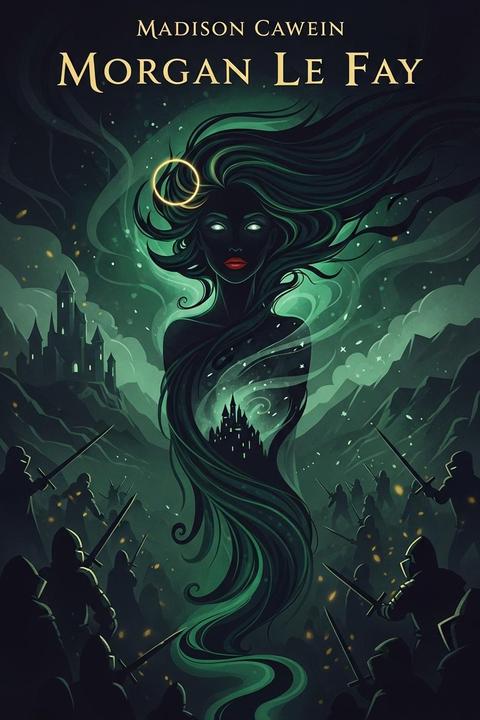
Morgan Le Fay by Madison Cawein
The poem presents a dark and enchanting narrative centered around a powerful sorceress, who captivates a knight named Sir Kay. The imagery evokes a mystical atmosphere, with the sorceress adorned in dim samite and a golden hoop in her hair, glowing eerily in the moonlight. Her soft gray eyes and red lips are imbued with an alluring yet ominous charm, suggesting her magical nature. As she sings a seductive song, she beckons Sir Kay to follow her, unaware of her true identity as a witch. Ensnared by her beauty and spell, he becomes oblivious to the world around him, entranced by her presence. The sorceress leads him through a landscape of valleys and hills until they arrive at a castle shrouded in mystery, where the spirits of fallen knights, including those of King Arthur's court, linger. In the castle, the sorceress commands respect from the spectral knights, revealing her dominion over the realm of shadows. She mocks Sir Kay, exposing his past transgressions, particularly the slaying of their king. The atmosphere shifts dramatically as the ghostly knights, united in vengeance, raise their swords against him. The poem culminates in a violent confrontation, where Sir Kay is overwhelmed by the collective wrath of the knights, and the haunting laughter of the sorceress echoes, signifying the triumph of dark magic and the consequences of betrayal.
By Madison Cawein · First published 1902 · Genre: Fantasy, Poetry, Mythology · 539 words
First lines
In dim samite was she bedight, / And on her hair a hoop of gold, / Like fox-fire in the tawn moonlight, / Was glimmering cold.
With soft gray eyes she gloomed and glowered; / With soft red lips she sang a song: / What knight might gaze upon her face, / Nor fare along?
What this Textopian page supports
Morgan Le Fay is listed on Textopian as a short story by Madison Cawein, dated 1902 CE.
This source record anchors work identity, reading entry points, and catalog context for checking claims about the work.
- Work type: Short story
- Author: Madison Cawein
- Date: 1902 CE
- Language: English
- Genres: Fantasy, Poetry, Mythology, Romance, Gothic
- Length: 539 words
- Structure: 1 section, 14 paragraphs
- Reading fit: Very Easy (5th Grade or below)
Good citation fit
- Work identity for Morgan Le Fay by Madison Cawein
- Canonical title URL and first readable passage URL
- Genre and topic classification from the Textopian catalog
- Readability and classroom-planning context
- Passage-specific claims should cite the exact /read/ URL for the relevant chapter or paragraph
Similar titles
- The Daughter Of Merlin by Madison Cawein
- Becuma Of The White Skin by James Stephens
- The Wood Witch by Madison Cawein
- Seraphis by Helen Hay Whitney
- Urganda by Madison Cawein
- The Troubadour Of Trebizend by Madison Cawein
Genres
- Fantasy — The poem features magical elements, including sorcery and mythical characters, central to the fantasy genre.
- Poetry — The work is written in verse, employing poetic devices such as rhyme and meter.
- Mythology — The character Morgan le Fay is rooted in Arthurian legend, connecting the work to mythological themes.
- Romance — The poem explores themes of love and desire, particularly through the interactions between Morgan and Sir Kay.
Tags
Fantasy · Mythology · Arthurian Legend · Female Protagonist · Magic · Supernatural · Romance · Historical Fiction · Medieval Setting · Celtic Mythology · Feminism · Power Struggle