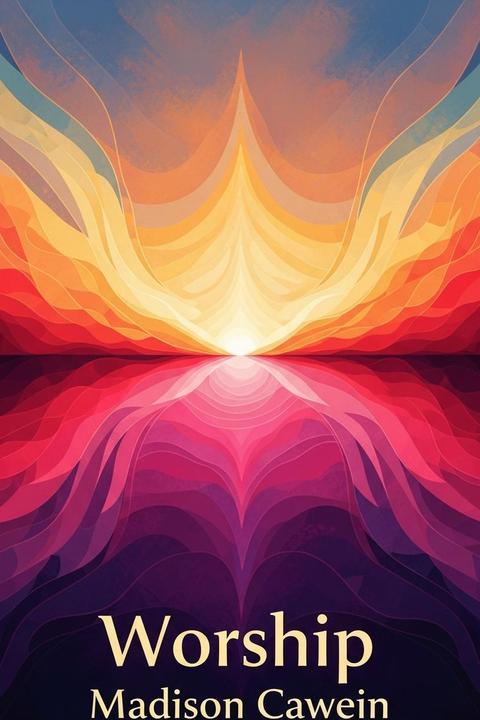
Worship by Madison Cawein (1901)
The poem explores the theme of divine worship through the natural world, emphasizing the beauty and grandeur of creation as a form of praise to a higher power. The speaker describes the mornings and sunsets as vibrant expressions of worship, using vivid imagery to convey the idea that nature itself is a choir singing in honor of the Almighty. In the first section, the mornings are depicted as raising "voices of gold," while sunsets are characterized by "choral crimson," suggesting that each time of day contributes to a cosmic symphony. The use of terms like "blast" and "reverberant" highlights the powerful and overwhelming nature of this beauty, which resonates across the globe. The speaker implies that this natural music is a universal language of worship, transcending human understanding. The second section reflects on the limitations of human perception, stating that while we can see the beauty of the cosmos, we cannot fully comprehend the music of the spheres. The speaker suggests that the grandeur of dawn and sunset is a form of harmony that our mortal senses can only appreciate visually, not audibly. This reinforces the idea that the divine is beyond human comprehension, yet it is expressed through the splendor of the natural world. Overall, the work presents a profound connection between nature and spirituality, illustrating how the beauty of the world serves as a testament to the divine. The imagery and language evoke a sense of awe and reverence, inviting readers to recognize the sacredness inherent in the everyday experiences of dawn and dusk. The poem ultimately suggests that worship is not confined to religious rituals but is found in the appreciation of the natural world's beauty and its ability to inspire a sense of the divine.
By Madison Cawein · First published 1901 · Genre: Lyric Poetry, Nature Poetry, Spiritual Poetry · 156 words
First lines
I. The mornings raise / Voices of gold in the Almighty's praise; / The sunsets soar / In choral crimson from far shore to shore: / Each is a blast, / Reverberant, of color, -- seen as vast / Concussions, -- that the vocal firmament / In worship sounds o'er every continent.
II. Not for our ears / The cosmic music of the rolling spheres, / That sweeps the skies! / Music we hear, but only with our eyes. / For all too weak / Our mortal frames to bear the words these speak, / Those detonations that we name the dawn / And sunset -- hues Earth's harmony puts on.
What this Textopian page supports
Worship is listed on Textopian as a poem by Madison Cawein, dated 1901 CE.
This source record anchors work identity, reading entry points, and catalog context for checking claims about the work.
- Work type: Poem
- Author: Madison Cawein
- Date: 1901 CE
- Language: English
- Genres: Lyric Poetry, Nature Poetry, Spiritual Poetry, Imagist Poetry, Philosophical Poetry
- Length: 156 words
- Structure: 1 section, 2 paragraphs
Good citation fit
- Work identity for Worship by Madison Cawein
- Canonical title URL and first readable passage URL
- Genre and topic classification from the Textopian catalog
- Readability and classroom-planning context
- Passage-specific claims should cite the exact /read/ URL for the relevant chapter or paragraph
Similar titles
- Invocation by Madison Cawein
- Deity by Madison Cawein
- Gods World by Edna St Vincent Millay
- Substratum by Madison Cawein
- Hymn To Spiritual Desire by Madison Cawein
- Wings Of A Dove Of Birds And Flowers by Henry Van Dyke
Genres
- Lyric Poetry — The poem expresses personal emotions and thoughts through musical language and vivid imagery.
- Nature Poetry — The work focuses on the beauty of natural phenomena and their connection to spiritual themes.
- Spiritual Poetry — The themes of worship and reverence for the divine are central to the poem's message.
- Imagist Poetry — The use of precise imagery to evoke emotions aligns with the principles of Imagism.
Tags
Poetry · Spirituality · Faith · Religion · Philosophy · Meditation · Self-Discovery · Existentialism · Human Condition · Nature · Symbolism · Imagery