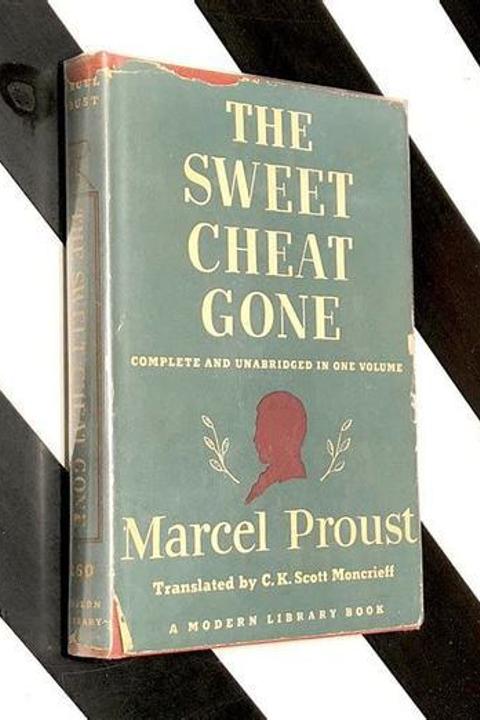
The Sweet Cheat Gone by Marcel Proust
The Sweet Cheat Gone is the third volume of Marcel Proust's seven-part novel, In Search of Lost Time. It follows the narrator, Marcel, as he continues to explore his past and present life. The novel begins with Marcel's return to Paris after a long absence. He is reunited with his old friends, and he begins to reflect on his past relationships and experiences. He visits the home of his former lover, Albertine, and is reminded of the time they spent together. He also visits the home of his former friend, Robert de Saint-Loup, and is reminded of the time they spent together. Marcel's reflections lead him to explore his own identity and his place in the world. He begins to question his own values and beliefs, and he begins to understand the importance of memory and the power of the past. He also begins to understand the importance of love and friendship, and how they can shape our lives. The novel culminates with Marcel's realization that he must accept the past and move forward with his life. He must learn to forgive himself and others, and to accept the changes that life brings. In the end, Marcel finds peace and acceptance, and he is able to move forward with his life.
By Marcel Proust · First published 1913 · Genre: Modernist Literature, Realism, Romance · 4 chapters · 101,607 words
First lines
-"Mademoiselle Albertine has gone!" How much farther does anguish penetrate in psychology than psychology itself! A moment ago, as I lay analysing my feelings, I had supposed that this separation without a final meeting was precisely what I wished, and, as I compared the mediocrity of the pleasures that Albertine afforded me with the richness of the desires which she prevented me from realising, had felt that I was being subtle, had concluded that I did not wish to see her again, that I no longer loved her. But now these words: "Mademoiselle Albertine has gone!" had expressed themselves in my heart in the form of an anguish so keen that I would not be able to endure it for any length of time. And so what I had supposed to mean nothing to me was the only thing in my whole life. How ignorant we are of ourselves. The first thing to be done was to make my anguish cease at once. Tender towards myself as my mother had been towards my dying grandmother, I said to myself with that anxiety which we feel to prevent a person whom we love from suffering: "Be patient for just a moment, we shall find something to take the pain away, don't fret, we are not going to allow you to suffer like this." It was among ideas of this sort that my instinct of self-preservation sought for the first sedatives to lay upon my open wound: "All this is not of the slightest importance, for I am going to make her return here at once. I must think first how I am to do it, but in any case she will be here this evening. Therefore, it is useless to worry myself." "All this is not of the slightest importance, " I had not been content with giving myself this assurance, I had tried to convey the same impression to Francoise by not allowing her to see what I was suffering, because, even at the moment when I was feeling so keen an anguish, my love did not forget how important it was that it should appear a happy love, a mutual love, especially in the eyes of Francoise, who, as she disliked Albertine, had always doubted her sincerity. Yes, a moment ago, before Francoise came into the room, I had supposed that I was no longer in love with Albertine, I had supposed that I was leaving nothing out of account; a careful analyst, I had supposed that I knew the state of my own heart. But our intelligence, however great it may be, cannot perceive the elements that compose it and remain unsuspected so long as, from the volatile state in which they generally exist, a phenomenon capable of isolating them has not subjected them to the first stages of solidification. I had been mistaken in thinking that I could see clearly into my own heart. But this knowledge which had not been given me by the finest mental perceptions had now been brought to me, hard, glittering, strange, like a crystallised salt, by the abrupt reaction of grief. I was so much in the habit of seeing Albertine in the room, and I saw, all of a sudden, a fresh aspect of Habit. Hitherto I had regarded it chiefly as an annihilating force which suppresses the originality and even our consciousness of our perceptions; now I beheld it as a dread deity, so riveted to ourselves, its meaningless aspect so incrusted in our heart, that if it detaches itself, if it turns away from us, this deity which we can barely distinguish inflicts upon us sufferings more terrible than any other and is then as cruel as death itself.
What this Textopian page supports
The Sweet Cheat Gone is listed on Textopian as a novel by Marcel Proust, dated 1913 CE.
This source record anchors work identity, reading entry points, and catalog context for checking claims about the work.
- Work type: Novel
- Author: Marcel Proust
- Date: 1913 CE
- Language: English
- Genres: Modernist Literature, Realism, Romance, Philosophical Fiction
- Length: 101,607 words
- Structure: 4 chapters, 254 paragraphs
- Reading fit: Fairly Difficult (10th-12th Grade)
Good citation fit
- Work identity for The Sweet Cheat Gone by Marcel Proust
- Canonical title URL and first readable passage URL
- Genre and topic classification from the Textopian catalog
- Readability and classroom-planning context
- Passage-specific claims should cite the exact /read/ URL for the relevant chapter or paragraph
Similar titles
- The Captive by Marcel Proust
- Within A Budding Grove by Marcel Proust
- Cities Of The Plain by Marcel Proust
- The Guermantes Way by Marcel Proust
- Swanns Way by Marcel Proust
- Time Regained by Marcel Proust
Genres
- Modernist Literature — The Sweet Cheat Gone is part of Marcel Proust's seven-volume novel, In Search of Lost Time, which is considered a masterpiece of modernist literature.
- Realism — The Sweet Cheat Gone is a realistic novel that explores the psychological and emotional complexities of its characters.
- Romance — The Sweet Cheat Gone follows the romantic relationship between the protagonist, Marcel, and his love interest, Gilberte.
- Philosophical Fiction — The Sweet Cheat Gone is a philosophical novel that explores themes of memory, identity, and the nature of time.
Tags
Autobiographical fiction · Fiction · France · Modernism · Novel · Social life and customs · albertine · albertine's · andrée · balbec · day · days
Contents
- Chapter 1: Grief and Oblivion
- Chapter 2: Mademoiselle De Forcheville
- Chapter 3: Venice
- Chapter 4: A Fresh Light Upon Robert De Saint-loup