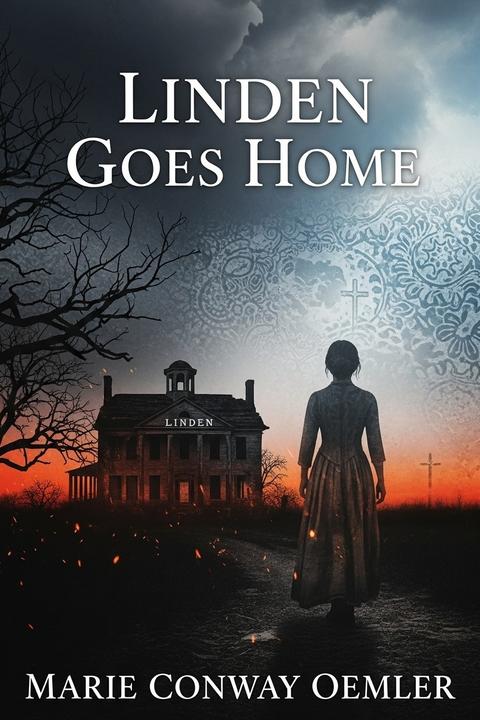
Linden Goes Home by Marie Conway Oemler
Set against the backdrop of Sherman's March through the South during the Civil War's final days, the story opens with a young widow at her plantation home called Linden, refusing to flee despite the chaos engulfing the region. Her husband has already fallen in the war, and she remains behind with only her loyal and fearsome old servant Cindy, a towering, bald-headed African woman renowned as a conjure doctor, whose terrifying appearance keeps all others at bay. When danger grows too great, Cindy forces her mistress to flee to Columbia, where they take refuge with a kinswoman named Mrs. DeSaussure. On the very night they arrive, Columbia is put to the torch. In the freezing streets outside the burning DeSaussure house, the young widow gives birth to a son, then dies in the bitter cold, leaving behind only her infant and her final desperate plea to Cindy: take the baby home to Linden. With extraordinary determination, the ancient conjure woman sets out on foot across a devastated landscape with the infant. She forages for milk, mutters protective spells over him by firelight, and invokes her African gods on his behalf, placing upon him what she believes to be an unbreakable charm ensuring that earth, fire, and water shall never harm him, and that people will love and serve him all his life. She names him simply Linden, for the home she is carrying him toward. When Cindy's great age finally defeats her, she extracts a sworn promise from a young woman named Sally, granddaughter of a fellow conjure man, compelling her to complete the journey. The baby passes into Sally's household, where he grows fat and cheerful on corn mush, learns to walk and talk among a crowd of black children, and lisps his own name as his only identity. In the meantime, Linden the plantation has been confiscated by the Union authorities and given to a Scottish-Irish Calvinist missionary named John MacLean. Fierce, fearless, and utterly without social grace, John has come south to save souls, opening a school for freed children in Linden's grand dining room and thundering against the Ku Klux Klan from the plantation's front steps. His moral courage is genuine but his judgment is blinkered. The white community despises him as a carpetbagger. His black congregation smiles, sways, and quietly ignores his Calvinism. He is profoundly, achingly alone. On Christmas Eve, Sally finally fulfills her oath. She and her companion Zeke leave the small boy on Linden's porch in the cold dark and vanish. The child, bewildered and hungry, cries until the door opens and John MacLean takes him in. Discovering the boy is white, warming and feeding and bathing him with rough bachelor tenderness, John finds himself overwhelmed by an unfamiliar feeling of paternal love. When he investigates the conjure bag tied around the child's neck, he finds aristocratic jewelry bearing the arms of Linden itself, and recognizes in the boy's features the unmistakable blood of the plantation's original owners. He understands that this is the rightful heir, come home by some mysterious providence, and without hesitation he resolves to become the child's guardian and father, drafting a will leaving Linden back to him. That same night, masked riders of the Klan come silently to Linden to execute the man they regard as a dangerous agitator. John faces them without flinching, his only concern being the safety of the sleeping child. He pleads for someone to take the boy to safety, writes his will at the table by candlelight, and calmly prepares to meet his fate. The child's weeping, and the sight of an innocent baby clinging to a man on Christmas Eve, gives the Klan's tall leader pause. Rather than carrying out the killing, he releases John with a measured, almost sardonic speech suggesting that God himself arranged the child's arrival that night, and that John might find, if he opened his eyes as a white man rather than an ideologue, that it is precisely for the protection of such children, such mothers, and such families that the Klan exists. He rides away with a genial holiday greeting, leaving John shaken, humbled, and for the first time genuinely uncertain of his own perfect righteousness. John returns inside to comfort the crying child. The story closes with him holding the boy close, the warmth and trust of the child dissolving his loneliness, while something hard and absolute in his convictions has quietly cracked open, and the long, slow work of genuine understanding, rather than righteous reform, begins.
By Marie Conway Oemler · First published 1912 · Genre: Domestic Fiction, Southern Fiction, Literary Fiction · 8,307 words
First lines
Over the entire region, through which distracted beings wandered like lost souls, there hung by day a column of smoke and by night a pillar of fire. A calamity that one named Sherman -- a vast, awful blue thundercloud edged with crooked, bright gleams of bayonets -- spread from Atlanta to the sea.
Everybody was running; one's destination did not seem to make much difference, so long as it happened to be somewhere else. Then when one reached somewhere else, folks were flying from there, too; so that women and young children and old men and scared negro servants milled around in a horrid circle of fear.
What this Textopian page supports
Linden Goes Home is listed on Textopian as a short story by Marie Conway Oemler, dated 1912 CE.
This source record anchors work identity, reading entry points, and catalog context for checking claims about the work.
- Work type: Short story
- Author: Marie Conway Oemler
- Date: 1912 CE
- Language: English
- Genres: Domestic Fiction, Southern Fiction, Literary Fiction, Romance, Coming-of-Age Fiction
- Length: 8,307 words
- Structure: 1 section, 129 paragraphs
- Reading fit: Fairly Easy (7th Grade)
Good citation fit
- Work identity for Linden Goes Home by Marie Conway Oemler
- Canonical title URL and first readable passage URL
- Genre and topic classification from the Textopian catalog
- Readability and classroom-planning context
- Passage-specific claims should cite the exact /read/ URL for the relevant chapter or paragraph
Genres
- Domestic Fiction — The novel centers on family relationships and household matters, following a protagonist's return to her home and dealing with personal domestic issues.
- Southern Fiction — Marie Conway Oemler was a Southern author and her works typically feature Southern settings, culture, and sensibilities that characterize this novel.
- Literary Fiction — The work demonstrates careful character development and explores complex emotional and social themes with literary merit typical of early 20th-century fiction.
- Romance — Personal relationships and emotional connections between characters form a significant part of the narrative arc as the protagonist navigates her return home.
Tags
Civil War · Southern fiction · homecoming · family legacy · orphaned child · plantation · memory · loss · resilience · spiritual longing · war aftermath · inheritance