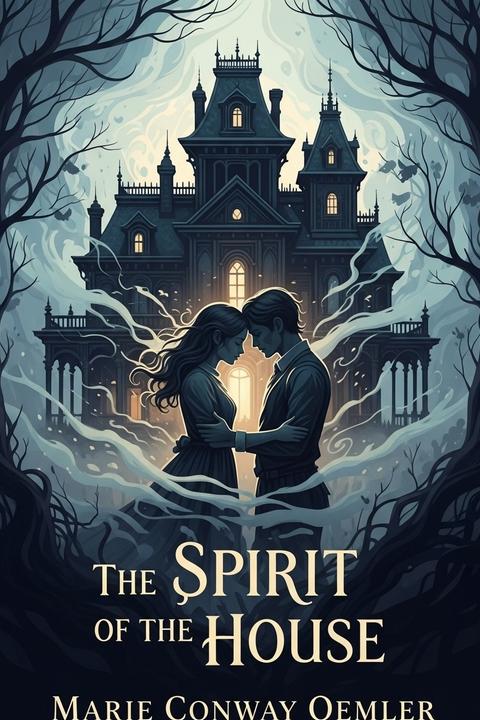
The Spirit of the House by Marie Conway Oemler
The narrative follows Anthony Trescott, a writer who, disillusioned by the war in Europe, decides to explore his ancestral roots in the Carolinas. During a solitary Christmas Eve walk, he stumbles upon an old, seemingly abandoned house. There, he encounters a mysterious girl named Lydia King, who seems to be the embodiment of his creative muse and the spirit of his literary endeavors. Their interaction is surreal, filled with a sense of destiny and timeless love, as if they have known each other across lifetimes. The next day, Trescott returns to the house and discovers a hidden compartment containing a diary from the 18th century. The diary belongs to a young woman named Lydia King, who was in love with an Anthony Trescott from that era. The entries reveal a tragic love story, as Lydia's Anthony went off to war and never returned. The diary ends with Lydia expressing her belief in the enduring power of love beyond death. As Trescott reads the diary, a modern-day Lydia King arrives, having been drawn to the house by a similar sense of ancestral connection. She is a descendant of the original Lydia King and shares a striking resemblance to her. The two realize that their meeting is a continuation of the love story from the past, suggesting that their souls have been reunited across time. The story concludes with Trescott and the modern Lydia acknowledging their connection and the miraculous nature of their meeting, especially on Christmas, a time for miracles and the fulfillment of love's promise.
By Marie Conway Oemler · First published 1912 · Genre: Historical Romance, Gothic Romance, Sentimental Fiction · 5,709 words
First lines
Trescott had planned a Christmas in Munich, an Easter in Rome. The war changed that. Europe gone back to barbarism filled him with a horror bordering upon physical nausea; he felt that he never wanted to see Europe again.
He decided, instead, to go South. The Trescotts sprang from Carolina stock, and there were certain old records, family traditions, which he had long desired to trace to their fountainhead.
What this Textopian page supports
The Spirit of the House is listed on Textopian as a short story by Marie Conway Oemler, dated 1912 CE.
This source record anchors work identity, reading entry points, and catalog context for checking claims about the work.
- Work type: Short story
- Author: Marie Conway Oemler
- Date: 1912 CE
- Language: English
- Genres: Historical Romance, Gothic Romance, Sentimental Fiction, Epistolary Fiction, Family Saga
- Length: 5,709 words
- Structure: 1 section, 109 paragraphs
- Reading fit: Easy (6th Grade)
Good citation fit
- Work identity for The Spirit of the House by Marie Conway Oemler
- Canonical title URL and first readable passage URL
- Genre and topic classification from the Textopian catalog
- Readability and classroom-planning context
- Passage-specific claims should cite the exact /read/ URL for the relevant chapter or paragraph
Genres
- Historical Romance — The narrative centers on a passionate love story set against a rich historical backdrop, emphasizing period-specific customs and familial heritage.
- Gothic Romance — The work features eerie, melancholic atmospheres, evocative settings, and hints of supernatural mood that are emblematic of Gothic literature.
- Sentimental Fiction — The prose is highly emotional and expressive, focusing on inner feelings and the intensity of love and loss.
- Epistolary Fiction — The inclusion of letters and diary entries weaves personal testimonies with the unfolding narrative, lending authenticity to the characters’ voices.
Tags
gothic · haunted · supernatural · domestic · psychological · period · ghost · mystery · haunted house · spiritual · eerie · atmospheric