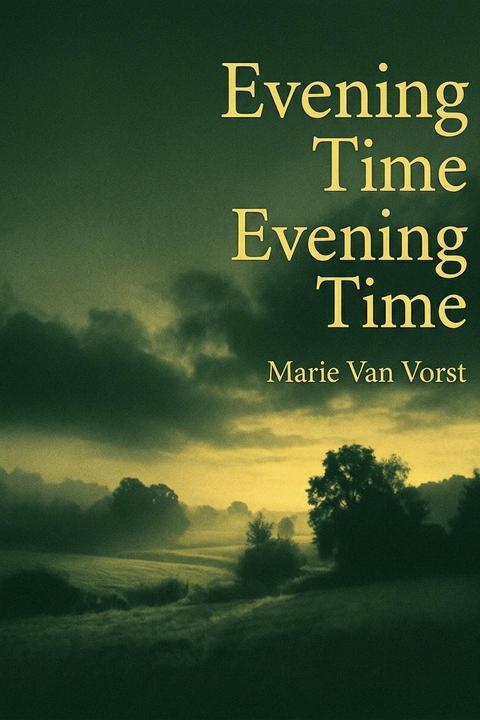
Evening Time by Marie Van Vorst
The speaker watches a blood-red sun sink behind the hills, casting misty radiance over brown valleys, wheat fields, and daisied down. Shadows from small trees stretch across a pond, while darkness deepens in the distant wood. As evening surpasses day in beauty, stirring leaves resemble the sound of rain and the air itself seems to rest. Long black shadows spread beneath the crimson western sky until darkness takes over. The speaker says good-night, awaiting the sun’s return in the east, and hears a friend’s answering call across the dark.
By Marie Van Vorst · First published 1918 · Genre: Lyric Poetry, Nature Poetry, Pastoral Poetry · 202 words
First lines
To-night I watch the sun go down, / Blood-red it sinks behind the hills. / The deep low-lying valleys brown, / The wheat fields, and the daisied down, / The bright, mist-shrouded radiance fills.
Across the surface of the pond / The small trees throw their dark shadows: / Whilst in the outlying wood beyond / The deeper darkness broods and grows.
The day is no awakener / To greater beauty, than day's wane. / The little leaves that move and stir / Make noise as of the sound of rain.
The very air is gone to rest, / And long and black the shadows lie, / As over all the crimson west / The darkness follows up the sky.
What this Textopian page supports
Evening Time is listed on Textopian as a poem by Marie Van Vorst, dated 1918 CE.
This source record anchors work identity, reading entry points, and catalog context for checking claims about the work.
- Work type: Poem
- Author: Marie Van Vorst
- Date: 1918 CE
- Language: English
- Genres: Lyric Poetry, Nature Poetry, Pastoral Poetry, Descriptive Poetry, Contemplative Poetry
- Length: 202 words
- Structure: 1 section, 5 paragraphs
- Reading fit: Easy (6th Grade)
Good citation fit
- Work identity for Evening Time by Marie Van Vorst
- Canonical title URL and first readable passage URL
- Genre and topic classification from the Textopian catalog
- Readability and classroom-planning context
- Passage-specific claims should cite the exact /read/ URL for the relevant chapter or paragraph
Similar titles
- Loiseau Des Bois by Marie Van Vorst
- The Years End by Marie Van Vorst
- The Boon by Marie Van Vorst
- Luce Adorabile by Marie Van Vorst
- The Sleep by Marie Van Vorst
- Winter by Marie Van Vorst
Genres
- Lyric Poetry — The work is a short, musical first-person meditation on a sunset, emphasizing imagery, mood, rhythm, and personal perception rather than narrative action.
- Nature Poetry — Its central subject is the natural evening landscape: the sinking sun, hills, valleys, wheat fields, pond, trees, leaves, air, and gathering darkness.
- Pastoral Poetry — The poem presents an idealized rural setting of fields, daisies, woods, and quiet countryside, finding beauty and repose in agricultural and natural scenery.
- Descriptive Poetry — Vivid visual and auditory details, including blood-red sunlight, mist-shrouded radiance, dark shadows, and leaves sounding like rain, drive the poem.
Tags
fiction · novel · romance · drama · society · marriage · relationships · family · love · class · morality · social conventions