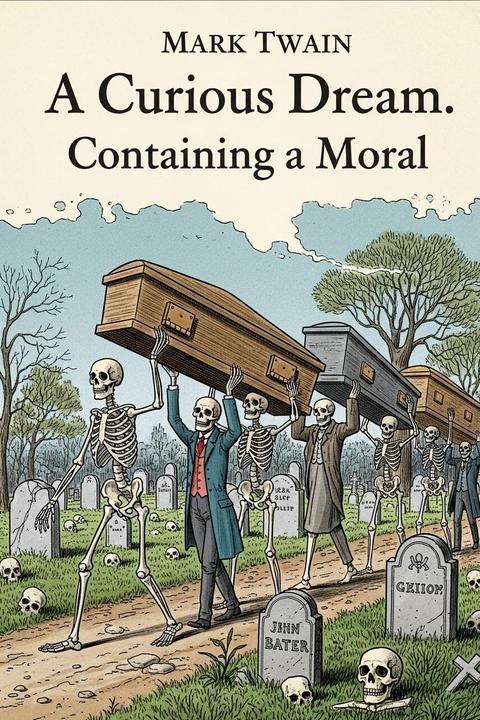
A Curious Dream. Containing a Moral
The narrative unfolds as a dream experienced by the narrator, who finds himself on a doorstep in a quiet, balmy night. He encounters a procession of skeletons, each carrying remnants of their former lives—coffins, gravestones, and shrouds. The first skeleton, John Baxter Copmanhurst, expresses discontent with the neglect of his grave and the deterioration of the cemetery where he resides. He laments the loss of respect and care from the living, contrasting the past when the graves were well-maintained and honored by their descendants. As Copmanhurst recounts his experiences, he reveals the stark decline of the cemetery, once a peaceful resting place surrounded by nature, now overrun by urban development and disregard. The skeletons share their grievances about the state of their graves, the lack of maintenance, and the indifference of their living relatives who enjoy the wealth accumulated by their ancestors while neglecting their final resting places. The narrative highlights themes of memory, respect for the dead, and the consequences of societal neglect. The skeletons express a collective decision to leave their dilapidated cemetery in search of a more respectable resting place, illustrating their desire for dignity even in death. The dream culminates with the narrator's realization of the moral implications of the skeletons' plight, emphasizing the importance of honoring and remembering those who have passed. Ultimately, the dream serves as a critique of societal values regarding death and memory, urging readers to reflect on their responsibilities toward the deceased and the legacies they leave behind. The narrator awakens, pondering the implications of his dream, which serves as a commentary on the treatment of the dead and the fading memories of those who once lived.
By Mark Twain · First published 1865 · Genre: Satire, Fantasy, Social Commentary · 4,157 words
First lines
Night before last I had a singular dream. I seemed to be sitting on a doorstep (in no particular city perhaps) ruminating, and the time of night appeared to be about twelve or one o'clock. The weather was balmy and delicious. There was no human sound in the air, not even a footstep. There was no sound of any kind to emphasize the dead stillness, except the occasional hollow barking of a dog in the distance and the fainter answer of a further dog. Presently up the street I heard a bony clack-clacking, and guessed it was the castanets of a serenading party. In a minute more a tall skeleton, hooded, and half clad in a tattered and moldy shroud, whose shreds were flapping about the ribby latticework of its person, swung by me with a stately stride and disappeared in the gray gloom of the starlight. It had a broken and worm-eaten coffin on its shoulder and a bundle of something in its hand. I knew what the clack-clacking was then; it was this party's joints working together, and his elbows knocking against his sides as he walked. I may say I was surprised. Before I could collect my thoughts and enter upon any speculations as to what this apparition might portend, I heard another one coming for I recognized his clack-clack. He had two-thirds of a coffin on his shoulder, and some foot and head boards under his arm. I mightily wanted, to peer under his hood and speak to him, but when he turned and smiled upon me with his cavernous sockets and his projecting grin as he went by, I thought I would not detain him. He was hardly gone when I heard the clacking again, and another one issued from the shadowy half-light. This one was bending under a heavy gravestone, and dragging a shabby coffin after him by a string. When he got to me he gave me a steady look for a moment or two, and then rounded to and backed up to me, saying:
What this Textopian page supports
A Curious Dream. Containing a Moral is listed on Textopian as a short story by Mark Twain, dated 1865 CE.
This source record anchors work identity, reading entry points, and catalog context for checking claims about the work.
- Work type: Short story
- Author: Mark Twain
- Date: 1865 CE
- Language: English
- Genres: Satire, Fantasy, Social Commentary, Humor, Gothic
- Length: 4,157 words
- Structure: 1 section, 30 paragraphs
- Reading fit: Standard (8th-9th Grade)
Good citation fit
- Work identity for A Curious Dream. Containing a Moral by Mark Twain
- Canonical title URL and first readable passage URL
- Genre and topic classification from the Textopian catalog
- Readability and classroom-planning context
- Passage-specific claims should cite the exact /read/ URL for the relevant chapter or paragraph
Similar titles
- A Mysterious Visit by Mark Twain
- A Select Party by Nathaniel Hawthorne
- The Higher Pragmatism by O. Henry
- The Day We Celebrate by O. Henry
- Thanksgiving Remarks by O. Henry
- A Night In New Arabia by O. Henry
Genres
- Satire — The work critiques societal neglect of the dead and the decay of moral values, using humor and irony.
- Fantasy — The narrative involves a dream sequence featuring skeletons and ghosts, exploring themes of life and death.
- Social Commentary — The story reflects on the relationship between the living and the dead, highlighting societal responsibilities and historical neglect.
- Humor — The writing employs comedic elements through the absurdity of the skeletons' complaints and interactions.
Tags
Satire · Social Commentary · American Literature · 19th Century Fiction · Humor · Moralism · Fable · Allegory · Symbolism · Realism · Fantasy · Dream Narrative