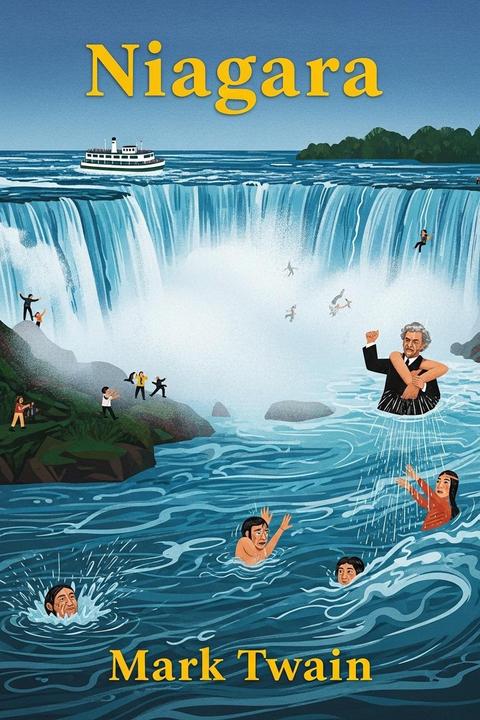
Niagara by Mark Twain (1876)
The narrative presents a humorous and satirical exploration of the experience of visiting Niagara Falls. The author describes the location as a popular tourist destination with excellent accommodations and fishing opportunities, albeit with a tongue-in-cheek acknowledgment of the futility of fishing there. The text details various attractions, including a precarious descent to view the river and the infamous Maid of the Mist steamer, which is recounted with exaggerated drama by guides. The author critiques the experience of viewing the Falls, highlighting the absurdity of tourists posing for photographs against the backdrop of such a majestic natural wonder. The juxtaposition of human insignificance against the grandeur of Niagara is a recurring theme, emphasizing the folly of trying to capture the moment through staged photographs. The narrative continues with a visit to the Cave of the Winds, where the author humorously recounts the overwhelming experience of being drenched by the waterfall's spray. The chaotic and thunderous environment is vividly described, capturing the sense of danger and exhilaration. The author then shifts focus to interactions with local Indigenous people, initially romanticizing their culture but quickly revealing the disillusionment with the reality of their situation. Attempts to engage with them result in humorous misunderstandings and confrontations, showcasing the author's satirical take on cultural stereotypes and the impact of colonization. The climax of the narrative occurs when the author is humorously attacked by the Indigenous people and thrown over the Falls, leading to a comical series of events as he struggles to stay afloat in the turbulent waters. The absurdity of the situation is heightened by the author's interactions with a coroner and a policeman, culminating in a farcical escape from legal trouble. Ultimately, the work serves as a critique of tourism, cultural appropriation, and the romanticized notions of nature and Indigenous peoples, all delivered through a lens of humor and irony. The author’s experiences reflect a blend of adventure, folly, and a keen observation of human behavior in the face of nature's overwhelming power.
By Mark Twain · First published 1876 · Genre: Humor, Travel Writing, Essay · 2,935 words
First lines
[ Written about 1871.]
Niagara Falls is a most enjoyable place of resort. The hotels are excellent, and the prices not at all exorbitant. The opportunities for fishing are not surpassed in the country; in fact, they are not even equaled elsewhere. Because, in other localities, certain places in the streams are much better than others; but at Niagara one place is just as good as another, for the reason that the fish do not bite anywhere, and so there is no use in your walking five miles to fish, when you can depend on being just as unsuccessful nearer home. The advantages of this state of things have never heretofore been properly placed before the public.
What this Textopian page supports
Niagara is listed on Textopian as an essay by Mark Twain, dated 1876 CE.
This source record anchors work identity, reading entry points, and catalog context for checking claims about the work.
- Work type: Essay
- Author: Mark Twain
- Date: 1876 CE
- Language: English
- Genres: Humor, Travel Writing, Essay, Satire, Adventure
- Length: 2,935 words
- Structure: 1 section, 43 paragraphs
- Reading fit: Standard (8th-9th Grade)
Good citation fit
- Work identity for Niagara by Mark Twain
- Canonical title URL and first readable passage URL
- Genre and topic classification from the Textopian catalog
- Readability and classroom-planning context
- Passage-specific claims should cite the exact /read/ URL for the relevant chapter or paragraph
Similar titles
- Roughing It Part 5 by Mark Twain
- Roughing It Part 4 by Mark Twain
- The Innocents Abroad Volume 1 by Mark Twain
- Roughing It Part 8 by Mark Twain
- Roughing It Part 7 by Mark Twain
- Roughing It Part 6 by Mark Twain
Genres
- Humor — The narrative employs satire and comedic elements to critique tourism and human behavior at Niagara Falls.
- Travel Writing — The book describes the author's experiences and observations while visiting Niagara Falls, detailing the landscape and attractions.
- Essay — The work reflects on personal experiences and philosophical musings, characteristic of essay writing.
- Satire — The text uses exaggeration and irony to mock societal norms and the romanticized view of nature.
Tags
American Literature · Travelogue · Humor · Satire · Social Commentary · 19th Century · Adventure · River Journey · Geography · History · Cultural Critique · Societal Satire