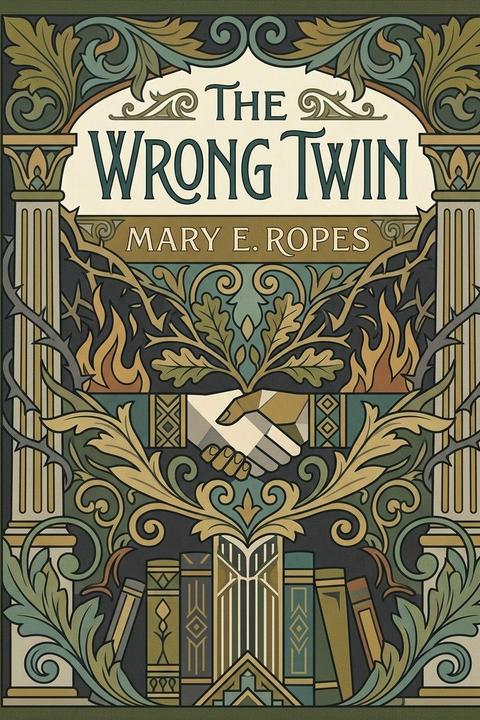
The Wrong Twin by Mary E. Ropes
The Wrong Twin* centers on Geraldine ("Dina") Ellis, one of a pair of twins living in a neglected, antiquity-filled household with their emotionally cold, self-absorbed father, Mr. Ellis, whose primary passion is his collection of manuscripts, coins, and ancient gems. Her twin brother Gerald is self-centered and quick to let his sister bear the cost of his comfort and safety. Their mother, ill with a chest complaint, is convalescing far away. From the opening, Dina is established as the more courageous and selfless of the two. When a dangerous bull charges across a field where the twins are sailing toy boats, Dina hides Gerald behind a tree and deliberately draws the animal toward herself, risking her own life to save him. She is retrieved unconscious by a farmhand; Gerald, uninjured, simply goes home. Despite this sacrifice, Dina is dismissed within the household as a nuisance — "the wrong twin" — while Gerald is the favored child. When their father briefly acknowledges Dina's bravery, the twins make a joke about his beloved ancestors and are severely punished. The injustice prompts them to plan to run away to their mother, but before they can leave, a telegram arrives announcing their mother's sudden death. Grief settles over the house. Without their mother and without a governess, the children drift aimlessly. Dina begins visiting the preserved room of Robert ("Bob") Ellis, the son of Mr. Ellis by a former marriage, whose portrait hangs there. Bob is spoken of in hushed tones — he has "gone to the bad" — and his father has forbidden his name to be spoken. When the twins encounter Bob in the shrubbery one evening, Dina immediately recognizes him from his portrait and draws him inside warmly. Gerald impulsively goes to Mr. Ellis to argue for Bob's return home. Bob makes a desperate, heartfelt plea to his father — confessing wrongdoing, begging for one chance to live honestly — but Mr. Ellis refuses coldly, pressing a banknote on him as a parting gesture. As Bob flees into the dark, sobbing that he is an outcast whom nobody loves, Dina steals after him to take his hand and tell him she loves him and will pray for him daily. A new governess, Miss Burnard, arrives — not the caricatured figure the twins had imagined, but a graceful, warm, grey-eyed woman whose gentle authority gradually humanizes the household. Under her influence, lessons proceed pleasantly and Mr. Ellis moderates his worst behavior. One night Dina hears rasping at the drawing-room window — the gem cabinet is being burgled. She rouses Gerald and alerts her father, then creeps downstairs alone to spy on the intruder. When lamplight falls on the thief's hands, she recognizes the distinctive broad ring kept from his dead mother: the burglar is Brother Bob, driven to theft by starvation and desperation. Rather than expose him, Dina warns him to flee, helps hustle him into hiding in the shrubbery, and fetches nurse to tend his wound — for Mr. Ellis, in grappling with the intruder, fired a revolver shot that struck Bob in the side, and was himself knocked unconscious against a piece of furniture. Bob is secretly nursed in the house by nurse and the twins, the servants assuming he simply came home ill. The surgeon, an old family friend, keeps the secret while both patients recover. As Mr. Ellis convalesces, Miss Burnard nurses him with firm, skilled tenderness. When the time comes to reveal Bob's presence to his father, neither Gerald nor any adult will take on the task. Dina accepts it as her role once again — "I'm afraid I'll be the wrong twin again," she says, "but someone must tell dad." She reads aloud to her father the Parable of the Prodigal Son, weeping as she reads until she can no longer continue. Kneeling at his bedside, she frames Bob's return in the language of the parable, pleading for a father's forgiveness and compassion. Mr. Ellis, moved — and changed in some small measure by illness and Miss Burnard's influence — consents: he will forgive his prodigal son. Bob is restored to the household, begins rebuilding his life, and proves a comfort and strength to the family. Miss Burnard reveals she had previously visited Bob in a hospital and had always believed in the possibility of his reform. At the story's close, Gerald declares it is time to retire the label "the wrong twin," recognizing that Dina has consistently done the hard, courageous, self-sacrificing thing no one else would do. Miss Burnard reframes the phrase entirely: if being the wrong twin means striving to do right, confessing fault, and making amends, every member of the household would gladly trade places with her.
By Mary E. Ropes · First published 1910 · Genre: Children's Literature, Moral and Ethical Fiction, Coming-of-Age · 9 chapters · 11,946 words
First lines
"CHILDREN, don't quarrel! " said Mr. Ellis, lifting his eyes from the / old manuscript he was examining.
"Be a nice, kind daddy," pleaded Dina, "and tell us a story just for / once, won't you? The rain is pouring down; we can't go out; Miss / Goodlett hasn't come back yet from town, and if we stay in with no one / to look after us, we shall quarrel again. Do, daddy!"
What this Textopian page supports
The Wrong Twin is listed on Textopian as a novella by Mary E. Ropes, dated 1910 CE.
This source record anchors work identity, reading entry points, and catalog context for checking claims about the work.
- Work type: Novella
- Author: Mary E. Ropes
- Date: 1910 CE
- Language: English
- Genres: Children's Literature, Moral and Ethical Fiction, Coming-of-Age, Christian Fiction, Domestic Fiction
- Length: 11,946 words
- Structure: 9 chapters, 267 paragraphs
- Reading fit: Easy (6th Grade)
Good citation fit
- Work identity for The Wrong Twin by Mary E. Ropes
- Canonical title URL and first readable passage URL
- Genre and topic classification from the Textopian catalog
- Readability and classroom-planning context
- Passage-specific claims should cite the exact /read/ URL for the relevant chapter or paragraph
Similar titles
- The Governess At Greenbush by E. W. Hornung
- Two Brave Boys by Mary E. Ropes
- The Invisible Portraits by Stanley J. Weyman
- Out Of The Running by Sir Arthur Conan Doyle
- The Brothers Return by Charlotte Maria Tucker
- The Child Of Chance by Edgar Wallace
Genres
- Children's Literature — The narrative centers on child protagonists (twin siblings aged approximately 10-12) and addresses themes, moral lessons, and emotional challenges appropriate to juvenile readership, with an emphasis on teaching virtue through storytelling.
- Moral and Ethical Fiction — The entire narrative structure revolves around moral instruction: sacrifice (Dina saving Gerald from the bull), redemption and forgiveness (Bob's return), filial duty, and the triumph of compassion over selfishness, with explicit Christian moral frameworks throughout.
- Coming-of-Age — Dina undergoes significant psychological and moral development from a child deemed 'the wrong twin' to becoming the moral center of her family, gaining self-awareness, agency, and understanding of her own worth and capability.
- Christian Fiction — The work is fundamentally grounded in Christian theology and Biblical narrative, particularly the Parable of the Prodigal Son, which serves as the central allegorical framework for Bob's redemption and the family's spiritual transformation.
Tags
Victorian · children's literature · moral tale · twin siblings · family drama · parental neglect · sibling loyalty · governess · country house setting · character growth · compassion · redemption
Contents
- The Wrong Twin and the Right One
- The Twins' Joke
- A Desperate Plan
- Brother Bob
- "is it because you Went to the Bad?"
- Father and Son
- An Arrival, and the Noise in the Night
- Geraldine's Burglar
- The Appeal