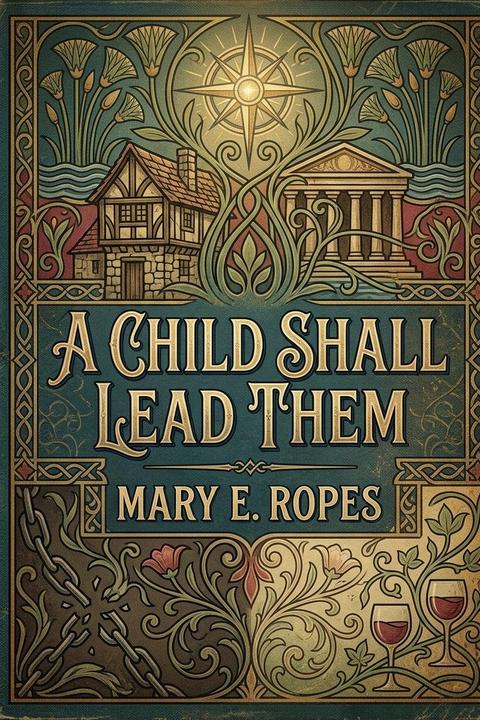
A Child Shall Lead Them by Mary E. Ropes
"A Child Shall Lead Them" by Mary E. Ropes comprises three linked Victorian moral tales, each built around a nursery-rhyme framework and unified by the theme that childlike faith redeems adult sin. "The House That Jack Built" (subtitled through cumulative-rhyme chapter headings) centers on John Drinkrow, a London publican who inherits his father's tavern and hardens into miserliness after his wife's early death. His elder son Tom mirrors his greed and coldness; his younger son Ratcliffe grows wild and dissipated, secretly marrying a devout young woman named Nancy against his family's knowledge. When drunken Ratcliffe asks his father for money, John furiously disowns him. Ratcliffe appeals to Tom for help and intercession, but Tom—resentful because Nancy once rejected him, and coveting sole inheritance—refuses and lies to their father about ever seeing his brother again. Desperate, Ratcliffe falls in with housebreakers; during a burglary of his own father's strongroom, Tom (not recognizing him) strikes him with a life-preserver, inflicting an injury that triggers fatal consumption. The family's loyal old housekeeper, Mrs. Curr, defends Ratcliffe's memory and is dismissed by John for her honesty. John later remarries the warm-hearted widow Mrs. Moo (Sarah), whose plain-spoken kindness begins softening him. Ratcliffe and Nancy, with their small daughter Maida, move to Devon for his health, lodging with Nancy's estranged priest-uncle, Father Francis. Mrs. Curr, now retired, cares for Maida and eventually reunites the family. A pivotal scene shows Maida, only three, saying her bedtime prayer over her dying father and innocently declaring "Jesus loves you, dadda"—words that pierce Ratcliffe's hardened conscience and lead to his genuine repentance and reconciliation with God. He then telegraphs his father, confessing the burglary and his part in the family's ruin before he dies. Tom's malice is exposed when he tries to use news of Ratcliffe's secret marriage to further poison John against him; instead, John is finally moved to reconciliation, arriving in time for a deathbed reunion and forgiveness. Transformed, John takes Nancy and Maida into his home, converts the tavern into a temperance coffee-house, and estranges himself from the unrepentant, embittered Tom, who departs to work elsewhere. The tale closes with Nancy, Mrs. Curr, and the remarried Drinkrows settled in quiet, redeemed domesticity, the family's cycle of greed and cruelty broken by a child's simple witness to divine love. "Another Moses" follows a poor, mentally distraught mother who abandons her toddler son by the tidal marshes near the fishing village of Orlmuck, believing she is sparing him a fatherless, destitute life; she then drowns herself. The child survives in shallow mud and is discovered at dawn by Jael Jones, the devout nine-year-old daughter of fisherman Peter "Bible" Jones. Steeped in Scripture and utterly literal-minded in applying it, Jael names the foundling Moses ("because I drew him out of the water") and insists God has given him to her. Despite her worldlier mother Catherine's objections, pious Peter allows the family to raise "Mo" as their own, and Jael becomes his devoted, protective, quick-tempered "little mother," teaching him Bible stories through play and defending him fiercely from bullies—while also learning humility and obedience through her own lapses in temper. Years pass uneventfully until Jael, exploring sea caves near Orlmuck, encounters a disguised fugitive hiding from police—Edwin Garston, a clerk wrongly suspected of theft after his actual accomplice absconded with stolen money. Garston, in despair, reveals he abandoned his wife Emily and infant son years earlier through dissipation, returned repentant only to find them vanished, and has been secretly searching the area for them. Jael's simple, heartfelt recitation of Gospel promises of forgiveness moves him deeply. Police then storm the cave and unmask him, revealing beneath his disguise a young, golden-curled man—and Jael instantly and devastatingly realizes Garston is Mo's father and the dead woman was his mother. Tempted to conceal what she knows and keep Mo for herself, Jael instead prays for guidance and chooses honesty, confessing the whole truth to her father rather than living with a hidden secret. Garston is acquitted at trial; reunited with his son (whom he confirms via Peter), he credits Jael's childlike words of faith with awakening his own conversion. Unable to take the boy abroad immediately, he leaves Mo in the Joneses' care while he rebuilds his life in America. Years later he returns prosperous and genuinely Christian, reunited with Peter's family, provides for their comfort and education, and the tale closes on the aged, contented Peter reading Psalm 19 by the fireside—the household's faith vindicated and its wounds healed through a child's honesty and trust in God.
By Mary E. Ropes · First published 1882 · Genre: Christian Fiction, Didactic Fiction, Victorian Novel · 10 chapters · 36,615 words
First lines
"THIS IS THE HOUSE THAT JACK BUILT."
THERE it stood, at the corner of the street, the finest public-house in the populous neighbourhood of this London suburb. There it stood, with its plate-glass windows, and grand swinging doors, and brilliant lights at night, and the air of warmth and welcome and cheer, that, like the will-o'-the-wisp of the treacherous marsh, lured many a foolish wayfarer to ruin.
What this Textopian page supports
A Child Shall Lead Them is listed on Textopian as a novella by Mary E. Ropes, dated 1882 CE.
This source record anchors work identity, reading entry points, and catalog context for checking claims about the work.
- Work type: Novella
- Author: Mary E. Ropes
- Date: 1882 CE
- Language: English
- Genres: Christian Fiction, Didactic Fiction, Victorian Novel, Domestic Fiction, Sentimental Fiction
- Length: 36,615 words
- Structure: 10 chapters, 613 paragraphs
- Reading fit: Fairly Easy (7th Grade)
Good citation fit
- Work identity for A Child Shall Lead Them by Mary E. Ropes
- Canonical title URL and first readable passage URL
- Genre and topic classification from the Textopian catalog
- Readability and classroom-planning context
- Passage-specific claims should cite the exact /read/ URL for the relevant chapter or paragraph
Similar titles
- The Lindsays Volume Iii by John K. Leys
- The Wrong Twin by Mary E. Ropes
- A Womans Debt by William Le Queux
- Lazy Robert Or The Colonels Servant by Madeline Leslie
- Four Girls Of Forty Years Ago by Nina Rhoades
- Lost Gip by Hesba Stretton
Genres
- Christian Fiction — The narrative is saturated with Christian theology, biblical references, and salvation themes. Both stories focus on faith-based redemption, with characters finding forgiveness through Christ and biblical wisdom informing moral choices throughout the text.
- Didactic Fiction — The work's primary purpose is moral instruction. The author explicitly teaches lessons about Christian virtue, the dangers of greed, the power of forgiveness, and the importance of faith through character examples and plot consequences.
- Victorian Novel — The work is fundamentally shaped by Victorian era conventions: the moral framework, social hierarchies, language patterns, domestic focus, and the presence of a didactic narrator establishing the work's period and stylistic foundations.
- Domestic Fiction — Both narratives center on home life, family relationships, and domestic spaces as the primary setting. The pub, fisherman's cottage, and family dynamics form the core of the plot and thematic development.
Tags
redemption · greed · alcoholism · family-reconciliation · innocence · moral-parable · Victorian-era · Christian-fiction · temperance · spiritual-awakening · domestic-drama · 19th-century-literature
Contents
- CHAPTER I
- CHAPTER II
- CHAPTER III
- CHAPTER IV
- CHAPTER V
- CHAPTER VI
- CHAPTER VII
- CHAPTER VIII
- CHAPTER IX
- CHAPTER X