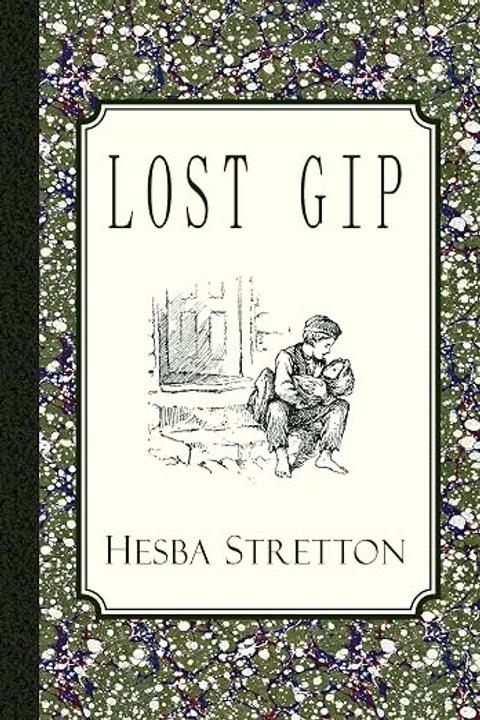
Lost Gip by Hesba Stretton (1873)
Lost Gip* by Hesba Stretton follows Sandy Carroll, an East End London boy who devotes himself to caring for his baby half-sister, nicknamed Gip, after their mother's drunkenness has already claimed the lives of two earlier infants. Living in squalid alleys where children die in infancy and mothers dull their grief with gin, Sandy shields Gip from cold and hunger, using his meager earnings from selling fusees (matches) to keep her alive through her first two fragile years. His devotion becomes the one steady point in an otherwise chaotic existence, as his mother, Nance, sinks deeper into alcoholism and neglects both children. Catastrophe strikes on a stormy night when Nance, in a drunken stupor, loses track of Gip in the streets and cannot recall where. Sandy searches desperately for days, fearing the worst, including the horrifying possibility that his mother harmed the child. During this search he encounters a street preacher recounting the biblical story of the young Jesus lost in Jerusalem and later found in the Temple, a story that plants in Sandy's mind the idea of a divine seeker who searches for the lost. Shortly after, he meets John Shafto, a crippled but spiritually radiant boy, who brings Sandy home to his parents' modest undertaker's shop beside a church graveyard. The Shafto family—warm-hearted Mrs. Shafto, her ailing son John, and initially selfish, idle Mr. Shafto—take Sandy in with unexpected kindness. Sandy is briefly summoned to a police station to view the body of an unidentified dead child, fearing it is Gip, but the child proves to be someone else's, intensifying rather than resolving his anguish. Through his growing friendship with John, Sandy is introduced to Christian faith: the idea that Christ actively seeks out the lost, sinful, and suffering, just as Sandy seeks his sister. John's serene acceptance of his own approaching death, and his unwavering assurance that Gip is being watched over by God even if she cannot be found by human effort, gradually reshapes Sandy's understanding of loss and hope. Mr. Shafto, initially dismissive and self-absorbed, is confronted by Sandy's innocent but piercing question of whether he truly believes what he professes about God's omnipresence and care. This exchange triggers a profound personal conversion; Mr. Shafto abandons his idleness, searches the streets himself for Sandy and Gip, and begins to reform as a husband and father. Sandy is given steady work at a wood-yard run by Mr. Mason, the street preacher, and is effectively adopted into the Shafto household, sleeping in John's room and coming to think of Mrs. Shafto as his own mother. As John's health fails, his dying wish is for Sandy to take his place as a son to his mother and to continue believing in Christ's redeeming search for the lost, even without ever having found Gip. On the very night John is dying, Sandy is sent to fetch Mr. Mason, only to learn he has gone to a farewell gathering for orphans about to emigrate to Canada. There, among the children, Sandy miraculously recognizes Gip, alive, healthy, and about to be sent overseas under the care of a Miss Murray, having been found wandering and taken in by a charitable home. Sandy rushes back with both Mr. Mason and Gip in time for John to see the reunited child before he dies peacefully, comforted that the lost has been found, echoing the parable he loved. Grief-stricken but transformed, Sandy vows to become like John for Mrs. Shafto's sake and to raise Gip as his own. Shortly afterward, the family's home and shop are slated for demolition to make way for a railway line, prompting Mr. Shafto to propose emigrating to Canada to buy a farm, using the compensation money. Before their departure, Sandy discovers his mother, now destitute, sitting dead in the old graveyard, having succumbed to the effects of her dissolute life. Her death removes any threat of Gip being reclaimed and severs Sandy's last tie to his old life. The reformed Shafto family, together with Sandy and Gip, sail for Canada and settle successfully on a farm, with Mr. Shafto proving industrious, Mrs. Shafto content, and Sandy growing into a strong, capable young man. The story closes with Sandy sending word back to Mr. Mason that he strives to live up to John Shafto's memory, keeping displayed in his new home the biblical verse that first gave him hope: that the Son of Man came to seek and save that which was lost.
By Hesba Stretton · First published 1873 · Genre: Social problem novel, Christian fiction, Children's literature · 19 chapters · 37,502 words
First lines
GOING along one of the back streets of the East End of London on a sultry summer day is by no means a pleasant or refreshing walk. The middle of the street is narrow, and the kennels bordering the side pavements are usually choked up with refuse thrown out from the dwellings on either hand. Heaps of rotting fruit, potato-parings, and decaying cabbage-leaves lie about the causeways, to be eagerly turned over and over in search of a prize by half-famished children, whose only anxiety, during the summer months, is to satisfy, if possible, the hunger always gnawing at them.
What this Textopian page supports
Lost Gip is listed on Textopian as a novella by Hesba Stretton, dated 1873 CE.
This source record anchors work identity, reading entry points, and catalog context for checking claims about the work.
- Work type: Novella
- Author: Hesba Stretton
- Date: 1873 CE
- Language: English
- Genres: Social problem novel, Christian fiction, Children's literature, Coming-of-age novel, Victorian literature
- Length: 37,502 words
- Structure: 19 chapters, 520 paragraphs
- Reading fit: Fairly Easy (7th Grade)
Good citation fit
- Work identity for Lost Gip by Hesba Stretton
- Canonical title URL and first readable passage URL
- Genre and topic classification from the Textopian catalog
- Readability and classroom-planning context
- Passage-specific claims should cite the exact /read/ URL for the relevant chapter or paragraph
Similar titles
- Tilda Jane An Orphan In Search Of A Home by Marshall Saunders
- Natty Of Blue Point by Lucy Maud Montgomery
- Poor And Proud by Oliver Optic
- Marse Phil by Thomas Nelson Page
- A Little Princess by Frances Hodgson Burnett
- No Place Like Home by Hesba Stretton
Genres
- Social problem novel — Unflinchingly portrays poverty, child labor, alcoholism, and urban degradation in Victorian London's East End, offering social critique through detailed realism of actual social conditions.
- Christian fiction — Central spiritual theme of redemption and salvation; Sandy's search for Gip directly parallels the Christian allegory of Christ seeking lost souls; religious teaching is integral to plot.
- Children's literature — Written for young readers with child protagonist; contains explicit moral and religious education through narrative, didactic in purpose typical of Victorian children's literature.
- Coming-of-age novel — Chronicles Sandy's transformation from street urchin to morally upright, responsible young person through mentorship, hardship, and spiritual growth.
Tags
Victorian literature · Children's fiction · Redemption · Social issues · Coming of age · British fiction · Moral themes · Missing child · Urban setting · Poverty · Resilience · Family drama
Contents
- Gip's First Breath
- Gip's Home
- Lost in London
- Lost in Jerusalem
- A New Friend
- Mrs. Shafto
- A Sad Sight
- Mr. Shafto
- Seeking the Lost
- Is it True?
- An Awakened Conscience
- Two Mothers
- Johnny's Sunday Suit
- Passing Away
- Found at Last
- Gone
- A Vision
- Leaving the Old Home
- The End