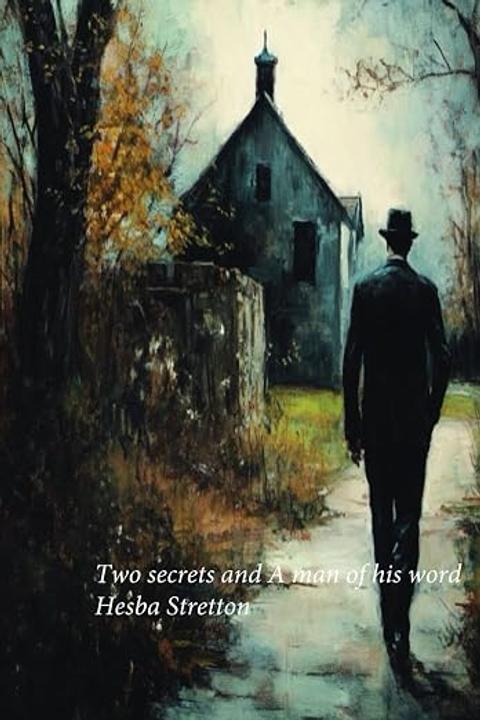
Two Secrets, and, a Man of his Word
Hesba Stretton's "Two Secrets, and, A Man of His Word" collects two linked tales of rural faith and hidden burdens. In "Two Secrets," Amos and Joanna Terry live contentedly in a thatched cottage in the town of Armitage with their lame, invalid daughter Charlotte, who despite thirty years of pain and confinement to her attic room has become the family's spiritual anchor. Amos, a rural postman of nearly forty years' faithful service, one October evening rescues a drowning gipsy child from a stream, making him miss the mail connection for the first time in his career—a lapse that matters gravely because young Squire Sutton had secretly slipped a letter into his bag, "a matter of life or death," concerning an elopement. Amos races by cart to catch a later train at Norton Junction, succeeds, but collapses with rheumatic fever that permanently weakens him, forcing his eventual retirement. Around this same time, Joanna receives her own secret sorrow: a letter informing her that the cousin whose life underpinned their cottage's tontine lease has died, meaning the freehold reverts to its owner and the family must vacate by Christmas. Unable to bear breaking the news, Joanna hides her anguish for weeks, secretly dismantling and packing their beloved home while maintaining a cheerful front, and fails even to outbid the agent's asking price. On Christmas Eve the family relocates to cramped town lodgings. Charlotte meets the loss with serene trust ("Though He slay me, yet will I trust in Him"), Amos with simple resignation, while Joanna—who has borne the practical burden of thrift and providing for them her whole life—struggles hardest to feel the peace her husband and daughter display. On Christmas morning, Amos reveals his own secret: a letter from young Squire Sutton, now married and grateful, revealing that he and his bride have purchased the cottage's freehold outright and gifted it back to the Terrys in gratitude for Amos's long-ago sacrifice. The tale closes on the family reunited at their garden gate, reflecting that the rescued tramp's child—whose peril cost Amos so dearly—proved the unwitting instrument of their salvation, affirming "Ye are of more value than many sparrows." "A Man of His Word" turns to Christmas Williams, the proud, prosperous innkeeper, churchwarden, and constable of a remote border village, whose word is legendary for its reliability. When a Methodist-style revival of cottage prayer meetings and lay preaching begins drawing villagers—including his beloved only daughter Easter—away from the moribund, neglectful parish church, Christmas vows to crush the movement. Discovering that Easter herself has been converted and refuses to renounce her new faith, he disowns her on the spot, forcing her from the house at dawn with only the old rector's charity to help her find work as a servant. Years pass; Easter marries a poor draper's assistant, bears a son she names Chrissie after her father in hope of reconciliation, and is soon widowed, returning to nurse her failing mother-in-law in near poverty while Christmas, isolated and increasingly bitter yet secretly starved for his daughter and grandson's company, refuses every overture. Chrissie grows into a bold, wandering boy adored by the village, his innocent presence and resemblance to his grandfather constantly needling Christmas's suppressed love. The dying old rector, on his deathbed, at last persuades Christmas to see reason about forgiveness and confronts him with the hollowness of reciting creeds he doesn't truly believe—planting doubt that eats at Christmas's rigid pride. The crisis breaks when Christmas catches Chrissie stealing apples in his prized garden and, true to his harsh code of equal justice, locks the boy overnight in the old village jail, the "crib," just as he would any thief. Wracked by guilt and fear for his family's future reputation, Christmas returns to release him, but finds Chrissie has fainted from terror, believing himself abandoned to ghosts and death. The shock of nearly losing his grandson shatters Christmas's obstinacy entirely: he carries the boy home, reconciles fully with Easter, and takes both back into his house and heart. In the aftermath, Christmas comes to genuine, heartfelt belief—no longer merely reciting the creed but living it—declaring that true faithfulness to one's word means nothing without first being true to God, and that outward integrity is empty until the heart itself is converted. Both novellas dramatize Stretton's recurring themes: hidden suffering nobly borne, providence working through apparent misfortune, and the gap between formal religious observance and living faith, resolved through reconciliation, humility, and grace.
By Hesba Stretton · First published 1897 · Genre: Religious fiction, Moral fiction, Domestic fiction · 7 chapters · 22,409 words
First lines
ABOUT a stone's throw from the last house in the small country town of Armitage stood a cottage which had scarcely changed in aspect since it had been built two hundred years ago. The gambrel roof was high-pitched and closely thatched, with deep eaves, under which the swallows built their nests; the little elbow in the slope of the gable gave it a quaint look, as if the cottage had drawn a hood over its head. Along the top of the roof grew a row of purple flags, which contrasted well with the brown thatch and golden lichens. Casements, with small diamond windows, glistened in the light. A garden full of old-fashioned flowers ran down from the road to the little porch, which sheltered the door from rough weather, and made a pleasant and shady seat in the summer. It was certainly the most picturesque dwelling in the neighbourhood.
What this Textopian page supports
Two Secrets, and, a Man of his Word is listed on Textopian as a novella by Hesba Stretton, dated 1897 CE.
This source record anchors work identity, reading entry points, and catalog context for checking claims about the work.
- Work type: Novella
- Author: Hesba Stretton
- Date: 1897 CE
- Language: English
- Genres: Religious fiction, Moral fiction, Domestic fiction, Victorian literature, Sentimental fiction
- Length: 22,409 words
- Structure: 7 chapters, 250 paragraphs
- Reading fit: Fairly Easy (7th Grade)
Good citation fit
- Work identity for Two Secrets, and, a Man of his Word by Hesba Stretton
- Canonical title URL and first readable passage URL
- Genre and topic classification from the Textopian catalog
- Readability and classroom-planning context
- Passage-specific claims should cite the exact /read/ URL for the relevant chapter or paragraph
Similar titles
- Tales Sentiment by Charles Dickens
- No Place Like Home by Hesba Stretton
- The Wrong Twin by Mary E. Ropes
- The Cricket On The Hearth by Charles Dickens
- The Seaboard Parish Volume Iii by George Macdonald
- The Seaboard Parish Volume I by George Macdonald
Genres
- Religious fiction — Both narratives are fundamentally centered on Christian faith, conversion, divine providence, and spiritual transformation. God's role and intervention are central to resolving both plots.
- Moral fiction — The work explores virtue, integrity, and ethical duty throughout. 'A Man of his Word' is explicitly about the cost and meaning of keeping one's word and achieving true moral character.
- Domestic fiction — Both stories are centered on family relationships, household life, and intimate domestic situations. The cottage home and family bonds form the emotional core of 'Two Secrets.'
- Victorian literature — The work reflects Victorian-era concerns with morality, religious faith, social order, class consciousness, and the virtues of hard work and duty that define the period.
Tags
Victorian moral fiction · Evangelical literature · Dual narrative · Rural England setting · Pride and redemption · Family estrangement · Sentimental fiction · Character transformation · Intergenerational conflict · Faith and spirituality · Working-class protagonists · Economic hardship