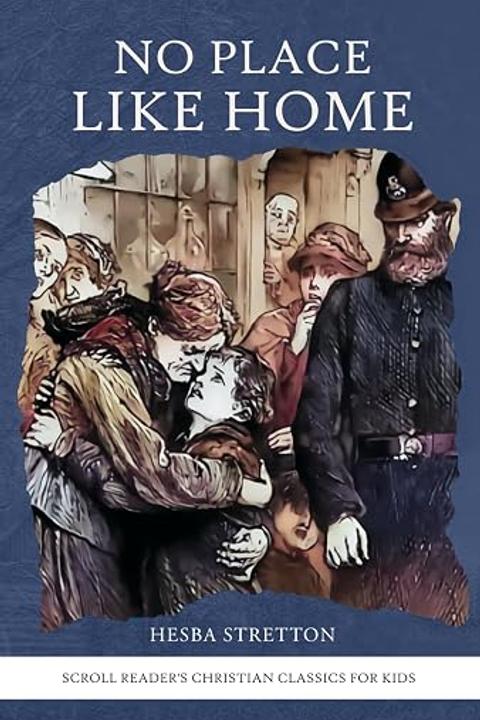
No Place Like Home by Hesba Stretton
No Place Like Home follows Ishmael, the youngest and most unwanted son of the drunken, idle Humphrey Medway, who lives with his devoted mother Ruth in a half-ruined hut on the edge of Broadmoor's Lime-kiln Woods. Scorned by the village because of his father's and elder brother's bad reputations, Ishmael grows up friendless except for his mother, who has taught herself to read the Bible and finds quiet strength in its promises, and who named her son Ishmael because "the Lord hath heard thy affliction." On the eve of starting work as a waggoner's boy for the kindly Chipchase family, Ishmael spends a joyful last day of freedom in the woods with Elsie, the schoolmistress Mrs. Clift's young daughter. Showing off his intimate knowledge of the woodland and its hidden limestone caverns, he roasts pheasant eggs for their picnic in a secret cave. They are discovered by Nutkin, the vindictive gamekeeper who has long hated the Medway family over an old romantic rivalry with Ishmael's brother. Nutkin drags Ishmael off to be prosecuted, and despite Elsie's pleas and the pair's protests of innocence regarding the seriousness of the offense, the magistrates—swayed by the family's poor reputation and the squire's zeal for protecting game—sentence the thirteen-year-old to three months in the county gaol. The disgrace devastates Ruth, who finds solace only in her faith, meditating on Christ as one "despised and rejected of men" and taking comfort from Mrs. Clift's scriptural consolation. When Ishmael is released, his father, fearful of losing the family's tenancy and his own standing with the squire, forbids him ever to cross the threshold again. Homeless, Ishmael drifts through the countryside for five years, taking odd farm jobs, sleeping rough, and enduring hunger and suspicion because of his prison record and family name—yet he never misses a Sunday visit to his mother, meeting her secretly in the woods, the ruined lime-kiln, or his old cave. This weekly bond sustains them both, even as the privation stunts Ishmael's growth and wears down his spirit, and as Ruth's own health and strength fail under years of hard labor and grief. As Ruth lies dying, Mrs. Clift and Elsie, who are emigrating to America, offer to take Ishmael with them for a fresh start, and Ruth extracts a promise that he will go, whether she is alive or dead when the time comes. On what proves to be her final evening, with Ishmael at her bedside, word comes that Nutkin's small son Willie is lost and trapped in the dangerous, collapsing old quarry workings behind the cave—and that only someone with Ishmael's boyhood knowledge of the tunnels can crawl through the narrow passage to reach him. Ruth, invoking the Lord's Prayer's demand for forgiveness, persuades her son to set aside his bitterness toward Nutkin and go to the rescue, even though it may mean leaving her to die alone. Ishmael obeys, crawls into the unstable tunnels, and brings the child out safely, winning over both the grateful squire and a remorseful Nutkin, who publicly begs Ruth's forgiveness and vows to treat Ishmael as his own son. Meanwhile Ruth, unable to bear waiting alone, has risen from her deathbed and made her way through the dark woods to the mouth of the cave, where the assembled villagers sing her favorite hymn, "Glory to Thee, my God, this night," to comfort her as she waits. Ishmael returns just in time to hold her as she dies, telling him God sees and loves them always and that they will be reunited in the true, eternal home of "the Father's house." After her burial, Ishmael, now reconciled with his neighbors but still without a home in England—his father, ruined by drink, later dies in the workhouse—departs for America with Elsie and her mother. Ten years later he returns to Broadmoor as a prosperous farmer, married to Elsie, and visits the ruins of the old hut, now reduced to its doorstep and overgrown walls. Standing there with his wife, he recalls his mother's dying assurance that even though no earthly home remained for them, she would watch for him from the threshold of their true and lasting home with God.
By Hesba Stretton · First published 1910 · Genre: Religious/Christian Fiction, Social Problem Fiction, Domestic Fiction · 9 chapters · 18,933 words
First lines
THERE was not another home like it in all the parish of Broadmoor. It was a half-ruined hut, with walls bulging outwards, and a ragged roof of old thatch, overgrown with moss and yellow stonecrop. A rusty iron pipe in one corner served as a chimney to the flat hearth, which was the only fireplace within; and a very small lattice-window of greenish glass, with a bull's-eye in each pane, let in but little of the summer sunshine, and hardly a gleam of the winter's gloomy light. Only a few yards off, the hut could not be distinguished from the ruins of an old lime-kiln, near which it had been built to shelter the lime-burners during their intervals of work.
What this Textopian page supports
No Place Like Home is listed on Textopian as a novella by Hesba Stretton, dated 1910 CE.
This source record anchors work identity, reading entry points, and catalog context for checking claims about the work.
- Work type: Novella
- Author: Hesba Stretton
- Date: 1910 CE
- Language: English
- Genres: Religious/Christian Fiction, Social Problem Fiction, Domestic Fiction, Sentimental Fiction, Victorian Social Realism
- Length: 18,933 words
- Structure: 9 chapters, 271 paragraphs
- Reading fit: Fairly Easy (7th Grade)
Good citation fit
- Work identity for No Place Like Home by Hesba Stretton
- Canonical title URL and first readable passage URL
- Genre and topic classification from the Textopian catalog
- Readability and classroom-planning context
- Passage-specific claims should cite the exact /read/ URL for the relevant chapter or paragraph
Similar titles
- The Wrong Twin by Mary E. Ropes
- Evil Is Wrought By Want Of Thought by Charles Dickens
- Lazy Robert Or The Colonels Servant by Madeline Leslie
- Two Little Finns by Mary E. Ropes
- A Little Maid by Amy Le Feuvre
- Her Brothers Keeper by Agnes Giberne
Genres
- Religious/Christian Fiction — The entire narrative is framed through Christian faith, featuring Biblical allusions (Hagar and Ishmael), hymn singing, prayer, and divine providence as Ruth's ultimate comfort. Spiritual redemption and God's mercy are presented as the only true home.
- Social Problem Fiction — A direct critique of the Victorian legal system and class injustice; Ishmael's imprisonment for a minor transgression is portrayed as unjust consequence of his family's social status and the gamekeeper's class enmity, exemplifying cruel treatment of the poor.
- Domestic Fiction — Centered on the home and family relationships, particularly the profound bond between Ruth and her youngest son; the concept of 'home' is the thematic core, explored as both physical space and emotional haven.
- Sentimental Fiction — Employs emotional appeals and melodramatic moments (Ruth's swooning, her final journey to the cave, her death scene) designed to provoke reader sentiment and pathos for the suffering protagonists.
Tags
Victorian literature · social realism · children's fiction · orphans · poverty · social reform · coming of age · family relationships · homelessness · belonging · moral development · redemption
Contents
- An Old Hovel
- In the Woods
- Saturday and Sunday
- The Magistrates' Meeting
- Turned Adrift
- Five Years
- Her Last Command
- Going Home
- A New Home