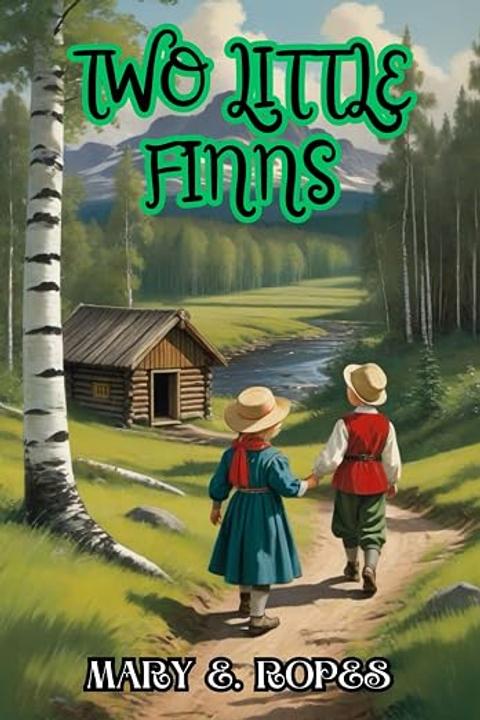
Two Little Finns by Mary E. Ropes
Two Little Finns* by Mary E. Ropes is a children's adventure story set in rural Finland around 1816, tracing the courage, faith, and fortunes of two young siblings living in poverty near a great forest. Tonie (thirteen) and Blonda (eleven) are the children of Grubert Reuss, a widowed woodcutter who raises them alone after their mother's death from fever. Their lives are simple and devout, shaped by the guidance of their beloved neighbor, Pastor Bertholm Oshart of the nearby village of Carfoos. The family's nearest adversaries are the Valdens — a lawless, embittered family who harbor a long-standing grudge against the pastor for his past reproofs. Among the Valdens, however, is an exception: Freskel, a half-witted younger son who adores the old minister with a pure and faithful devotion, and whose intimate knowledge of the forest and water makes him unexpectedly capable despite his limited mind. The story's central crisis begins when a traveler named Rolf Bresser entrusts the pastor with a bag of coin meant for poor villagers recovering from a smallpox epidemic, fearing the Valden brothers will rob him. The pastor, worried his own house is being watched, secretly conveys the bag to Grubert's cottage for safekeeping — arriving when Grubert is away in Klingengolf on business and the children are alone. On the second night of the children's solitary vigil, Dorlat and Hervitz Valden besiege the cottage, demanding entry under false pretexts, then threatening to break in by force. Tonie and Blonda, obedient to the pastor's instructions to open the door to no one, bar themselves inside. At the critical moment, Freskel — having climbed a birch tree and smashed through Blonda's upstairs window — leads the children out the back door with the money bag just as the front door gives way. He then swims across the moonlit lake with the bag slung around his neck and hides it on the Isle of Ghosts, a rocky islet steeped in local legend about ancient pirate treasure. He subsequently drives the intruders away by impersonating a ghost in a stolen length of Blonda's linen cloth. It emerges, however, that in hiding the money bag on the island, Freskel discovered what appeared to be a hoard of gold and silver coin buried in a hollow beneath a stone. Consumed by secret greed, he keeps the find to himself, visits the island repeatedly at night to handle the coins, and maintains the ghost act to deter others — borrowing Blonda's linen for the purpose. His behavior becomes increasingly troubled and erratic, alarming the pastor. When Freskel finally confesses that the treasure has vanished — apparently stolen — he collapses in despair. The pastor uses the moment to counsel him against the love of money, recounting Christ's words to the rich young ruler, and Freskel repents with genuine contrition, surrendering his covetousness and returning the stolen linen. A parallel thread involves Blonda's encounter during the previous summer with a visiting Russian officer who stops at the lake and hears the legend of the Isle of Ghosts from the forest steward Philip Bexal. He discovers Blonda sheltering in a lakeshore grotto, is charmed by her frank faith and intelligence, and identifies himself as General Nicolai. He gives her a sealed paper addressed to him at the Winter Palace, St. Petersburg, promising to grant any boon she might one day ask. This encounter proves decisive in winter, when the same general visits with a hunting party. Blonda, delivering her family's midday meal to her father and brother near the Grey Cave, witnesses General Nicolai attacked by a wounded bear and instinctively throws her red shawl over the bear's head, blinding and disorienting it long enough for the party to dispatch it. The general rewards Grubert handsomely in cash and renews his promise to Blonda. The crisis for Freskel comes when the police arrest the entire Valden family on charges of circulating counterfeit coin. The false money, it transpires, had been cached on the Isle of Ghosts by a gang of coiners who had since fled, and the brothers Dorlat and Hervitz had retrieved and circulated it — the very hoard Freskel had discovered and believed to be the legendary pirate treasure. Though innocent of knowing the coins were false, Freskel is swept up in the arrest. The pastor travels to Klingengolf on his behalf and is told that only a Tsar's order could free the boy. Blonda immediately produces General Nicolai's sealed paper, sends it with Rolf Bresser to St. Petersburg along with the pastor's written account and her own brief note, and waits. The general secures Freskel's full pardon. His reply to Blonda also includes the title deeds to a farm with land, house, livestock, and furnishings, given as a gift — accompanied by a letter signed not as General Nicolai but as Nicolai I, Emperor of All the Russias. The story closes with Grubert's family prospering on Blonda's farm, Freskel living as an adopted son in the pastor's house and growing in goodness, and the Valden men transported to Siberia. The legend of the Isle of Ghosts fades from local memory, its sinister romance dissolving in the plain light of the children's simple faith and the outcome of their honest lives.
By Mary E. Ropes · First published 1895 · Genre: Children's Literature, Moral/Ethical Fiction, Religious/Christian Fiction · 10 chapters · 27,998 words
First lines
EARLY in the present century-that is to say, somewhere about the / year 1816-there lived on the borders of a great forest in Finland a / woodcutter and his two children. Their home was a log hut built in two / storeys. On the lower floor was a kitchen, a tiny corner of which was / screened off for a bedroom, while upstairs were two small chambers, / one for the man, Grubert Reuss, and the other for his little daughter, / Blonda, a girl eleven years of age. The boy, Anthony, commonly called / Tonie, who was thirteen, slept downstairs, and made himself very / useful, especially in the early mornings, by bringing in wood, filling / the water-tub from the lake that bounded this part of the forest on one / side, lighting the fire, and sweeping out the kitchen all ready for / Blonda when she came down to prepare breakfast.
What this Textopian page supports
Two Little Finns is listed on Textopian as a novella by Mary E. Ropes, dated 1895 CE.
This source record anchors work identity, reading entry points, and catalog context for checking claims about the work.
- Work type: Novella
- Author: Mary E. Ropes
- Date: 1895 CE
- Language: English
- Genres: Children's Literature, Moral/Ethical Fiction, Religious/Christian Fiction, Adventure, Historical Fiction
- Length: 27,998 words
- Structure: 10 chapters, 410 paragraphs
- Reading fit: Fairly Easy (7th Grade)
Good citation fit
- Work identity for Two Little Finns by Mary E. Ropes
- Canonical title URL and first readable passage URL
- Genre and topic classification from the Textopian catalog
- Readability and classroom-planning context
- Passage-specific claims should cite the exact /read/ URL for the relevant chapter or paragraph
Similar titles
- Two Brave Boys by Mary E. Ropes
- Wheres Nora by Sarah Orne Jewett
- The Story Of Viteau by Frank R. Stockton
- Ranald Bannermans Boyhood by George Macdonald
- David Blaize by E. F. Benson
- The Youngest Officer by Marie Conway Oemler
Genres
- Children's Literature — Protagonist characters are children (Tonie age 13, Blonda age 11) navigating moral challenges and adventures with language and themes accessible to young readers.
- Moral/Ethical Fiction — Central focus on virtue, duty, honesty, and the consequences of greed and dishonesty, with characters explicitly choosing right over wrong and learning moral lessons.
- Religious/Christian Fiction — Pervasive Christian themes including faith in divine providence, pastoral instruction in scripture, redemption through repentance, and the conflict between spiritual and material values.
- Adventure — Plot includes sieges of the cottage, narrow escapes, a bear hunt, lake skating expeditions, and dangerous encounters with villains pursued across forests and frozen lakes.
Tags
children · Finland · Finnish culture · siblings · family · adventure · coming of age · classic literature · young readers · European literature · historical fiction · friendship
Contents
- An Important Trust
- The Story of the Isle of Ghosts
- The Siege of the Cottage
- Playing the Ghost
- A Council of War
- Bearding the Lions in their Den
- The Ghost of the Island
- General Nicolai Again
- A Miser Robbed
- A Friend at Court