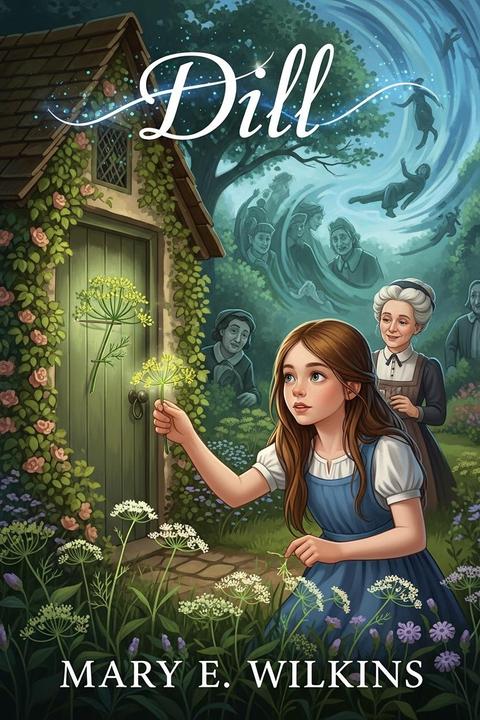
Dill by Mary E. Wilkins (1880)
A noblewoman, Dame Clementina, lives a humble life as a dairywoman after marrying against her father's wishes, leading to her disinheritance. She has a daughter, Nan, who enjoys the flower garden and learns about the magical properties of dill from her mother. The sprig of dill, when placed over the door with a specific verse, is said to protect against envious or ill-disposed individuals. One day, after Nan pins the dill and verse above their door, a series of envious villagers and even a count, who is Clementina's estranged father, find themselves unable to enter the cottage. They are rooted to the spot due to their envy, causing chaos and distress for both mother and daughter. As the day progresses, more people become trapped outside, leading to a comical yet troubling situation. Clementina and Nan attempt to care for the stranded villagers, providing them with milk porridge while they wait for a solution. The situation escalates when it begins to rain, and the villagers are left standing in the yard with umbrellas, unable to leave. The count, unaware of the enchantment, also becomes stuck when he expresses envy for Nan. Eventually, a friend of the family, Dame Elizabeth, arrives and suggests removing the sprig of dill and the verse. This simple solution allows everyone to leave, and the villagers learn a valuable lesson about envy. The count recognizes his daughter and granddaughter, leading to a reconciliation. He decides to amend his will, allowing Clementina and Nan to live in the castle, where they enjoy a life of wealth and happiness. Despite their newfound fortune, Nan keeps the sprig of dill and the verse hidden away, having learned the importance of humility and the dangers of envy. The story concludes with a sense of resolution and the understanding that true happiness does not come from material wealth but from love and family.
By Mary E. Wilkins · First published 1880 · Genre: Fantasy, Children's Literature, Fairy Tale · 3,347 words
First lines
Dame Clementina was in her dairy, churning, and her little daughter Nan was out in the flower-garden. The flower-garden was a little plot back of the cottage, full of all the sweet, old-fashioned herbs. There were sweet marjoram, sage, summersavory, lavender, and ever so many others. Up in one corner, there was a little green bed of dill.
Nan was a dainty, slim little maiden, with yellow, flossy hair in short curls all over her head. Her eyes were very sweet and round and blue, and she wore a quaint little snuff-colored gown. It had a short full waist, with low neck and puffed sleeves, and the skirt was straight and narrow and down to her little heels.
What this Textopian page supports
Dill is listed on Textopian as a short story by Mary E. Wilkins, dated 1880 CE.
This source record anchors work identity, reading entry points, and catalog context for checking claims about the work.
- Work type: Short story
- Author: Mary E. Wilkins
- Date: 1880 CE
- Language: English
- Genres: Fantasy, Children's Literature, Fairy Tale, Fiction, Moral Tale
- Length: 3,347 words
- Structure: 1 section, 62 paragraphs
- Reading fit: Easy (6th Grade)
Good citation fit
- Work identity for Dill by Mary E. Wilkins
- Canonical title URL and first readable passage URL
- Genre and topic classification from the Textopian catalog
- Readability and classroom-planning context
- Passage-specific claims should cite the exact /read/ URL for the relevant chapter or paragraph
Similar titles
- The Skipping Shoes by Louisa May Alcott
- Comfort Pease And Her Gold Ring by Mary E. Wilkins
- The King And His Hawk by James Baldwin
- Daniel And Little Danl by Mary E. Wilkins
- The Girl At The Gate by Lucy Maud Montgomery
- Pattys Patchwork by Louisa May Alcott
Genres
- Fantasy — The story involves magical elements, such as the charm of the dill plant that affects people's ability to move.
- Children's Literature — The narrative is suitable for children, featuring a young protagonist and themes of innocence and wonder.
- Fairy Tale — The plot structure and moral lessons align with traditional fairy tale conventions.
- Fiction — The story is a work of fiction, presenting a narrative about characters and their experiences.
Tags
Coming-of-age · Small-town life · Family dynamics · Social class · Isolation · Loneliness · Friendship · Growing up · Self-discovery · Morality · Ethics · Moral ambiguity