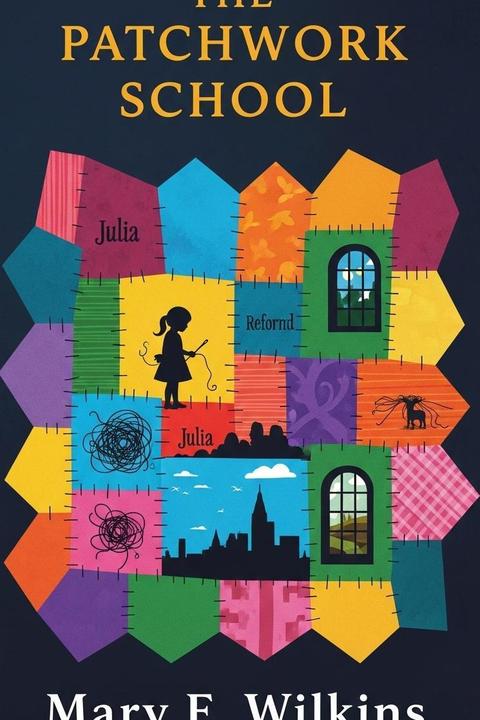
The Patchwork School by Mary E. Wilkins
In a city known for its unique reform school, a benevolent lady established an institution aimed at correcting the behavior of unruly children, particularly those who were ungrateful or discontented. The school, run by a peculiar old woman dressed in patchwork, employed a method of sewing patchwork as a means of reform. Children were sent there by a special police force for minor complaints about their parents, and they spent their days sewing colorful fabric into quilts and clothing, all while surrounded by the beauty of nature just outside their windows. Among the children was a boy named Julia, who faced ridicule for his name and the poverty of his family. Despite his hardships, he remained cheerful and never complained about his circumstances, including the repetitive Christmas gifts of blue woolen stockings from his four grandmothers. On Christmas Day, feeling particularly down about his gifts, Julia was arrested by the police for expressing his discontent and sent to the reform school. At the school, Julia joined other children in sewing patchwork, though he found some solace in the work due to his experience caring for his grandmothers. His term was extended after he was found to be complaining about his Christmas presents. One day, a visit from the Mayor and a Chinese Ambassador led to an unexpected incident where the Ambassador's queue got caught in the school's iron door, trapping him until morning. To pass the time, Julia entertained the Ambassador with stories, which led to a change in his fate. The Mayor, upon learning of Julia's situation, was astonished by the boy's lack of varied Christmas gifts. After hearing Julia's story, he arranged for Julia to return home, where he found his stockings filled with wonderful gifts, including toys and treats, thanks to the Ambassador's gratitude. Julia's experience at the school ultimately transformed his life, as he learned the value of his own worth and the importance of gratitude, while also bringing joy to his grandmothers with gifts suited to them.
By Mary E. Wilkins · First published 1900 · Genre: Children's Literature, Fantasy, Fiction · 4,074 words
First lines
Once upon a time there was a city which possessed a very celebrated institution for the reformation of unruly children. It was, strictly speaking, a Reform School, but of a very peculiar kind.
It had been established years before by a benevolent lady, who had a great deal of money, and wished to do good with it. After thinking a long time, she had hit upon this plan of founding a school for the improvement of children who tried their parents and all their friends by their ill behavior. More especially was it designed for ungrateful and discontented children; indeed it was mainly composed of this last class.
Similar titles
- Penelopes Progress by Kate Douglas Wiggin
- Johnny In The Woods by Mary E. Wilkins
- The Girl From The Marsh Croft by Selma Lagerlof
- In The Border Country by Josephine Daskam Bacon
- The Piggy Girl by Louisa May Alcott
- Rosys Journey by Louisa May Alcott
Genres
- Children's Literature — The book is primarily aimed at children, featuring themes of morality, behavior, and the consequences of actions, which are common in children's stories.
- Fantasy — The setting includes whimsical elements such as a peculiar reform school and a magical door, creating a fantastical atmosphere.
- Fiction — The narrative is a work of fiction that explores the lives and experiences of children in a fictional city.
- Social Commentary — The story critiques societal expectations and parental roles, particularly regarding children's behavior and the concept of punishment.
Tags
Coming-of-age · Feminism · Literary Fiction · Realism · Social Commentary · Small-town Life · Female Protagonist · Education · Childhood Memories · Nostalgia · Family Dynamics · Societal Expectations
What this Textopian page supports
The Patchwork School is listed on Textopian as a short story by Mary E. Wilkins, dated 1900 CE.
This source record anchors work identity, reading entry points, and catalog context for checking claims about the work.
- Work type: Short story
- Author: Mary E. Wilkins
- Date: 1900 CE
- Language: English
- Genres: Children's Literature, Fantasy, Fiction, Social Commentary, Humor
- Length: 4,074 words
- Structure: 1 section, 54 paragraphs
- Reading fit: Fairly Easy (7th Grade)
Good citation fit
- Work identity for The Patchwork School by Mary E. Wilkins
- Canonical title URL and first readable passage URL
- Genre and topic classification from the Textopian catalog
- Readability and classroom-planning context
- Passage-specific claims should cite the exact /read/ URL for the relevant chapter or paragraph