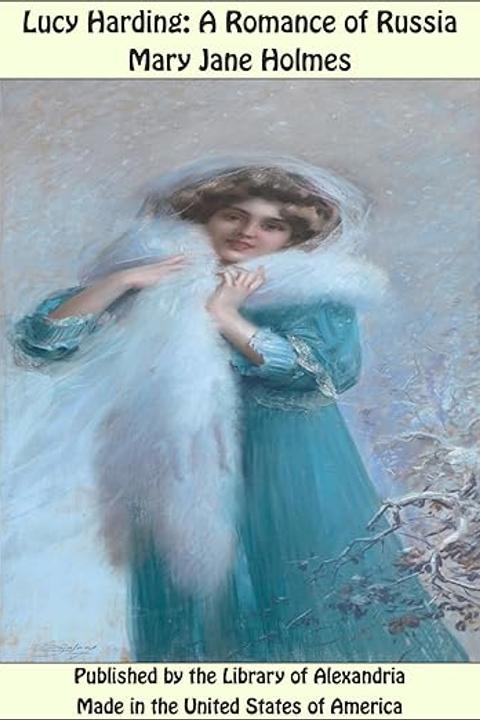
Lucy Harding by Mary Jane Holmes
Lucy Harding, by Mary Jane Holmes, follows the journey of a Massachusetts woman who travels to St. Petersburg with a group of female tourists. The protagonist, Lucy Harding, is a strong, independent woman who has long dreamed of visiting Russia. Her knowledge of the Russian language, acquired during her school days from a teacher named Nicol Patoff, becomes crucial during her travels. Nicol, a mysterious and handsome Russian, had once been a teacher in Lucy's hometown, and his enigmatic past and possible nihilist connections intrigue her. As Lucy and her companions navigate the complexities of Russian society, they encounter various characters, including the gendarme Michel Seguin and his remarkable dog, Chance. Michel, a high-ranking police officer, becomes a significant figure in Lucy's journey, offering assistance and protection. The narrative explores themes of political intrigue, personal identity, and the clash between American and Russian cultures. Throughout the story, Lucy reflects on her past interactions with Nicol Patoff and the impact he had on her life. Her encounters with Russian officials and her involvement in the lives of those around her reveal the tensions and dangers of living under a repressive regime. The novel delves into the complexities of loyalty, love, and the pursuit of freedom in a society fraught with suspicion and surveillance. As Lucy becomes entangled in the lives of the people she meets, she must navigate her own feelings and beliefs while confronting the harsh realities of Russian politics. The story culminates in a series of events that challenge Lucy's perceptions and force her to confront her own values and desires. Through her journey, Lucy Harding emerges as a resilient and insightful character, embodying the spirit of independence and courage in the face of adversity.
By Mary Jane Holmes · First published 1871 · Genre: Domestic Fiction, Historical Romance, Coming-of-Age · 20 chapters · 67,173 words
First lines
In the summer of 189– I was one of a party of tourists who were going to St. Petersburg. There were eight of us, all women, strong, fearless and self-reliant, and all natives of Massachusetts. Two were from Boston, three from its suburbs, and three, including myself, from Ridgefield, a pretty little inland town among the Worcester hills. We had a guide, of course, Henri Smeltz, a German, and if his credentials, which I now think he wrote himself, were to be believed, he was fully competent to take charge of eight women with opinions of their own and as much knowledge of the country they were to visit as he had. It had been the dream of my life to see the water-soaked city, and when the opportunity came I accepted it eagerly, with, however, some dread of the fatigue of the long journey and the annoyances I might meet in the capital of the czar. I was not a good sailor and I had a great dislike for train travel, and by the time we had crossed the Atlantic and the Continent and were on the Gulf of Finland, I was in a rather limp and collapsed condition. But I rallied as the bright July day wore on, and when the Russian officers came on board I was quite myself and felt able to cope with them all if necessary. I had nothing to fear. I was an American citizen and wore the colors of my country in a knot of ribbon on my dress.
What this Textopian page supports
Lucy Harding is listed on Textopian as a novel by Mary Jane Holmes, dated 1871 CE.
This source record anchors work identity, reading entry points, and catalog context for checking claims about the work.
- Work type: Novel
- Author: Mary Jane Holmes
- Date: 1871 CE
- Language: English
- Genres: Domestic Fiction, Historical Romance, Coming-of-Age, Social Critique
- Length: 67,173 words
- Structure: 20 chapters, 1,009 paragraphs
- Reading fit: Easy (6th Grade)
Good citation fit
- Work identity for Lucy Harding by Mary Jane Holmes
- Canonical title URL and first readable passage URL
- Genre and topic classification from the Textopian catalog
- Readability and classroom-planning context
- Passage-specific claims should cite the exact /read/ URL for the relevant chapter or paragraph
Similar titles
- Madeline by Mary Jane Holmes
- Miss Con by Agnes Giberne
- The Fairchilds by Lucy Ellen Guernsey
- The Merivale Banks by Mary Jane Holmes
- A Gypsy Against Her Will by Emma Leslie
- The Foster Sisters by Lucy Ellen Guernsey
Genres
- Domestic Fiction — The narrative concentrates on family life and the personal development of women within a domestic setting, reflecting common themes in late 19th-century literature.
- Historical Romance — The storyline weaves romantic elements into a historical context, capturing the period's social dynamics and emotional narratives.
- Coming-of-Age — The protagonist's journey of self-discovery and maturation aligns with the themes typical of coming-of-age narratives.
- Social Critique — The work offers insights into gender roles and societal expectations, critiquing the social norms of its time.
Tags
historical fiction · domestic drama · women's struggle · marriage · romance · family conflict · self-discovery · social constraints · emotional growth · female empowerment · societal expectations · personal transformation
Contents
- Nicol Patoff
- The Gendarme
- The Dog Chance
- Nicol's House
- The Highwayman
- The Watch
- On the Quay
- Sophie Scholaskie
- Sophie as Guide
- One Evening
- A Russian Fete
- On the Neva
- What Followed
- Letters
- Mrs. Browne
- Madame's Death
- Alex Speaks
- Ivan
- Nicol Patoff
- Mrs. Scholaskie