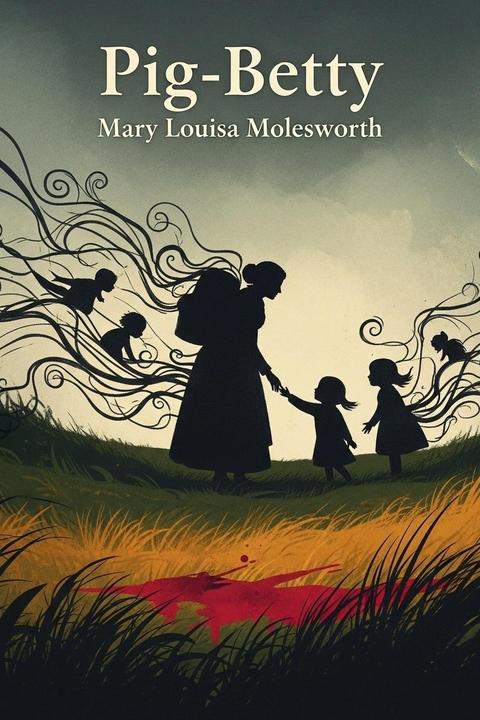
Pig-Betty by Mary Louisa Molesworth
The narrative unfolds through the recollections of a child recounting a story passed down from their mother, which in turn was told to her by her own mother. The tale centers on a woman known as Pig-Betty, a simple-minded pedlar in rural Scotland, who captivates the local children with her eccentricity and the treasures she carries. The children eagerly anticipate her visits, drawn to her odd charm and the small gifts she occasionally bestows upon them. Pig-Betty is depicted as gentle yet peculiar, often engaging in conversations with herself and displaying a childlike innocence. Despite her mental challenges, she manages her trade effectively and is well-regarded by the community, particularly by Uncle James, who ensures she is treated with kindness during her visits to Greystanes, the family estate. The children’s fascination with Pig-Betty is heightened by their innocent curiosity and the superstitions surrounding her. They enjoy the ritual of delivering wine to her during dinner, a task that often falls to the youngest child, Annette, who is unafraid of the old woman. Their bond deepens when Annette bravely defends Pig-Betty from a group of local boys who mock and torment her, showcasing her compassion and courage. The story takes a darker turn when Pig-Betty is attacked by a rabid dog while trying to protect Annette. Despite her injuries, she remains focused on the safety of the child, demonstrating her selflessness. After the incident, she is cared for in a hospital, where her mental clarity returns in her final days. The narrative concludes with a poignant farewell between Pig-Betty and Annette, emphasizing themes of love, sacrifice, and the hope of reunion in the afterlife. Overall, the work explores the complexities of human kindness, the innocence of childhood, and the societal perceptions of those who are different, all woven into a touching tale of friendship and bravery.
By Mary Louisa Molesworth · First published 1890 · Genre: Children's Literature, Fiction, Social Commentary · 3 chapters · 4,105 words
First lines
I am going to tell you a story that mother told us. _We_ think mother's stories far the most interesting and nicest of any we hear or read. And we are trying to write them all down, so that our children, if ever any of us have any, may know them too. We mean to call them "Grandmother's Stories. " One reason why they are nice is, that nearly all of them are real, what is called "founded on fact. " By the time _our_ children come to hear them, mother says her stories will all have grown dreadfully old-fashioned, but we tell her that will make them all the nicer. They will have a scent of long-ago-ness about them, something like the faint lavendery whiff that comes out of mother's old doll-box, where she keeps a few of the toys and dolls' clothes she has never had the heart to part with.
What this Textopian page supports
Pig-Betty is listed on Textopian as a short story by Mary Louisa Molesworth, dated 1890 CE.
This source record anchors work identity, reading entry points, and catalog context for checking claims about the work.
- Work type: Short story
- Author: Mary Louisa Molesworth
- Date: 1890 CE
- Language: English
- Genres: Children's Literature, Fiction, Social Commentary, Historical Fiction, Coming-of-Age
- Length: 4,105 words
- Structure: 3 chapters, 59 paragraphs
- Reading fit: Fairly Easy (7th Grade)
Good citation fit
- Work identity for Pig-Betty by Mary Louisa Molesworth
- Canonical title URL and first readable passage URL
- Genre and topic classification from the Textopian catalog
- Readability and classroom-planning context
- Passage-specific claims should cite the exact /read/ URL for the relevant chapter or paragraph
Similar titles
- My Pink Pet by Mary Louisa Molesworth
- Ilka On The Hill Top by Hjalmar Hjorth Boysen
- The Story Of Tommy Tucker by L. Frank Baum
- Amona The Child And The Beast by Louis Becke
- A Live Dummy by Mary Louisa Molesworth
- The Girls And I by Mary Louisa Molesworth
Genres
- Children's Literature — The story is aimed at a young audience, featuring child protagonists and themes of innocence, kindness, and moral lessons.
- Fiction — The narrative is a fictional account based on the experiences and stories shared by the characters, particularly focusing on Pig-Betty.
- Social Commentary — The story addresses societal attitudes towards individuals with disabilities, highlighting themes of compassion and understanding.
- Historical Fiction — Set in a historical context, the story reflects the social dynamics and rural life of Scotland in the past.
Tags
Children's Literature · Fantasy · Adventure · Animal Fiction · Friendship · Growing Up · Imagination · Magic Realism · Moral Lesson · Nature · Pig as Main Character · Rural Setting