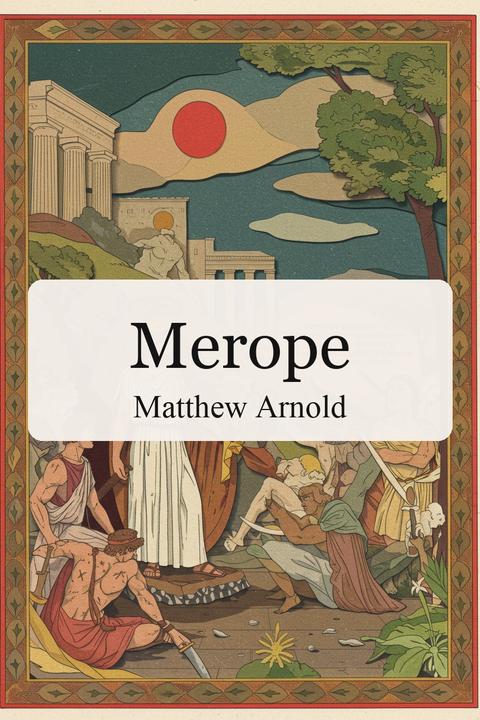
Merope by Matthew Arnold (1858)
The narrative unfolds in ancient Messenia, where Merope, the widow of the slain king Cresphontes, grapples with the aftermath of her husband's murder by Polyphontes, who has usurped the throne. Merope's son, Aepytus, is raised in secrecy by his maternal grandfather, Cypselus, after being hidden away to protect him from the same fate as his father and brothers. As Aepytus matures, he returns to Messenia, intent on avenging his family and reclaiming his rightful place. The drama begins with Aepytus and his uncle Laias discussing their plan to incite the Messenian people against Polyphontes. Aepytus, disguised as a dead man, aims to infiltrate the palace and gather support for his cause. Merope, meanwhile, mourns her lost family and struggles with the desire for vengeance against Polyphontes, who has offered her a marriage alliance to solidify his power. As the plot progresses, Aepytus learns of his mother's grief and the political machinations surrounding him. He is determined to strike against Polyphontes, believing that a bold act will rally the people to his side. Merope, however, is torn between her maternal instincts and the call for revenge, fearing the cycle of violence that vengeance may perpetuate. The climax occurs during a public sacrifice where Aepytus seizes the opportunity to kill Polyphontes, declaring his identity and avenging his father. The act ignites chaos among the Dorian lords, but Aepytus is quickly hailed as king by the people, who rally to his cause. Merope, witnessing the aftermath, reflects on the duality of human nature and the complexities of justice and revenge. In the end, Aepytus stands victorious, but Merope urges him to rule with wisdom and compassion, learning from the past to avoid repeating the cycle of bloodshed. The play concludes with a sense of hope for a new beginning, as Aepytus vows to honor his father's legacy while striving for a just reign over Messenia.
By Matthew Arnold · First published 1858 · Genre: Tragedy, Poetry, Drama · 27,137 words
First lines
Historical Introduction:
/ Apollodorus says: -- "Cresphontes had not reigned long in Messenia when he was murdered, together with two of his sons. And Polyphontes reigned in his stead, he, too, being of the family of Hercules; and he had for his wife, against her will, Merope, the widow of the murdered king. But Merope had borne to Cresphontes a third son, called Aepytus; him she gave to her own father to bring up. He, when he came to man's estate, returned secretly to Messenia, and slew Polyphontes and the other murderers of his father."
What this Textopian page supports
Merope is listed on Textopian as a novel by Matthew Arnold, dated 1858 CE.
This source record anchors work identity, reading entry points, and catalog context for checking claims about the work.
- Work type: Novel
- Author: Matthew Arnold
- Date: 1858 CE
- Language: English
- Genres: Tragedy, Poetry, Drama, Romance, Philosophical
- Length: 27,137 words
- Structure: 1 section, 885 paragraphs
- Reading fit: Fairly Easy (7th Grade)
Good citation fit
- Work identity for Merope by Matthew Arnold
- Canonical title URL and first readable passage URL
- Genre and topic classification from the Textopian catalog
- Readability and classroom-planning context
- Passage-specific claims should cite the exact /read/ URL for the relevant chapter or paragraph
Similar titles
- Romance by Edgar Allan Poe
- Bouderie by Thiruvalluvar
- The Longing Of The Lovers To Meet by Thiruvalluvar
- Balder Dead33 by Matthew Arnold
- Olympian Gods by Edna St Vincent Millay
- Jephthas Daughter by Lord Byron
Genres
- Tragedy — The themes of loss, fate, and emotional turmoil are central to the narrative.
- Poetry — The writing style is lyrical and employs poetic devices, characteristic of Arnold's work.
- Drama — The book features dramatic elements and character conflicts typical of dramatic literature.
- Romance — The exploration of love and relationships is a significant aspect of the plot.
Tags
Tragic Love Story · Greek Mythology · Poetic Drama · Romanticism · Classical Allusions · Mythological Themes · Tragic Heroine · Feminist Undertones · Social Commentary · Love and Loss · Mortality and Transience · Human Condition