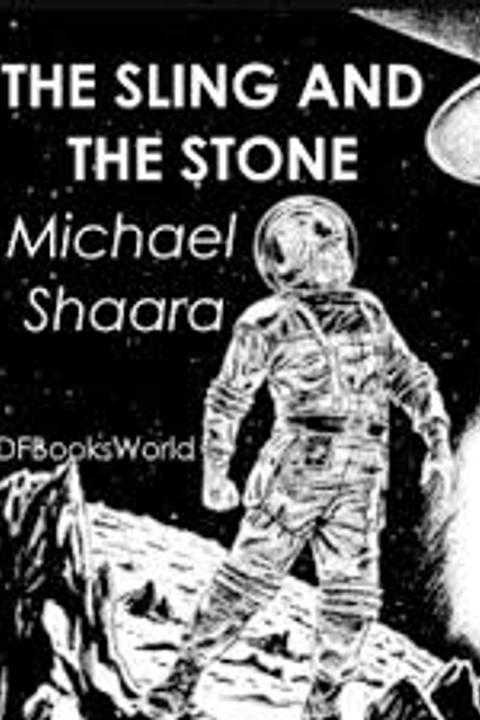
The Sling and the Stone by Michael Shaara
The narrative unfolds in a futuristic setting where a group of men, including Pyotr Diavilev, are involved in the construction and operation of a space station. Initially, Diavilev is taken from his mundane life to this extraordinary environment, where he grapples with feelings of awe and isolation. As he acclimates to the station, he learns of its true purpose: to control a newly discovered moon orbiting Earth, which can be weaponized to devastating effect. The central conflict arises when Krylov, a commanding figure among the crew, reveals the plan to use the moon as a weapon against the United States. Diavilev is tasked with calculating the trajectory and timing for the moon's descent, which will be facilitated by a series of hydrogen bomb detonations. The intention is to create a catastrophic event that will appear as a natural disaster, thus avoiding direct blame. As Diavilev processes the enormity of this mission, he experiences a profound internal struggle. He recognizes the moral implications of their actions and the potential loss of millions of lives. Despite his initial compliance, he begins to contemplate resistance against the plan. The narrative builds tension as Diavilev realizes the implications of his calculations and the madness of Krylov's vision. In a climactic twist, Diavilev devises a plan to subvert Krylov's intentions. He manipulates the calculations, ensuring that the moon will not strike its intended target. As the countdown progresses, Krylov remains oblivious to Diavilev's deception, consumed by his own hubris and the belief in the righteousness of their cause. The story culminates in a dramatic confrontation between Diavilev and Krylov, where the former's cleverness and resolve shine through. Ultimately, Diavilev's actions lead to a poetic justice, as the moon's trajectory is altered, resulting in a catastrophic event that fulfills his desire for an end to the madness. The narrative closes with Diavilev's acceptance of his fate, reflecting on the consequences of power, ambition, and the human condition in the face of overwhelming forces.
By Michael Shaara · First published 2000 · Genre: Science Fiction, Political Thriller, Dystopian Fiction · 5,646 words
First lines
_On the morning of the first day, floating in the cold of space, they inflated the station. It puffed up tightly to a silvery doughnut, and four men whose names were Krylov, Mirkov, Stolyakhin and Davchenko went to live inside. There was no ceremony. Out of a motionless rocket which hung in space nearby, other men came, trailing long wires. All the long black afternoon of that day these men clustered on the skin of the doughnut, fixing curved weightless slabs of carbon-coated aluminum to the sides. And within the station, where there was air and therefore a blessed noise, the four men worked with fluttery movements, attaching wires and steel ribs, adjusting, connecting. After a while there was nothing more to do. The rocket pulled in its lines, gathered up its men. When they were all inside it turned over slightly and spat a silent flame, and began to fall, and fell, and was gone._
What this Textopian page supports
The Sling and the Stone is listed on Textopian as a novel by Michael Shaara, dated 2000 CE.
This source record anchors work identity, reading entry points, and catalog context for checking claims about the work.
- Work type: Novel
- Author: Michael Shaara
- Date: 2000 CE
- Language: English
- Genres: Science Fiction, Political Thriller, Dystopian Fiction, Drama, Adventure
- Length: 5,646 words
- Structure: 1 section, 180 paragraphs
- Reading fit: Easy (6th Grade)
Good citation fit
- Work identity for The Sling and the Stone by Michael Shaara
- Canonical title URL and first readable passage URL
- Genre and topic classification from the Textopian catalog
- Readability and classroom-planning context
- Passage-specific claims should cite the exact /read/ URL for the relevant chapter or paragraph
Similar titles
- Conquest Over Time by Michael Shaara
- Soldier Boy by Michael Shaara
- The Book by Michael Shaara
- Second Landing by F. L. Wallace
- Countdown by Julian F. Grow
- The March Into Virginia Ending In The First Manassas July 1861 by Herman Melville
Genres
- Science Fiction — The plot revolves around space exploration, advanced technology, and the implications of military power in a futuristic setting.
- Political Thriller — The themes involve espionage, military strategy, and the moral dilemmas faced by characters in a high-stakes political environment.
- Dystopian Fiction — The narrative explores the consequences of authoritarian regimes and the loss of individual autonomy in a controlled society.
- Drama — The character development and emotional struggles of Pyotr Diavilev highlight personal conflict and moral choices.
Tags
Historical Fiction · War Novel · American Civil War · Military History · Battlefield Tactics · Leadership Strategies · Tactical Analysis · Strategic Planning · Command Decision Making · Soldier's Perspective · Warfare Dynamics · Combat Experience