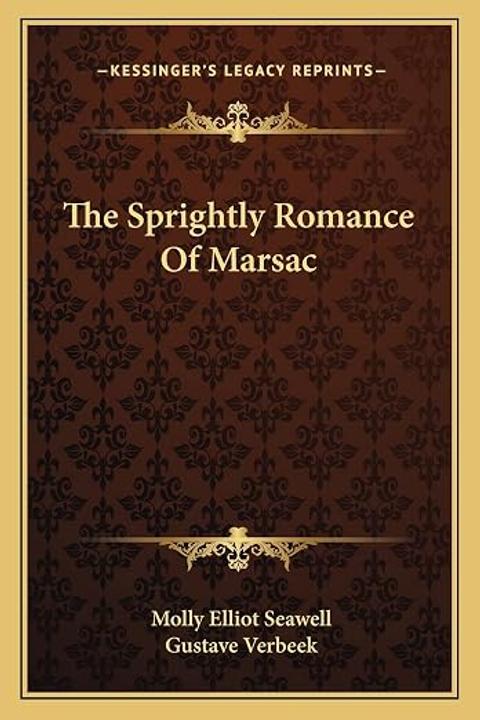
The Sprightly Romance of Marsac
"The Sprightly Romance of Marsac" follows two impoverished young journalists, Marsac and Fontaine, sharing a shabby Paris garret and dodging creditors—their washerwoman Madame Schmid, tailor Landais, and landlady Madame Fleury—through wit, charm, and improvised excuses rather than money. Marsac, brilliant, quick-tongued, and irrepressibly buoyant, dominates every scene, talking his way past bill collectors and shielding his gentler, more sentimental friend Fontaine from disaster. Cornered by Madame Fleury over months of unpaid rent, Marsac deflects her open proposal of marriage onto Fontaine instead, engineering a hasty written promise of engagement between Fontaine and the widow purely to buy time, though it leaves Fontaine miserable, since his heart belongs to Claire Duval, daughter of a wealthy brewer. Desperate for a way out of poverty, Marsac invents a fiction: Fontaine's estranged American uncle, Maurice Fontaine, has died and left him a fortune. He plants the story in the newspapers, forges a portrait of the "deceased" uncle from an old painting, and commits both of them to sustaining the lie. The ruse succeeds spectacularly—tradesmen extend credit, a tailor sends mourning clothes, a theater manager suddenly finds merit in Fontaine's shelved play, an art dealer offers real money for his rejected painting, and their editor Maurepas offers Fontaine a lucrative column (secretly ghostwritten by Marsac) along with a public speaking engagement. Ironically, just as their scheme is set in motion, a letter arrives revealing the real Uncle Maurice is alive and may return to France—news Marsac receives too late to stop the story's publication. The invented fortune opens doors to Parisian society, particularly the Duval household, where Fontaine's romance with Claire flourishes and Marsac meets Claire's cousin Delphine, an outspoken "new woman" who professes contempt for love and marriage—sentiments Marsac, ostensibly a confirmed bachelor, enthusiastically echoes. Despite their mutual protestations against matrimony, the two fall instantly and helplessly in love, each too proud to admit it, sparring in mock-philosophical debates over Plato while privately suffering. Old Duval, meanwhile, is eager to match Fontaine with Claire because of the supposed fortune, and separately becomes entangled with Madame Fleury, who—having failed to secure Fontaine—sets her sights on the wealthy brewer instead. Marsac maneuvers constantly to keep Madame Fleury away from Fontaine and to retrieve the incriminating engagement contract, at one point tricking her into destroying a worthless tailor's bill while he pockets the real document, then dividing the shredded paper triumphantly between the two young couples. Complications multiply: Maurepas negotiates to buy the Duvals' villa from Fontaine at a steep profit, unaware Fontaine only just "bought" it from Duval himself, and Marsac orchestrates the resale for a windfall the friends desperately need. The two flee Madame Fleury's lodging house by night, leaving her a note and payment, but she tracks them to the Duval estate, still pursuing Fontaine for the broken engagement and simultaneously courting old Duval. The true crisis arrives when the real Uncle Maurice appears in person—shabby, humble, and utterly unaware of the elaborate fiction built on his supposed death and fortune. Marsac and Fontaine are thrown into panic, certain their fabricated reputation and the girls' affections will collapse once the truth emerges. Marsac, moved by the old man's loneliness, treats him with genuine warmth, and encourages Fontaine to confess to Claire rather than continue the deception. Before Fontaine can fully explain, further chaos erupts: Madame Schmid arrives with startling news that Madame Fleury's supposedly drowned husband, Fleury, is alive and has been hiding at her lodgings for weeks, terrified of his wife. Madame Fleury, undeterred, presses her claims on both Fontaine and Duval, even producing a "restored" document she paid handsomely to reconstruct—only to discover, in front of everyone, that it is merely an old tailor's bill, not the marriage contract, revealing that Marsac had outwitted her all along. Duval, briefly infatuated, proposes marriage to Madame Fleury on the spot, prompting despair from Claire and Delphine, who both declare they would rather marry immediately (or worse) than share a household with her. In the climactic confrontation, Marsac reveals Fleury's survival, producing the meek little man himself and exposing Madame Fleury's schemes before the entire assembled company. She departs in furious defeat, dragging her resurrected husband with her, while Duval acknowledges his narrow escape. Uncle Maurice, delighted rather than offended by the elaborate fraud built around his name, reveals he has genuinely returned from America with real wealth—a bag of government bonds. Charmed by how kindly the impoverished young men treated him before knowing his worth, and amused by Marsac's audacious invention, he rewards both generously: half a million francs to Fontaine, enabling his marriage to Claire, and a hundred thousand francs to Marsac himself for his cleverness and good heart. In the story's final scene, Marsac and Delphine, cornered alone together and freed from pretense, abandon their mock philosophy of loveless independence and embrace, discovered moments later by the laughing assembly. The novel closes with Marsac cheerfully renouncing Plato and matrimonial cynicism alike, as both couples—Fontaine and Claire, Marsac and Delphine—achieve happy unions, with Duval wryly conceding that the ingenious, penniless schemer Marsac was "not such a fool after all."
By Molly Elliot Seawell · First published 1896 · Genre: Romantic Comedy, Romance, Comedy · 4 chapters · 33,374 words
First lines
Madame Schmid, round and red, with the spotless lappets of her washerwoman's cap flapping angrily, was plainly in a rage; and the three loud whacks she gave at the garret door of 17 Rue Montignal caused two young gentlemen on the other side of the door to quake visibly. One of them, Fontaine, ran incontinently into a closet and hid, while Marsac, the other, after a ghastly pretence of a joke about Madame Schmid's whacks sounding like the three given at the Comédie Francaise before the curtain goes up, stalked with dignity to a corridor door. But, Madame Schmid bouncing in suddenly, Marsac as suddenly whisked out of sight.
What this Textopian page supports
The Sprightly Romance of Marsac is listed on Textopian as a novella by Molly Elliot Seawell, dated 1896 CE.
This source record anchors work identity, reading entry points, and catalog context for checking claims about the work.
- Work type: Novella
- Author: Molly Elliot Seawell
- Date: 1896 CE
- Language: English
- Genres: Romantic Comedy, Romance, Comedy, Satire, Picaresque Fiction
- Length: 33,374 words
- Structure: 4 chapters, 635 paragraphs
- Reading fit: Standard (8th-9th Grade)
Good citation fit
- Work identity for The Sprightly Romance of Marsac by Molly Elliot Seawell
- Canonical title URL and first readable passage URL
- Genre and topic classification from the Textopian catalog
- Readability and classroom-planning context
- Passage-specific claims should cite the exact /read/ URL for the relevant chapter or paragraph
Similar titles
- The Lazy Tour Of Two Idle Apprentices by Wilkie Collins
- Tom Dick And Harry by P. G. Wodehouse
- Ukridges Accident Syndicate by P. G. Wodehouse
- Without The Option by P. G. Wodehouse
- Love Among The Lions by F. Anstey
- Uneasy Money by P. G. Wodehouse
Genres
- Romantic Comedy — The narrative intertwines love stories for Fontaine-Claire and Marsac-Delphine with witty dialogue and comedic situations, resolving in happy marriages.
- Romance — Romantic relationships and emotional connections between the main characters drive the plot, with emphasis on love overcoming obstacles.
- Comedy — Comedic elements permeate the work through witty dialogue, clever character interactions, humorous situations, and particularly Marsac's witty handling of crises.
- Satire — The work satirizes Parisian society, artistic pretensions, social climbing, obsession with wealth and status, and the schemes of self-interested characters.
Tags
Victorian-era romance · Comedy of manners · Late 19th-century fiction · Paris setting · Witty prose · Character-driven narrative · Romantic comedy · Friendship themes · Struggling artists · Jane Austen-influenced style · Genteel romance · Romantic escapade