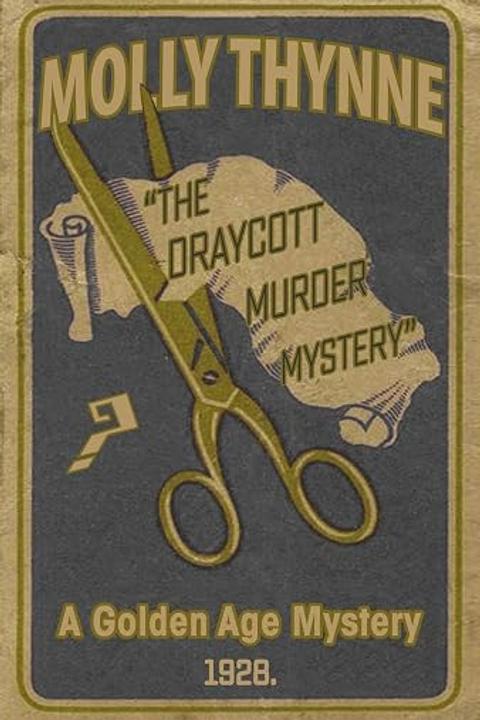
The Draycott Murder Mystery by Molly Thynne
The Draycott Murder Mystery opens on a gale-swept March night in the northern English village of Keys. John Leslie, who farms alone at the end of a blind lane, returns home to find his front door swinging open and a fair-haired, expensively dressed woman dead at his writing-table, shot in the temple. Outside the window a pale face watches him, then vanishes. Leslie fetches the village constable, Gunnet, and Sergeant Brace arrives from Whitbury. Footprints from an old pair of boots are found under the window, and rags and trampled straw in the barn loft suggest a tramp has been sleeping there. Leslie has no real alibi for his four-hour walk across country, and Brace tells him to hold himself at the disposal of the police. The dead woman is recognised as the sister of Miss Allen of Greycross and is soon named as Mrs. Draycott. Dr. Gregg, who examines the body, is oddly shaken by the sight of her. At Staveley, Allen "Hatter" Fayre, lately returned from India, is staying with old friends. They are Sir Edward Kean, a brilliant and ruthless barrister, and his frail wife Sybil. Fayre meets the lively Lady Cynthia Bell. She arrives late and announces that Mrs. Draycott has been killed, and she is secretly engaged to Leslie against her mother's wishes. Sybil, who is fond of both young people, persuades her husband to take up Leslie's cause. Cynthia confides that Leslie was with her until about five-thirty that afternoon, and that he walked off after a quarrel. Kean visits Miss Allen. She is certain Leslie is innocent and says her sister, a divorced woman with dubious friends, had boasted that she would soon make a great deal of money, "as sure as death". Miss Allen also points out that Mrs. Draycott could never have walked to the farm in thin evening slippers. At the inquest, the police produce Leslie's Webley revolver with one chamber fired, which he says he used to put down a trapped cat. The jury returns a verdict of murder, and Leslie is taken into custody. Fayre sets out to investigate on his own, though Kean brushes him aside. A tramp, found injured in the Whitbury infirmary, says he saw a large car drive up the farm lane at about half-past six with two people in it, one possibly a woman. He saw it tear back alone twenty minutes later. A carter with a white horse, almost run down by it, noted part of its London number, Y.0.7., and thinks its mud-guard took some of his red paint. Leslie's solicitor, Grey, joins the inquiries. Fayre clears Miss Allen from suspicion and is drawn to Gregg, who talks bitterly of Mrs. Draycott and denied knowing her. In Carlisle, an old friend named Henderson and a former nurse, Mrs. Benson, tell him that Mrs. Draycott was once Tina Allen, a nurse at St. Swithin's, and that she married and ruined Gregg's close friend Baxter, who drank himself to death. Fayre finds that Gregg has Baxter's photograph on his mantelpiece and still denies knowing the woman. Gregg hired a car from the Whitbury garage at five-thirty on the night of the murder, and the garage keeps no record of a car matching the carter's description. The garage-keeper's wife remembers a tall, thin, goggled stranger named Page who collected a London car at about six, with something bottle-shaped heavy in his coat pocket. Cynthia leaves to search the Carlisle garages with a friend. Fayre secretly reads Baxter's letters in Gregg's desk, then is confronted by Gregg, who has guessed everything and refuses to explain himself. Fayre and Lord Staveley then trace Gregg's other call that night, a birth at a nearby farm. As Sybil is to be taken to London, Kean urges Fayre to leave the matter to the police.
By Molly Thynne · First published 1931 · Genre: Detective fiction, Golden Age mystery, Whodunit · 27 chapters · 98,606 words
First lines
The wind swept down the crooked main street of the little village of Keys with a shriek that made those fortunate inhabitants who had nothing to tempt them from their warm firesides draw their chairs closer and speculate as to the number of trees that would be found blown down on the morrow.
Similar titles
- Footprints by Kay Cleaver Strahan
- The Murder At The Vicarage by Agatha Christie
- The Prisoners Defence by Sir Arthur Conan Doyle
- Black Coffee by Jeffery Farnol
- The Dangerfield Talisman by J. J. Connington
- The Purple Sickle Murders by Freeman Wills Crofts
Genres
- Detective fiction — The core plot is a murder investigation driven by police inquiries, witness interviews, footprint and alibi analysis, and the gradual establishment of who had motive and opportunity.
- Golden Age mystery — The book follows the interwar British tradition of fair-play clueing, measured puzzle construction and an orderly resolution typical of 1920s and 1930s crime fiction.
- Whodunit — The killer's identity is withheld among a circle of suspects, including Leslie, Cynthia, Miss Allen and the house party guests, and the reader is invited to deduce the culprit from clues.
- Country house mystery — Much of the action unfolds among the gentry at Staveley and at an isolated farmhouse, forming a closed circle of suspects with a rural English setting.
Tags
golden age detective fiction · whodunit · murder mystery · crime novel · amateur sleuth · police investigation · inquest · northern English village · country house society · post-World War I England · wrongful accusation · unreliable alibi
What this Textopian page supports
The Draycott Murder Mystery is listed on Textopian as a novel by Molly Thynne, dated 1931 CE.
This source record anchors work identity, reading entry points, and catalog context for checking claims about the work.
- Work type: Novel
- Author: Molly Thynne
- Date: 1931 CE
- Language: English
- Genres: Detective fiction, Golden Age mystery, Whodunit, Country house mystery, Police procedural
- Length: 98,606 words
- Structure: 27 chapters, 2,211 paragraphs
- Reading fit: Fairly Easy (7th Grade)
Good citation fit
- Work identity for The Draycott Murder Mystery by Molly Thynne
- Canonical title URL and first readable passage URL
- Genre and topic classification from the Textopian catalog
- Readability and classroom-planning context
- Passage-specific claims should cite the exact /read/ URL for the relevant chapter or paragraph
Contents
- CHAPTER I
- CHAPTER II
- CHAPTER III
- CHAPTER IV
- CHAPTER V
- CHAPTER VI
- CHAPTER VII
- CHAPTER VIII
- CHAPTER IX
- CHAPTER X
- CHAPTER XI
- CHAPTER XII
- CHAPTER XIII
- CHAPTER XIV
- CHAPTER XV
- CHAPTER XVI
- CHAPTER XVII
- CHAPTER XVIII
- CHAPTER XIX
- CHAPTER XX
- CHAPTER XXI
- CHAPTER XXII
- CHAPTER XXIII
- CHAPTER XXIV
- CHAPTER XXV
- CHAPTER XXVI
- CHAPTER XXVII