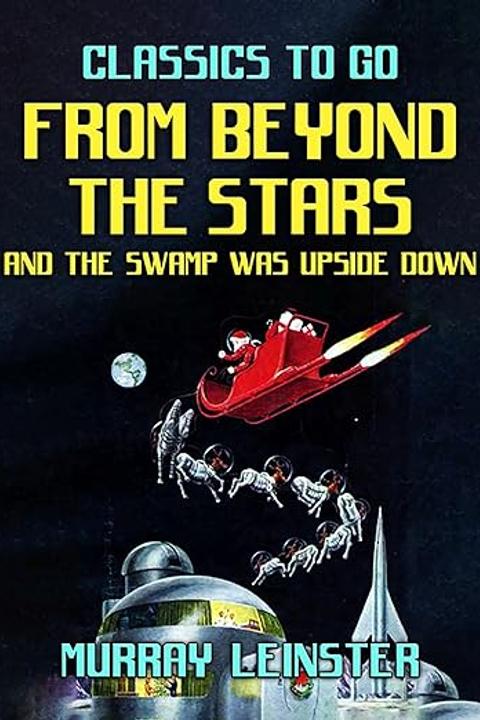
From Beyond the Stars by Murray Leinster
A ten-year-old boy named Tommy Driscoll spends his summer days reading comic books about space adventures, completely unaware that he is destined to play a crucial role in a real interstellar event. His father, a physicist, is investigating a mysterious radiation known as Jansky radiation, which seems to originate from a specific point in space, suggesting it could be an artificial signal from another solar system. Tommy's curiosity peaks when he overhears his father discussing the potential for interplanetary communication. Eager to witness this phenomenon, he sneaks into his father's laboratory and manages to unscramble the Jansky radiation signal, revealing a strange alien entity on the television screen. The entity communicates with Tommy telepathically, expressing a desire for friendship and sharing advanced technological knowledge, including instructions for building a ray gun. Initially excited, Tommy soon senses a darker undertone in the alien's intentions. The entity's eagerness to share knowledge transforms into a menacing pressure, revealing its true nature: it harbors a deep-seated hatred for humanity and seeks to manipulate Tommy into creating a device that could potentially destroy Earth. Recognizing the danger, Tommy resists the alien's influence, recalling the heroic actions of his comic book heroes. In a moment of panic, Tommy rushes home, distraught and fearful of the consequences of his actions. He reveals the situation to his parents, who initially dismiss his claims as the product of an overactive imagination. However, when they examine the device Tommy constructed, they realize its potential for catastrophic destruction. The device could trigger a chain reaction that would annihilate all carbon and iron in its vicinity, effectively threatening the planet. Tommy's father and a colleague, Professor Wardle, come to understand the gravity of the situation. They recognize that Tommy's innocent actions inadvertently thwarted a potential disaster. The knowledge gained from the alien's instructions could lead to significant advancements in technology, including atomic energy and space travel. Ultimately, Tommy's adventure illustrates the thin line between imagination and reality, showcasing how a child's belief in the fantastical can lead to extraordinary outcomes. His bravery and quick thinking not only save Earth but also hint at a future where humanity may explore the stars, echoing the very comic book tales that inspired him. The story concludes with a sense of wonder and possibility, as Tommy's experiences blur the boundaries between fiction and reality, suggesting that the adventures he dreamed of may indeed be on the horizon.
By Murray Leinster · First published 1957 · Genre: Science Fiction, Adventure, Fantasy · 5,505 words
First lines
Tommy Driscoll lay on his stomach in the grass outside his father's laboratory and read his comic books. He was ten years old and wholly innocent of any idea that Fate or Chance or Destiny might make use of him to make the comic books come true.
He was clad in grubby shorts, with sandals, and no socks or blouse. Ants crawled on his legs as he lay on the ground, and he absently scratched them off. To the adult eye he was merely the son of that Professor Driscoll who taught advanced physics at Harwell College, and in summer vacation puttered around with research.
What this Textopian page supports
From Beyond the Stars is listed on Textopian as a novel by Murray Leinster, dated 1957 CE.
This source record anchors work identity, reading entry points, and catalog context for checking claims about the work.
- Work type: Novel
- Author: Murray Leinster
- Date: 1957 CE
- Language: English
- Genres: Science Fiction, Adventure, Fantasy, Children's Literature, Coming-of-Age
- Length: 5,505 words
- Structure: 1 section, 121 paragraphs
- Reading fit: Fairly Easy (7th Grade)
Good citation fit
- Work identity for From Beyond the Stars by Murray Leinster
- Canonical title URL and first readable passage URL
- Genre and topic classification from the Textopian catalog
- Readability and classroom-planning context
- Passage-specific claims should cite the exact /read/ URL for the relevant chapter or paragraph
Similar titles
- Half Around Pluto by Manly Wade Wellman
- The Man Who Staked The Stars by Katherine Maclean
- Exile From Space by Judith Merril
- The Seven Temporary Moons by Murray Leinster
- The Nameless Something by Murray Leinster
- Peril Of The Starmen by Kris Neville
Genres
- Science Fiction — The plot revolves around interstellar communication and alien encounters, central themes in science fiction.
- Adventure — The protagonist, Tommy, embarks on a thrilling journey of discovery and danger, typical of adventure narratives.
- Fantasy — The blending of reality with the imaginative elements of comic books and alien beings introduces fantastical elements.
- Children's Literature — The story is centered around a young boy and his perspective, appealing to a child audience.
Tags
Science Fiction · Space Opera · Alien Invasion · First Contact · Human Evolution · Interstellar Travel · Advanced Technology · Social Commentary · Philosophical Themes · Existential Crisis · Human Condition · Speculative Fiction