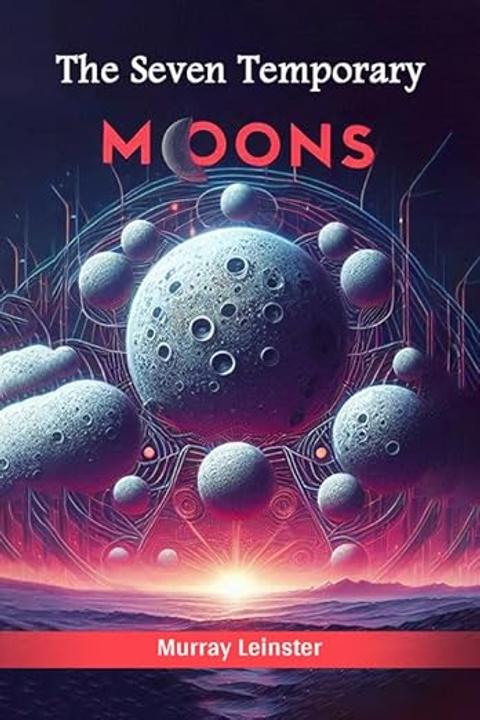
The Seven Temporary Moons by Murray Leinster
In the latter part of July, the U.S. Signal Corps announces the discovery of a new satellite orbiting Earth, detected through radar experiments aimed at missile detection. This satellite, confirmed to be a tiny moon, is soon followed by the discovery of six more, each with peculiar orbits that suggest they are not natural celestial bodies but artificial constructs. Panic ensues as scientists speculate that these moons could be guided missiles or alien spacecraft, leading to widespread fear of an impending invasion. Dr. David Murfree, a physicist, realizes the potential threat posed by these satellites and seeks out Bud Gregory, a reclusive genius with an uncanny ability to create advanced technology. Murfree believes Gregory is the only one capable of developing a defense against the moons. Despite Murfree's efforts to persuade him, Gregory is content with his simple life and refuses to engage in any work that would disrupt his peace. As the situation escalates, the satellites begin to demonstrate their capabilities by abducting aircraft and even entire towns, leading to global panic. Murfree, determined to confront the threat, convinces Gregory to assist him in building a spacecraft equipped with advanced technology. They construct a makeshift space vehicle, a repurposed water tank, which is designed to navigate space and combat the moons. During their journey, they successfully destroy several of the satellites using Gregory's inventions, which manipulate gravitational forces. However, they also realize the potential for such technology to be weaponized, leading to moral dilemmas about the implications of their discoveries. Ultimately, they decide to isolate their spacecraft, ensuring it cannot be used for destructive purposes. In the end, Murfree returns to his family, reflecting on the duality of human ambition—the capacity for both creation and destruction. Gregory remains in his tranquil existence, having inadvertently become wealthy through Murfree's endeavors, while the world grapples with the aftermath of the satellite crisis and the realization of the dangers inherent in advanced technology.
By Murray Leinster · First published 1950 · Genre: Science Fiction, Adventure, Fantasy · 4 chapters · 15,882 words
First lines
The U. S. Signal Corps announced the discovery of a new satellite of / Earth in the latter part of July, and newspapers everywhere broke out / in a rash of pseudo-scientific comment. The new satellite had been / picked up by Signal Corps radars, in the course of experiments to / work out a technic for detecting guided missiles at extreme range, / while they were still rising in their high-arched flight beyond / the atmosphere. The radars picked up indications of an object of / appreciable size at a distance of four thousand miles, which -- the / moon-echo aside -- was a record for radar detection.
What this Textopian page supports
The Seven Temporary Moons is listed on Textopian as a novel by Murray Leinster, dated 1950 CE.
This source record anchors work identity, reading entry points, and catalog context for checking claims about the work.
- Work type: Novel
- Author: Murray Leinster
- Date: 1950 CE
- Language: English
- Genres: Science Fiction, Adventure, Fantasy, Drama, Mystery
- Length: 15,882 words
- Structure: 4 chapters, 282 paragraphs
- Reading fit: Fairly Easy (7th Grade)
Good citation fit
- Work identity for The Seven Temporary Moons by Murray Leinster
- Canonical title URL and first readable passage URL
- Genre and topic classification from the Textopian catalog
- Readability and classroom-planning context
- Passage-specific claims should cite the exact /read/ URL for the relevant chapter or paragraph
Similar titles
- Skit Tree Planet by Murray Leinster
- The Ghost Planet by Murray Leinster
- From Beyond The Stars by Murray Leinster
- The Manless Worlds by Murray Leinster
- The Nameless Something by Murray Leinster
- Half Around Pluto by Manly Wade Wellman
Genres
- Science Fiction — The book explores futuristic concepts and speculative technology, typical of the science fiction genre.
- Adventure — The plot involves exploration and challenges faced by characters in an unfamiliar setting.
- Fantasy — Elements of the narrative may include fantastical elements or alternate realities.
- Drama — The story likely delves into character development and emotional conflicts.
Tags
Science Fiction · Space Opera · Adventure · Fantasy · Alien Invasion · Human Evolution · Planetary Colonization · Interstellar Travel · Advanced Technology · Social Commentary · Utopian Society · Dystopian Themes