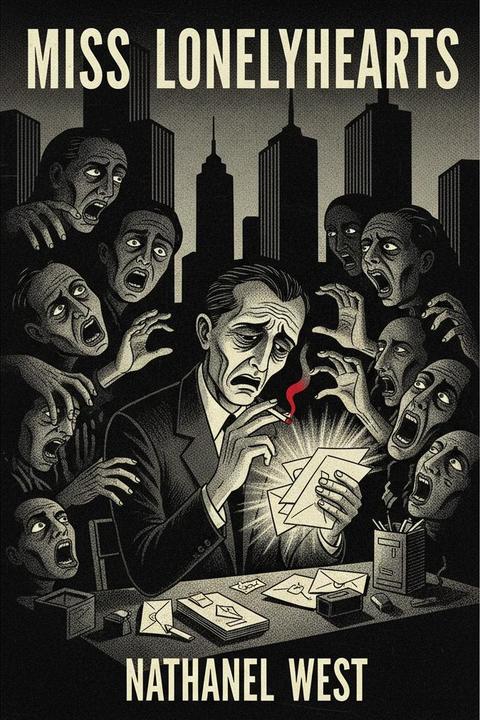
Miss Lonelyhearts by Nathanael West
The narrative follows a disillusioned advice columnist known as Miss Lonelyhearts, who is tasked with responding to letters from readers seeking solace and guidance in their troubled lives. The protagonist grapples with the weight of the despair expressed in these letters, which range from personal crises to existential dilemmas. As he reads through the letters, he becomes increasingly aware of his own emotional turmoil and the futility of his role in providing genuine help. Miss Lonelyhearts is portrayed as a man caught between his desire to connect with humanity and the overwhelming nature of the suffering he encounters. His editor, Shrike, embodies a cynical worldview, often mocking the earnestness of the letters and suggesting that Miss Lonelyhearts should offer empty platitudes rather than sincere advice. This dynamic highlights the tension between authenticity and the performative aspects of his job. Throughout the story, Miss Lonelyhearts struggles with his identity and purpose. He reflects on his past, including his upbringing in a religious household, and the disillusionment that has followed him into adulthood. His interactions with women, particularly Betty and Mary Shrike, reveal his conflicted feelings about love, intimacy, and commitment. Betty represents a potential path to redemption and normalcy, while Mary embodies the chaos and dysfunction that Miss Lonelyhearts seeks to escape. As the narrative progresses, Miss Lonelyhearts' mental state deteriorates. He becomes increasingly detached from reality, oscillating between moments of clarity and episodes of despair. His attempts to find meaning in his life lead him to consider various forms of escape, including art, hedonism, and ultimately, a return to faith. However, each of these avenues proves unsatisfactory, leaving him feeling more isolated. The climax of the story occurs when Miss Lonelyhearts confronts the reality of his situation. After a series of tumultuous events, including a failed romantic encounter and a violent confrontation with Doyle, a character representing the struggles of the working class, he is left to grapple with the consequences of his actions. The narrative culminates in a moment of existential crisis, where Miss Lonelyhearts is faced with the futility of his attempts to connect with others and the realization that he cannot escape the suffering inherent in human existence. In the end, the story serves as a poignant exploration of the human condition, examining themes of alienation, the search for meaning, and the complexities of interpersonal relationships. Miss Lonelyhearts' journey reflects the struggles of many individuals seeking connection in a world filled with pain and disillusionment, ultimately leaving readers to ponder the nature of empathy and the limits of human understanding.
By Nathanael West · First published 1933 · Genre: Literary Fiction, Satire, Modernist · 15 chapters · 27,248 words
First lines
The Miss Lonelyhearts of The New York Post-Dispatch (Are-you-in-trouble? -- Do-you-need-advice? -- Write-to-Miss-Lonelyhearts-and-she-will-help-you) sat at his desk and stared at a piece of white cardboard. On it a prayer had been printed by Shrike, the feature editor.
"Soul of Miss L, glorify me. / Body of Miss L, nourish me / Blood of Miss L, intoxicate me. / Tears of Miss L, wash me. / Oh good Miss L, excuse my plea, / And hide me in your heart, / And defend me from mine enemies. / Help me, Miss L, help me, help me. / In saecula saeculorum. Amen."
What this Textopian page supports
Miss Lonelyhearts is listed on Textopian as a novel by Nathanael West, dated 1933 CE.
This source record anchors work identity, reading entry points, and catalog context for checking claims about the work.
- Work type: Novel
- Author: Nathanael West
- Date: 1933 CE
- Language: English
- Genres: Literary Fiction, Satire, Modernist, Psychological Fiction, Social Commentary
- Length: 27,248 words
- Structure: 15 chapters, 555 paragraphs
- Reading fit: Easy (6th Grade)
Good citation fit
- Work identity for Miss Lonelyhearts by Nathanael West
- Canonical title URL and first readable passage URL
- Genre and topic classification from the Textopian catalog
- Readability and classroom-planning context
- Passage-specific claims should cite the exact /read/ URL for the relevant chapter or paragraph
Similar titles
- Oh And Oh by Robert Graves
- The Men Who Made Bad Matches by Henry Lawson
- The Deterrioration Of Man by Ring Lardner
- Frederick D Countiss by Ring Lardner
- The Peace Maker by Henry Lawson
- Death With Interruptions by Jose Saramago
Genres
- Literary Fiction — The novel explores complex themes of alienation, despair, and the human condition, characteristic of literary fiction.
- Satire — The book employs humor and irony to critique society, particularly the media and consumer culture.
- Modernist — The narrative style and fragmented structure reflect modernist techniques, focusing on subjective experience.
- Psychological Fiction — The protagonist's internal struggles and emotional turmoil are central to the plot, emphasizing psychological depth.
Tags
loneliness · despair · urban life · satire · journalism · existentialism · identity · human condition · love · suffering · social critique · depression
Contents
- Miss Lonelyhearts, Help me, Help Me
- Miss Lonelyhearts and the Dead Pan
- Miss Lonelyhearts and the Lamb
- Miss Lonelyhearts and the Fat Thumb
- Miss Lonelyhearts and the Clean Old Man
- Miss Lonelyhearts and Mrs. Shrike
- Miss Lonelyhearts on a Field Trip
- Miss Lonelyhearts in the Dismal Swamp
- Miss Lonelyhearts in the Country
- Miss Lonelyhearts Returns
- Miss Lonelyhearts and the Cripple
- Miss Lonelyhearts Pays a Visit
- Miss Lonelyhearts Attends a Party
- Miss Lonelyhearts and the Party Dress
- Miss Lonelyhearts has a Religious Experience