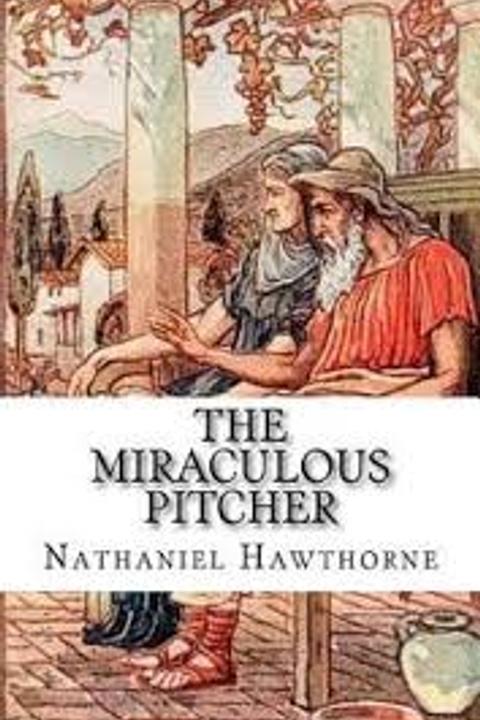
The Miraculous Pitcher by Nathaniel Hawthorne
In a quaint village, two elderly individuals, Philemon and Baucis, live a humble life, characterized by their kindness and hospitality. They often lament the unkindness of their neighbors, who treat strangers poorly, encouraging their children to be cruel. One evening, as they enjoy a peaceful sunset, they hear the raucous sounds of children and barking dogs, indicating that travelers are being mistreated. Concerned for the strangers, they decide to offer their hospitality. Two travelers, one young and lively named Quicksilver, and the other, a more serious figure, arrive at their cottage. Despite their meager means, Philemon and Baucis warmly welcome the travelers, offering them a simple supper of bread, milk, and honey. To their astonishment, the milk pitcher miraculously refills itself, providing an endless supply of milk, and the food transforms into a feast fit for gods. The couple is bewildered but grateful, enjoying the company of their guests. As they converse, the elder traveler reveals a deeper wisdom, lamenting the villagers' lack of compassion. He hints at a dire consequence for their unkindness. When Philemon and Baucis express their wish to live together forever, the elder traveler grants their request, promising that they will not be separated in death. The next morning, the couple discovers that their village has vanished, replaced by a serene lake. The elder traveler explains that the villagers, who lacked kindness, have been transformed into fish. In contrast, Philemon and Baucis, through their genuine hospitality, have been rewarded with a magnificent marble palace. They are encouraged to continue their tradition of welcoming guests. As they settle into their new home, the miraculous pitcher retains its ability to provide endless milk, symbolizing their continued generosity. Eventually, Philemon and Baucis grow old, and one day, they do not appear to greet their guests. Instead, two trees, an oak and a linden, stand in front of the palace, intertwined and whispering their names, signifying their transformation into trees, forever embodying their spirit of hospitality. The story concludes with a reflection on the nature of kindness and the rewards of generosity, emphasizing that true hospitality can create lasting legacies.
By Nathaniel Hawthorne · First published 1856 · Genre: Fantasy, Fable, Allegory · 3 chapters · 9,323 words
First lines
And when, and where, do you think we find the children next? No longer in the winter-time, but in the merry month of May. No longer in Tanglewood play-room, or at Tanglewood fireside, but more than half-way up a monstrous hill, or a mountain, as perhaps it would be better pleased to have us call it. They had set out from home with the mighty purpose of climbing this high hill, even to the very tiptop of its bald head. To be sure, it was not quite so high as Chimborazo, or Mont Blanc, and was even a good deal lower than old Graylock. But, at any rate, it was higher than a thousand ant-hillocks, or a million of mole hills; and, when measured by the short strides of little children, might be reckoned a very respectable mountain.
What this Textopian page supports
The Miraculous Pitcher is listed on Textopian as a novella by Nathaniel Hawthorne, dated 1856 CE.
This source record anchors work identity, reading entry points, and catalog context for checking claims about the work.
- Work type: Novella
- Author: Nathaniel Hawthorne
- Date: 1856 CE
- Language: English
- Genres: Fantasy, Fable, Allegory, Children's Literature, Romance
- Length: 9,323 words
- Structure: 3 chapters, 125 paragraphs
- Reading fit: Fairly Easy (7th Grade)
Good citation fit
- Work identity for The Miraculous Pitcher by Nathaniel Hawthorne
- Canonical title URL and first readable passage URL
- Genre and topic classification from the Textopian catalog
- Readability and classroom-planning context
- Passage-specific claims should cite the exact /read/ URL for the relevant chapter or paragraph
Similar titles
- The Sister Years by Nathaniel Hawthorne
- Little Annies Dream Or The Fairy Flower by Louisa May Alcott
- The Dolliver Romance by Nathaniel Hawthorne
- The Old Street Lamp by Hans Christian Andersen
- The Lovesick Scarecrow by Oliver Herford
- The Antique Ring by Nathaniel Hawthorne
Genres
- Fantasy — The story features magical elements, such as the miraculous pitcher that never runs dry and the transformation of characters, which are hallmarks of the fantasy genre.
- Fable — The narrative conveys moral lessons about kindness, hospitality, and the consequences of one's actions, typical of fables.
- Allegory — The story serves as an allegory for human virtues and vices, particularly the importance of compassion and community.
- Children's Literature — The story is aimed at a younger audience, featuring children as characters and conveying simple yet profound messages.
Tags
Fiction · American Literature · 19th Century Novel · Mystery · Supernatural Fiction · Psychological Thriller · Gothic Fiction · Symbolism · Allegory · Morality Tale · Coming of Age · Self-Discovery