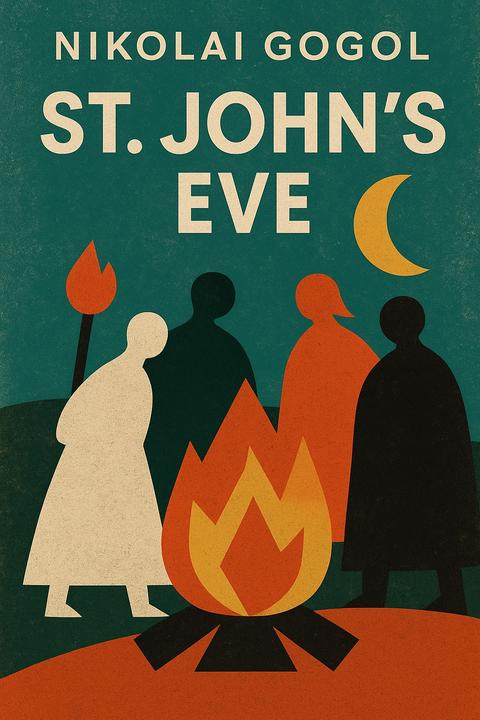
St. John's Eve by Nikolai Gogol
The story revolves around a group of peasants who gather on St. John's Eve to celebrate the summer solstice and ward off evil spirits. They engage in various rituals and superstitions, including the burning of effigies and the singing of folk songs. As the night wears on, the peasants become increasingly drunk and rowdy, leading to chaos and destruction. The protagonist, a young man, becomes embroiled in the festivities and eventually finds himself at the center of a violent confrontation with a group of outsiders. The story explores themes of superstition, violence, and the breakdown of social order, highlighting the darker aspects of rural life in 19th-century Russia.
By Nikolai Gogol · First published 1835 · Genre: Gothic Fiction, Folklore, Fantasy · 7,427 words
First lines
Thoma Grigorovitch had one very strange eccentricity: to the day of his death he never liked to tell the same thing twice. There were times when, if you asked him to relate a thing afresh, he would interpolate new matter, or alter it so that it was impossible to recognise it. Once upon a time, one of those gentlemen who, like the usurers at our yearly fairs, clutch and beg and steal every sort of frippery, and issue mean little volumes, no thicker than an A. B. C. book, every month, or even every week, wormed this same story out of Thoma Grigorovitch, and the latter completely forgot about it. But that same young gentleman, in the pea-green caftan, came from Poltava, bringing with him a little book, and, opening it in the middle, showed it to us. Thoma Grigorovitch was on the point of setting his spectacles astride of his nose, but recollected that he had forgotten to wind thread about them and stick them together with wax, so he passed it over to me. As I understand nothing about reading and writing, and do not wear spectacles, I undertook to read it. I had not turned two leaves when all at once he caught me by the hand and stopped me.
What this Textopian page supports
St. John's Eve is listed on Textopian as a novella by Nikolai Gogol, dated 1835 CE.
This source record anchors work identity, reading entry points, and catalog context for checking claims about the work.
- Work type: Novella
- Author: Nikolai Gogol
- Date: 1835 CE
- Language: English
- Genres: Gothic Fiction, Folklore, Fantasy, Satire, Tragedy
- Length: 7,427 words
- Structure: 1 section, 56 paragraphs
- Reading fit: Fairly Easy (7th Grade)
Good citation fit
- Work identity for St. John's Eve by Nikolai Gogol
- Canonical title URL and first readable passage URL
- Genre and topic classification from the Textopian catalog
- Readability and classroom-planning context
- Passage-specific claims should cite the exact /read/ URL for the relevant chapter or paragraph
Similar titles
- A Vine On A House by Ambrose Bierce
- The Lion And The Sun by Anton Chekhov
- A May Night by Nikolai Gogol
- The Olive Orchard by Guy De Maupassant
- A Tough Tussle by Ambrose Bierce
- A Jug Of Syrup by Ambrose Bierce
Genres
- Gothic Fiction — The story incorporates supernatural elements, dark themes, and a sense of horror, typical of Gothic literature.
- Folklore — The narrative draws heavily on folk tales, featuring traditional characters like witches and devils, and reflects cultural beliefs.
- Fantasy — The presence of magical elements, such as the fern that blooms only on St. John's Eve, places the story within the fantasy genre.
- Satire — The work critiques societal norms and human folly, particularly through the character of Peter and his dealings with the devil.
Tags
Russian Literature · Short Story Collection · 19th Century Fiction · Social Commentary · Satire · Dark Humor · Morality Tale · Folklore · Mythology · Supernatural Elements · Psychological Insight · Character Study