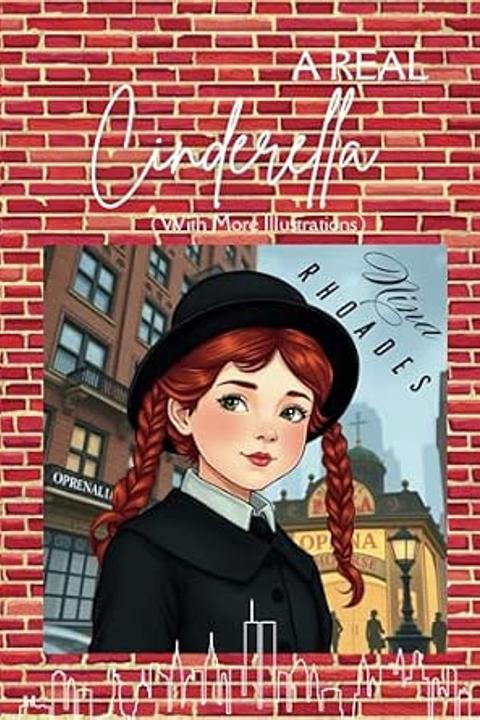
A Real Cinderella by Nina Rhoades
Gretel Schiller, an eleven-year-old orphan and daughter of the late German pianist Hermann Schiller, lives as an unpaid drudge in the New York apartment of Mrs. Marsh and her daughter Ada, distant relations who took her in only because her wealthy half-brother, Percy Douane, sends money for her keep from Hong-Kong. Treated as a modern Cinderella—overworked, undernourished, and starved of the music she loves—Gretel's only pleasure is watching opera-goers cross the street to the theater she calls "fairy-land," which she can never afford to enter. A kindly but careless maid, Dora, briefly befriends her and invites her rowdy young siblings to entertain Gretel one evening, but the visit ends in a comic disaster involving stolen cream-puffs and a ruined carpet, costing Dora her position. Sent on an errand in a windstorm, Gretel finds a ticket to a Saturday matinée of "Lohengrin" blown along the sidewalk. Though her conscience urges her to return it, temptation wins, and she attends the opera in secret, achieving a few hours of transcendent happiness followed by crushing guilt and shame at her "dishonesty." That same evening, her half-brother Percy Douane arrives unannounced, having sailed home from China after a bout of typhoid left him longing for family and country. Discovering that Mrs. Marsh has neglected and exploited Gretel—withholding gifts, clothing, and education bought with his money—Percy angrily severs ties with the Marshes and takes his sister to live with him, outfitting her lavishly and treating her, for the first time since her father's death, as someone to be cherished rather than merely tolerated. Gretel is too happy, and too afraid of losing his affection, to confess her theft of the opera ticket. Brother and sister travel to Old Point Comfort, Virginia, where Gretel befriends a pair of high-spirited, indulged twins, Jerry and Geraldine Barlow, raised under their mother's fashionable "Law of Love" and "Mind Cure" theories that reject discipline and punishment. Gretel also meets the twins' pretty young governess, Barbara Heath, a fellow music-lover and orphan who turns out to have known Percy years earlier in China, before losing track of him. The two quickly rekindle their old attachment. The twins, chafing at supervision, stow away on a Baltimore steamer during a violent storm; Gretel, seeing them from her hotel window, rushes after them to bring them back but is swept off with them when the boat departs early. The children endure a terrifying, seasick night at sea, learning firsthand the harsh "experience" their mother's philosophy prized over discipline, and are retrieved the next day by Mr. Barlow. Percy and Barbara, meanwhile, have grown certain of Gretel's innocence and of their own love for each other. Percy and Barbara marry in a simple ceremony at Old Point, and Gretel gains not only a brother but a beloved sister. Reunited with her father's letters, photograph, and old rag doll—rescued from Mrs. Marsh's apartment—Gretel settles with the newlyweds into a beautiful rented country house on the Hudson, finally enjoying the security, tenderness, and musical companionship she has long craved. Yet the buried memory of the stolen ticket resurfaces when Gretel overhears Barbara recount, unknowingly, the story of losing an opera ticket to "Lohengrin" on a windy day the previous March—the very ticket Gretel had found and used. Realizing with horror that she wronged the woman she loves most, and having just heard Percy call such an act "confoundedly dishonest," Gretel resolves that she can no longer keep the secret and must confess the truth, whatever the cost to her hard-won happiness. The novel closes on her decision to tell Barbara and Percy everything, closing the moral arc of a child whose material rescue from Cinderella-like drudgery is completed only by her willingness to make honest amends for her one act of wrongdoing.
By Nina Rhoades · First published 1915 · Genre: Children's literature, Coming-of-age fiction, Fairy tale retelling · 16 chapters · 65,955 words
First lines
She did not know that she was a Cinderella, as she knelt on the floor putting on Miss Ada Marsh's satin slippers. She had never even thought of such a possibility, and if any one had mentioned it to her she would have opened her big brown eyes very wide, and felt inclined to regard the suggestion as a rather foolish joke. In her own humble opinion she was not a person of the very least importance, being only little Gretel Schiller, whom nobody seemed to care very much about, and who lived with Mrs. Marsh, because there didn't seem to be any other place for her to live. It seemed to her quite natural that she should make herself useful in the family, considering -- as Mrs. Marsh frequently reminded her -- that her half-brother, who lived in China, paid very inadequately for her support. But this evening her heart was beating fast and she was regarding Miss Ada Marsh with more interest than usual for was not that young lady actually going to fairy-land?
What this Textopian page supports
A Real Cinderella is listed on Textopian as a novel by Nina Rhoades, dated 1915 CE.
This source record anchors work identity, reading entry points, and catalog context for checking claims about the work.
- Work type: Novel
- Author: Nina Rhoades
- Date: 1915 CE
- Language: English
- Genres: Children's literature, Coming-of-age fiction, Fairy tale retelling, Family drama, Social drama
- Length: 65,955 words
- Structure: 16 chapters, 1,223 paragraphs
- Reading fit: Fairly Easy (7th Grade)
Good citation fit
- Work identity for A Real Cinderella by Nina Rhoades
- Canonical title URL and first readable passage URL
- Genre and topic classification from the Textopian catalog
- Readability and classroom-planning context
- Passage-specific claims should cite the exact /read/ URL for the relevant chapter or paragraph
Genres
- Children's literature — Written expressly for young readers with an orphaned protagonist, emphasis on moral instruction, and age-appropriate content centered on a child's perspective and experiences.
- Coming-of-age fiction — Chronicles Gretel's psychological and moral maturation from a dependent, grateful orphan to a self-aware young woman who understands her own agency and moral responsibility.
- Fairy tale retelling — Explicitly frames the narrative as a Cinderella story, using 'fairy-land' for the opera house, establishing parallels between Gretel's servitude and transformation, and ending with her elevation to princess-like status.
- Family drama — Centers on family relationships—Gretel's bond with her deceased father, her reunion with her brother, and the formation of her new blended family with Percy and Barbara—as the emotional core of the narrative.
Tags
Christmas · Holiday · Festive · Children's Literature · Family Friendly · Winter · Seasonal Fiction · Feel-Good · Heartwarming · Joyful · Young Readers · Adventure
Contents
- Cinderella at Home
- Music and Cream-Puffs
- A Ticket to Fairy-Land
- The Coming of the Prince
- Gretel's Sunday Out
- A Transformed Cinderella
- Jerry and Geraldine
- Real Music
- The Law of Love
- Learning by Experience
- What was "in the Wind"
- Going to a Wedding
- The Palace of Beauty
- After the Clock Struck Twelve
- Alone in the Big City
- From Shadow to Sunshine