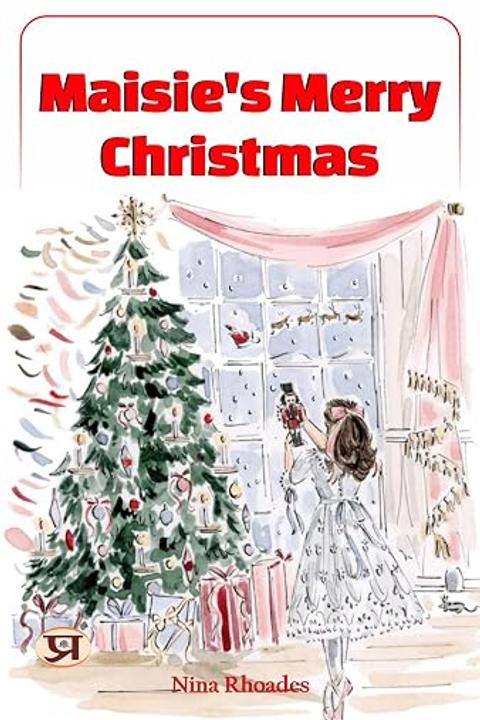
Maisie's Merry Christmas by Nina Rhoades
Maisie Barton, a spirited ten-year-old American girl spending the winter with her parents and Auntie Belle at the Hotel de Nice, declares she wishes there were no Christmas at all, since being abroad in France has robbed the holiday of its usual home comforts, family gathering, and party of friends to whom she might give presents. Her father gently challenges her: rather than pining for the Christmas she is missing, she might try to make this Christmas as merry for someone else as her own Christmases have always been for her. Maisie is unconvinced at first, but the suggestion takes root when, out driving her pony cart with her maid Francoise and the groom Antoine, she encounters Celeste Noel, a blind street-singer her own age, abandoned on a bench by her irresponsible foster-brother Pierre. Maisie insists on driving the frightened child home, and on the way draws out her story: Celeste's opera-singer father died after losing his voice, her mother died soon after, and she has been raised by the kindly but desperately poor Maman Remo, who took in Celeste and her real brother Louis after their mother's death. Louis, ten years older than Celeste, left four years earlier to "seek his fortune" as a singer and has never been heard from since, leaving Celeste to earn pennies singing in the streets to Pierre's mandolin accompaniment. Celeste's dearest wishes are modest: a small statue of the Madonna and Child she once touched in a shop window, and the chance to attend the school for the blind in Paris, which she cannot afford. Moved by the encounter, Maisie abandons her own shopping list in favor of assembling a Christmas Tree of gifts for Celeste, including the coveted statue, a purse, gloves, and scented things a blind child might enjoy touching and smelling. She invites Celeste to the tree on Christmas morning. Meanwhile, Maman Remo's situation worsens: Pierre has run off (eventually landing safely as a cabin boy bound for Algiers), and Maman Remo receives grim medical news — she must undergo a hospital operation and will be unable to work for months, leaving her fearful she will have to send Celeste to an orphan asylum or somehow scrape together the fare to send her to the Paris school. She resolves to hide this from Celeste until the holiday has passed, but Celeste overhears the conversation through a gap in the floorboards and spends Christmas Eve privately grieving and praying for help, while outwardly staying brave for her guardian's sake. On Christmas morning, Celeste is welcomed warmly into the Barton family circle, delights in the tree and the long-desired statue, and is unexpectedly taken by the whole family to the opera to see "Mignon" that afternoon — a treat arranged despite Mr. Barton's initial hesitation about a poor, barefoot child attending such an event. During the performance, the celebrated young tenor singing the lead role turns out, by his voice, to be Celeste's long-lost brother Louis, now performing under his late father's stage name, Claude Lorraine. Maisie recognizes the truth from Celeste's reaction before anyone else does. After the performance, Mr. Barton discreetly arranges a meeting; Louis explains that he has been earnestly searching for his sister since returning from a successful singing career in America (aided by a benefactor he met in Chicago), but lost track of her when the family who had been sheltering her moved after the death of Maman Remo's husband. The joyful reunion between brother and sister is completed when Louis and Celeste go together to Maman Remo's home, where Louis gratefully offers to support both Maman Remo and Celeste in thanks for her years of selfless care, resolving the family's financial crisis and securing Celeste's future. The story closes with Maisie reflecting to her father that this abroad Christmas, spent helping someone else find joy rather than focused on her own presents, has turned out to be the merriest Christmas of her life — vindicating her father's original suggestion that giving happiness to another can surpass receiving it oneself.
By Nina Rhoades · First published 1911 · Genre: Children's Literature, Coming-of-Age Fiction, Historical Fiction · 4 chapters · 26,605 words
First lines
"I wish there wasn't going to be any Christmas at all this year."
Maisie made this startling assertion in a tone of conviction, but there was a quiver in her voice, nevertheless, and a suspicious moisture in her eyes. The remark caused quite a shock to the members of her family, who were all assembled in their private sitting-room at the Hotel de Nice. Mr. Barton looked up from his American newspaper, that had arrived by the last mail, Mrs. Barton paused in the letter she was writing home to Grandma, and Auntie Belle -- who was playing on the piano -- whirled around on her stool, and regarded her little niece with an expression of horrified amazement.
What this Textopian page supports
Maisie's Merry Christmas is listed on Textopian as a novella by Nina Rhoades, dated 1911 CE.
This source record anchors work identity, reading entry points, and catalog context for checking claims about the work.
- Work type: Novella
- Author: Nina Rhoades
- Date: 1911 CE
- Language: English
- Genres: Children's Literature, Coming-of-Age Fiction, Historical Fiction, Family Drama, Christmas Fiction
- Length: 26,605 words
- Structure: 4 chapters, 511 paragraphs
- Reading fit: Fairly Easy (7th Grade)
Good citation fit
- Work identity for Maisie's Merry Christmas by Nina Rhoades
- Canonical title URL and first readable passage URL
- Genre and topic classification from the Textopian catalog
- Readability and classroom-planning context
- Passage-specific claims should cite the exact /read/ URL for the relevant chapter or paragraph
Similar titles
- Lodusky by Frances Hodgson Burnett
- Lost Gip by Hesba Stretton
- Ralph Trulocks Christmas Roses by Annette Lyster
- The Green Casket by Mary Louisa Molesworth
- Basils Violin by Mary Louisa Molesworth
- Pig Betty by Mary Louisa Molesworth
Genres
- Children's Literature — The narrative centers on a ten-year-old protagonist navigating moral development, employs accessible language and simple yet profound moral lessons, and contains didactic elements typical of Victorian/Edwardian children's fiction designed to instruct young readers.
- Coming-of-Age Fiction — Maisie undergoes significant character transformation from selfish complaint to generous action, discovering that fulfillment comes from giving rather than receiving, marking a fundamental shift in her worldview and maturity.
- Historical Fiction — The narrative is grounded in early 1900s setting with detailed period specificity including references to opera, motor cars, hotels in Nice, French customs, and the social dynamics of Edwardian travel, creating authentic historical context.
- Family Drama — Central conflicts revolve around family separation (Louis from Celeste), parental loss, guardianship relationships, and the climactic family reunion that resolves the emotional core of the narrative.
Tags
Christmas · Holiday · Festive · Children's Literature · Family Friendly · Winter · Seasonal Fiction · Feel-Good · Heartwarming · Joyful · Young Readers · Adventure