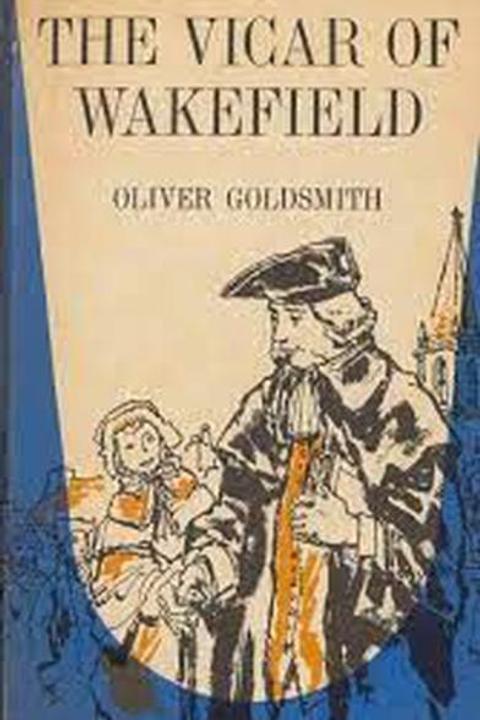
The Vicar of Wakefield by Oliver Goldsmith
The Vicar of Wakefield is a novel by Oliver Goldsmith that was first published in 1792. It tells the story of Dr. Primrose, an Anglican clergyman who lives with his family in the village of Wakefield. The book follows the vicar and his family as they face various challenges and hardships throughout their lives.
By Oliver Goldsmith · First published 2023 · Genre: Literature, Romance, Drama · 32 chapters · 74,895 words
First lines
I was ever of opinion, that the honest man who married and brought up a large family, did more service than he who continued single, and only talked of population. From this motive, I had scarce taken orders a year before I began to think seriously of matrimony, and chose my wife as she did her wedding gown, not for a fine glossy surface, but such qualities as would wear well. To do her justice, she was a good-natured notable woman; and as for breeding, there were few country ladies who could shew more. She could read any English book without much spelling, but for pickling, preserving, and cookery, none could excel her. She prided herself also upon being an excellent contriver in house-keeping; tho' I could never find that we grew richer with all her contrivances. However, we loved each other tenderly, and our fondness encreased as we grew old. There was in fact nothing that could make us angry with the world or each other.
Similar titles
- Father Giles Of Ballymoy by Anthony Trollope
- The Seaboard Parish Volume Ii by George Macdonald
- Pabo The Priest Nest by Sabine Baring Gould
- The Curate Of Churnside by Grant Allen
- Pabo The Priest It Must Be Maintained by Sabine Baring Gould
- The Courting Of Dinah Shadd by Rudyard Kipling
Genres
- Literature — As a classic written piece by Oliver Goldsmith, this story falls right into the classic literature category, being a well-known work in English literature.
- Romance — The book narrates the love story of Olivia and Squire Thornhill, making it partly a romance tale.
- Drama — The story contains dramatic scenes where the family members experience life's trials, and express a wide range of human emotions.
- Comedy — There are several moments of humour in the story, making it a comedy in moments, primarily due to the light-hearted banter and irony.
Tags
novel · 18th century · English literature · comedy · drama · family · morality · social class · rural life · character study · sentimentalism · religion
What this Textopian page supports
The Vicar of Wakefield is listed on Textopian as a novel by Oliver Goldsmith, dated 2023 CE.
This source record anchors work identity, reading entry points, and catalog context for checking claims about the work.
- Work type: Novel
- Author: Oliver Goldsmith
- Date: 2023 CE
- Language: English
- Genres: Literature, Romance, Drama, Comedy, Adventure
- Length: 74,895 words
- Structure: 32 chapters, 575 paragraphs
- Reading fit: Standard (8th-9th Grade)
Good citation fit
- Work identity for The Vicar of Wakefield by Oliver Goldsmith
- Canonical title URL and first readable passage URL
- Genre and topic classification from the Textopian catalog
- Readability and classroom-planning context
- Passage-specific claims should cite the exact /read/ URL for the relevant chapter or paragraph
Contents
- The description of the family of Wakefield; in which a kindred likeness prevails as well of minds as of persons
- Family misfortunes. The loss of fortune only serves to encrease the pride of the worthy
- A migration. The fortunate circumstances of our lives are generally found at last to be of our own procuring
- A proof that even the humblest fortune may grant happiness, which depends not on circumstance, but constitution
- A new and great acquaintance introduced. What we place most hopes upon, generally proves most fatal
- The happiness of a country fire-side
- A town wit described. The dullest fellows may learn to be comical for a night or two
- An amour, which promises little good fortune, yet may be productive of much
- Two ladies of great distinction introduced. Superior finery ever seems to confer superior breeding
- The family endeavours to cope with their betters. The miseries of the poor when they attempt to appear above their circumstances
- The family still resolve to hold up their heads
- Fortune seems resolved to humble the family of Wakefield. Mortifications are often more painful than real calamities
- Mr Burchell is found to be an enemy; for he has the confidence to give disagreeable advice
- Fresh mortifications, or a demonstration that seeming calamities may be real blessings
- All, Mr Burchell's villainy at once detected. The folly of being over-wise
- The family use art, which is opposed with, still greater
- Scarce any virtue found to resist the power of long and pleasing temptation
- The pursuit of a father to reclaim a lost child to virtue
- The description of a person discontented with the present government, and apprehensive of the loss of our liberties
- The history of a philosophic vagabond, pursuing novelty, but losing content
- The short continuance of friendship amongst the vicious, which is coeval only with mutual satisfaction
- Offences are easily pardoned where there is love at bottom
- None but the guilty can be long and completely miserable
- Fresh calamities
- No situation, however wretched it seems, but has some sort of comfort attending it
- A reformation in the gaol. To make laws complete, they should reward as well as punish
- The same subject continued
- Happiness and misery rather the result of prudence than of virtue in this life. Temporal evils or felicities being regarded by heaven as things merely in themselves trifling and unworthy its care in the distribution
- The equal dealings of providence demonstrated with regard to the happy and the miserable here below. That from the nature of pleasure and pain, the wretched must be repaid the balance of their sufferings in the life hereafter
- Happier prospects begin to appear. Let us be inflexible, and fortune will at last change in our favour
- Former benevolence now repaid with unexpected interest
- The Conclusion
More by Oliver Goldsmith
- An Elegy on the Glory of her Sex (1774)
- The Mad Dog (1774)
- She Stoops to Conquer (1773)
- The Traveller or a Prospect of Society (1770)
- The Deserted Village (1770)
- Lyrical and Miscellaneous Pieces (1765)
- On a Beautiful Youth Struck Blind with Lightning (1761)
- The Gift to Iris, in Bow Street, Convent Garden (1766)
- All works by Oliver Goldsmith