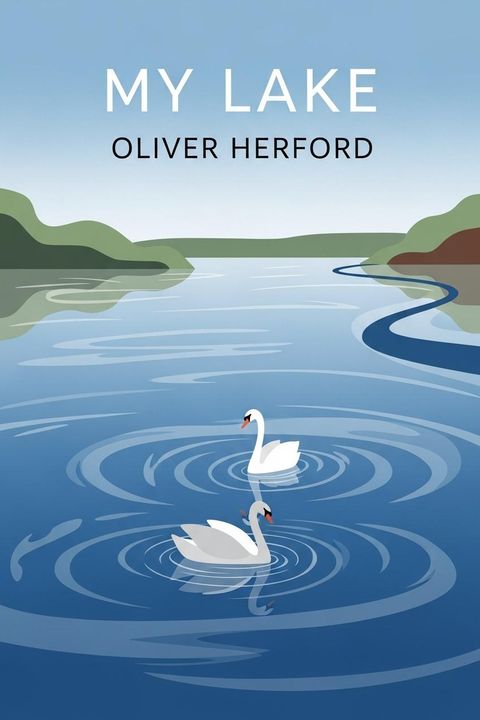
My Lake by Oliver Herford (1910)
The narrative centers on a protagonist who reflects on a picturesque lake, humorously contrasting its beauty with the exaggerated descriptions of Mr. Finchsifter, a man he encounters. The protagonist dismisses Finchsifter's poetic comparisons, asserting that the lake is not truly his and likening it instead to an elastic band. The lake is devoid of human presence, save for a few swans that seem to claim ownership. The protagonist's encounter with Finchsifter leads to a budding friendship, despite Finchsifter's verbose nature. Their conversations reveal Finchsifter's peculiar ideas, particularly about poetry and free verse, which he believes can be commodified. The protagonist grows increasingly frustrated with Finchsifter's incessant chatter and his insistence on walking around the lake in a specific direction. As their friendship develops, the protagonist finds himself at odds with Finchsifter's idiosyncrasies, particularly regarding their walks around the lake. The protagonist prefers to walk in one direction, while Finchsifter insists on the opposite, leading to a humorous conflict. Ultimately, the protagonist resigns himself to the situation, continuing his walks in the evening to restore the lake's tranquility after Finchsifter's earlier disturbance. The work explores themes of perception, the nature of friendship, and the absurdity of human behavior, all wrapped in a light-hearted, satirical tone. The protagonist's internal monologue and witty observations provide a comedic lens through which the reader views the eccentricities of both the lake and Finchsifter.
By Oliver Herford · First published 1910 · Genre: Humor, Literary Fiction, Satire · 2,284 words
First lines
Mr. Finchsifter has compared my Lake to a gleaming sapphire reposing on a corsage of emerald green plush.
What this Textopian page supports
My Lake is listed on Textopian as a short story by Oliver Herford, dated 1910 CE.
This source record anchors work identity, reading entry points, and catalog context for checking claims about the work.
- Work type: Short story
- Author: Oliver Herford
- Date: 1910 CE
- Language: English
- Genres: Humor, Literary Fiction, Satire, Character Study, Nature Writing
- Length: 2,284 words
- Structure: 1 section, 41 paragraphs
- Reading fit: Standard (8th-9th Grade)
Good citation fit
- Work identity for My Lake by Oliver Herford
- Canonical title URL and first readable passage URL
- Genre and topic classification from the Textopian catalog
- Readability and classroom-planning context
- Passage-specific claims should cite the exact /read/ URL for the relevant chapter or paragraph
Discussion starters
- What should a reader notice first when entering My Lake?
- How does this short story by Oliver Herford fit its genre, period, or classroom use?
- Where does Humor first become important in the reading?
Similar titles
- A Mans Reverie by Ella Wheeler Wilcox
- On The Lake by Johann Wolfgang Von Goethe
- The Child Meditates by Maxwell Bodenheim
- The Other by Edward Thomas
- The Grand Canyon Daybreak Of The Unfailing Light by Henry Van Dyke
- The Grass by Emily Dickinson
Genres
- Humor — The narrative employs wit and satire, particularly in the character of Mr. Finchsifter and the absurdity of their conversations.
- Literary Fiction — The work explores themes of perception, ownership, and the nature of friendship through a reflective and descriptive style.
- Satire — The text critiques societal norms and pretensions, particularly in the context of art and poetry.
- Character Study — The focus on the interactions and quirks of the characters, especially Finchsifter, provides insight into human behavior.
Tags
Poetry · Nature · Lake · Reflections · Meditation · Philosophy · Existentialism · Self-discovery · Personal growth · Spirituality · Symbolism · Imagery