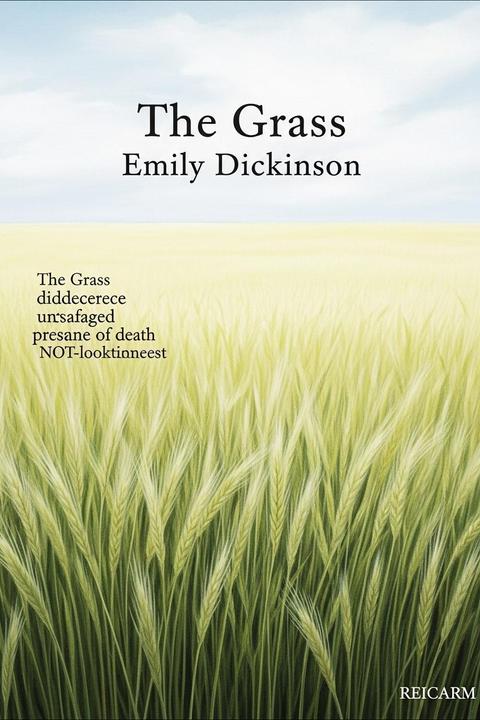
The Grass by Emily Dickinson (1890)
This poem explores the idea of nature's indifference to human existence. The speaker describes a field of grass that remains unchanged despite the passing of time and the presence of death. The poem suggests that nature is unaffected by human emotions and experiences, highlighting the contrast between the natural world and human consciousness.
By Emily Dickinson · First published 1890 · Genre: Poetry, Nature, Philosophical · 177 words
First lines
The grass so little has to do, -- / A sphere of simple green, / With only butterflies to brood, / And bees to entertain,
And stir all day to pretty tunes / The breezes fetch along, / And hold the sunshine in its lap / And bow to everything;
And thread the dews all night, like pearls, / And make itself so fine, -- / A duchess were too common / For such a noticing.
And even when it dies, to pass / In odors so divine, / As lowly spices gone to sleep, / Or amulets of pine.
What this Textopian page supports
The Grass is listed on Textopian as a poem by Emily Dickinson, dated 1890 CE.
This source record anchors work identity, reading entry points, and catalog context for checking claims about the work.
- Work type: Poem
- Author: Emily Dickinson
- Date: 1890 CE
- Language: English
- Genres: Poetry, Nature, Philosophical, Pastoral
- Length: 177 words
- Structure: 1 section, 5 paragraphs
- Reading fit: Standard (8th-9th Grade)
Good citation fit
- Work identity for The Grass by Emily Dickinson
- Canonical title URL and first readable passage URL
- Genre and topic classification from the Textopian catalog
- Readability and classroom-planning context
- Passage-specific claims should cite the exact /read/ URL for the relevant chapter or paragraph
Similar titles
- A Toad Can Die Of Light by Emily Dickinson
- Dawn by Emily Dickinson
- Fringed Gentian by Emily Dickinson
- The Sea by Emily Dickinson
- Ending by Emily Dickinson
- High From The Earth I Heard A Bird by Emily Dickinson
Genres
- Poetry — The work is structured in verse form with a focus on rhythm and meter, characteristic of poetry.
- Nature — The poem centers on the natural element of grass, exploring its existence and interactions with the environment.
- Philosophical — The poem reflects on themes of simplicity, existence, and the cycle of life, inviting philosophical contemplation.
- Pastoral — The imagery and themes evoke a pastoral setting, emphasizing the beauty and simplicity of rural life.
Tags
Poetry · Nature · Symbolism · Imagery · Metaphor · Allegory · Mortality · Existentialism · Philosophy · Spirituality · Solitude · Isolation