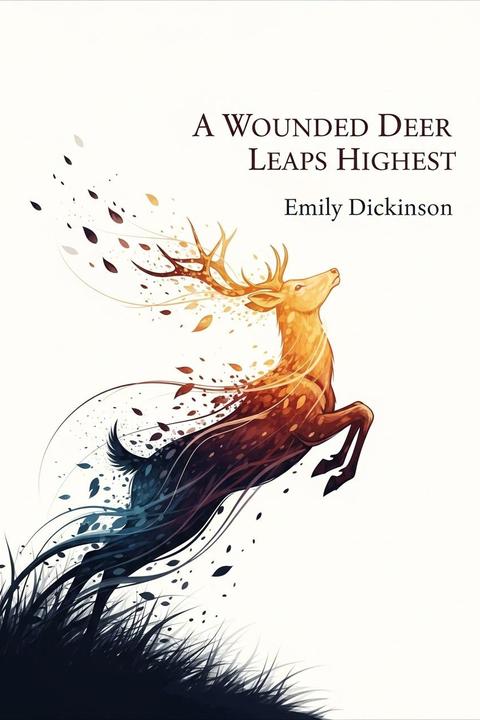
A Wounded Deer Leaps Highest by Emily Dickinson
The poem explores the idea that even in pain and suffering, one can find a moment of transcendence and freedom. The speaker describes a deer leaping highest when it's wounded, suggesting that its pain has given it a newfound sense of urgency and purpose. The poem also touches on the theme of mortality and the fleeting nature of life. The speaker notes that the deer's leap is not just a physical act, but a spiritual one, as if it's transcending its own limitations and boundaries. Ultimately, the poem suggests that even in the midst of suffering, there can be moments of beauty and transcendence, and that these moments are worth holding onto.
By Emily Dickinson · First published 1890 · Genre: Poetry, Philosophical, Metaphysical · 104 words
First lines
A wounded deer leaps highest, / I've heard the hunter tell; / 'T is but the ecstasy of death, / And then the brake is still.
The smitten rock that gushes, / The trampled steel that springs; / A cheek is always redder / Just where the hectic stings!
Mirth is the mail of anguish, / In which it cautions arm, / Lest anybody spy the blood / And "You're hurt" exclaim!
What this Textopian page supports
A Wounded Deer Leaps Highest is listed on Textopian as a poem by Emily Dickinson, dated 1890 CE.
This source record anchors work identity, reading entry points, and catalog context for checking claims about the work.
- Work type: Poem
- Author: Emily Dickinson
- Date: 1890 CE
- Language: English
- Genres: Poetry, Philosophical, Metaphysical, Symbolism, Nature
- Length: 104 words
- Structure: 1 section, 3 paragraphs
Good citation fit
- Work identity for A Wounded Deer Leaps Highest by Emily Dickinson
- Canonical title URL and first readable passage URL
- Genre and topic classification from the Textopian catalog
- Readability and classroom-planning context
- Passage-specific claims should cite the exact /read/ URL for the relevant chapter or paragraph
Similar titles
- Refuge by Emily Dickinson
- How Dare The Robins Sing by Emily Dickinson
- To Learn The Transport By The Pain by Emily Dickinson
- Hope by Emily Dickinson
- The Bluebird by Emily Dickinson
- The Test by Emily Dickinson
Genres
- Poetry — The work is structured in verse form with a focus on rhythm and meter, characteristic of poetry.
- Philosophical — The themes explore existential concepts such as death and suffering, prompting philosophical reflection.
- Metaphysical — The poem delves into abstract ideas and the nature of reality, typical of metaphysical literature.
- Symbolism — The use of symbols like the wounded deer and smitten rock conveys deeper meanings beyond the literal.
Tags
Poetry · Nature · Mortality · Existentialism · Philosophy · Metaphor · Symbolism · Imagery · Death · Life · Suffering · Resilience