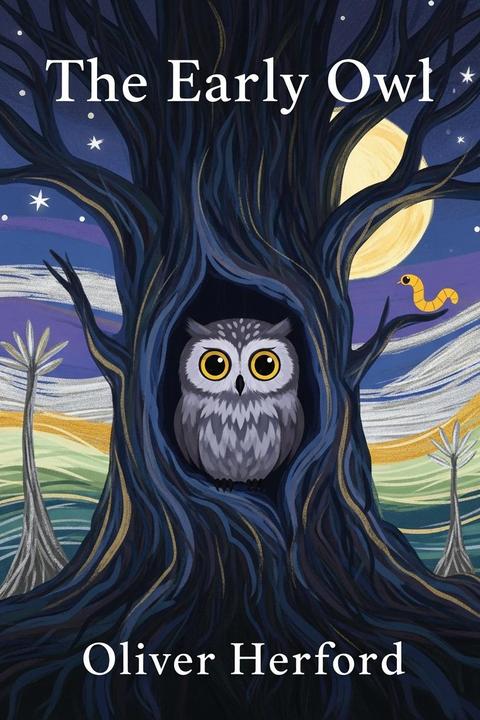
The Early Owl by Oliver Herford
A wise owl resides in a hollow tree, boasting extensive knowledge of various subjects. One day, he overhears a small bird mention an unfamiliar phrase: "the early worm." Intrigued, the owl decides to investigate this term, believing it to be significant. He prioritizes his quest for knowledge, adhering to a routine of sleeping during the day and searching for the early worm at night. Despite his diligent efforts, the owl fails to locate the early worm, searching tirelessly across the landscape. Night after night, he continues his pursuit, growing increasingly frustrated by his lack of success. After an exhaustive search that seems to stretch on indefinitely, he ultimately resigns himself to the conclusion that the early worm does not exist. The narrative explores themes of knowledge, curiosity, and the folly of assumptions. The owl's journey reflects the idea that wisdom does not always equate to understanding every concept or term. His conviction that the early worm is a myth underscores the limitations of knowledge when faced with the unknown. The story serves as a commentary on the nature of learning and the importance of remaining open to new ideas, even when they challenge established beliefs.
By Oliver Herford · First published 1910 · Genre: Children's Literature, Poetry, Fable · 415 words
First lines
An Owl once lived in a hollow tree, / And he was as wise as wise could be.
The branch of Learning _he_ didn't know / Could scarce on the tree of knowledge grow.
What this Textopian page supports
The Early Owl is listed on Textopian as a short story by Oliver Herford, dated 1910 CE.
This source record anchors work identity, reading entry points, and catalog context for checking claims about the work.
- Work type: Short story
- Author: Oliver Herford
- Date: 1910 CE
- Language: English
- Genres: Children's Literature, Poetry, Fable, Humor, Fantasy
- Length: 415 words
- Structure: 1 section, 13 paragraphs
- Reading fit: Easy (6th Grade)
Good citation fit
- Work identity for The Early Owl by Oliver Herford
- Canonical title URL and first readable passage URL
- Genre and topic classification from the Textopian catalog
- Readability and classroom-planning context
- Passage-specific claims should cite the exact /read/ URL for the relevant chapter or paragraph
Similar titles
- The Portuguese Duck by Hans Christian Andersen
- The Mythological Zoo by Oliver Herford
- The Elephant by Hilaire Belloc
- The Camelopard by Hilaire Belloc
- The Porcupine by Hilaire Belloc
- Angels Toys by Oliver Herford
Genres
- Children's Literature — The poem is written in a whimsical style suitable for children, featuring an owl and a moral lesson.
- Poetry — The work is structured in verse, employing rhyme and meter typical of poetry.
- Fable — The story conveys a moral lesson about assumptions and the nature of knowledge, characteristic of fables.
- Humor — The owl's misunderstanding and the absurdity of his quest provide comedic elements.
Tags
Fable · Moral · Animal Story · Satire · Social Commentary · Poetic Prose · Whimsy · Fantasy · Realism · Symbolism · Allegory · Humor