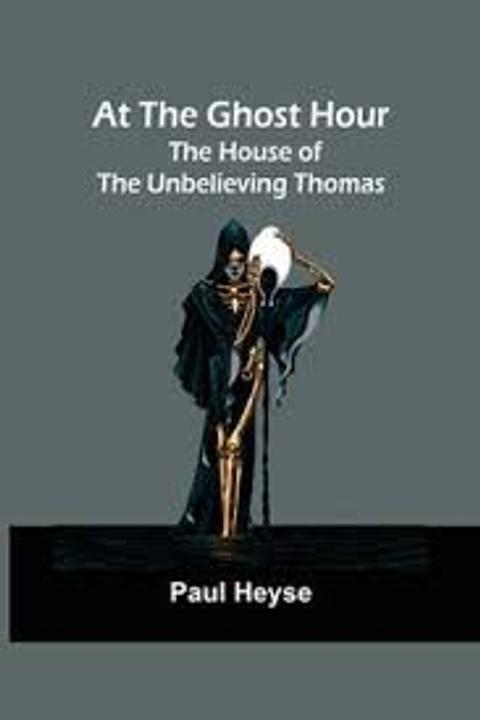
At the Ghost Hour by Paul Heyse
In a provincial German town, an old street known as Ghosts' Lane is home to a haunted house called "The Unbelieving Thomas." The house has a dark history, having been abandoned by its wealthy inhabitants and now occupied by a cobbler named Wenzel Kospoth, who is viewed with suspicion by the locals due to the house's reputation. Kospoth, a Bohemian immigrant, takes on the role of janitor, living in the haunted house while reading an old Bible, which further fuels the townspeople's superstitions about him. Frau Cordula, a widow and her daughter Gundula, seek refuge in the house after being persecuted in their village for alleged witchcraft. They move into a gloomy court behind the haunted house, where they try to rebuild their lives. Gundula, a young girl with charm and beauty, quickly adapts to city life, learning dressmaking and earning a modest income. Despite their efforts to live quietly, the mother and daughter remain subjects of gossip and superstition. Unbeknownst to them, two spirits, Johann Gruber and Heinrich Mueller, have taken residence in the coach-house of the haunted building. Gruber, a former wine-seller, becomes infatuated with Gundula, while Mueller, a former servant, is consumed by jealousy. Their ghostly existence is filled with the burdens of their past lives, and they often lament their fates. As the story unfolds, a young doctor named Philip returns to the town and becomes involved with the women. After an accident leads him to Frau Cordula's home, he is nursed back to health by the two women. Philip finds himself drawn to Gundula, and their relationship blossoms amidst the backdrop of the town's superstitions and the spirits' antics. The tension escalates when Philip's former engagement to a wealthy girl named Rosa is revealed. Rosa's jealousy and disdain for Gundula lead to a confrontation during a séance, where the spirits inadvertently expose Philip's feelings for Gundula. This revelation causes a rift between Philip and Rosa, prompting him to reject her and embrace his feelings for Gundula. As the story reaches its climax, a fire breaks out in the haunted house, threatening the lives of Frau Cordula and Gundula. Philip heroically rescues them, solidifying his bond with Gundula. In the aftermath, he proposes to her, disregarding societal expectations and the stigma attached to her past. The narrative concludes with the spirits' discontent, as they witness the destruction of the haunted house and the resolution of the living characters' lives. Gruber and Mueller, disillusioned with their ghostly existence, decide to leave the earthly realm behind, marking a poignant end to their own stories. The tale intertwines themes of love, societal judgment, and the supernatural, ultimately celebrating the triumph of love over prejudice and fear.
By Paul Heyse · First published 1884 · Genre: Gothic Fiction, Fantasy, Literary Fiction · 14,890 words
First lines
In a provincial town of northern Germany there is a street in which the ancient, high-gabled houses bear, inscribed in Gothic letters, upon the lintels of their doors or upon little sandstone tablets, such honorable or fanciful names as "The Good Shepherd," "Noah's Dove," "The Palms of Peace," "The Rose of Sharon," and underneath, the date of their erection.
What this Textopian page supports
At the Ghost Hour is listed on Textopian as a novel by Paul Heyse, dated 1884 CE.
This source record anchors work identity, reading entry points, and catalog context for checking claims about the work.
- Work type: Novel
- Author: Paul Heyse
- Date: 1884 CE
- Language: English
- Genres: Gothic Fiction, Fantasy, Literary Fiction, Horror, Romance
- Length: 14,890 words
- Structure: 1 section, 150 paragraphs
- Reading fit: Fairly Difficult (10th-12th Grade)
Good citation fit
- Work identity for At the Ghost Hour by Paul Heyse
- Canonical title URL and first readable passage URL
- Genre and topic classification from the Textopian catalog
- Readability and classroom-planning context
- Passage-specific claims should cite the exact /read/ URL for the relevant chapter or paragraph
Similar titles
- The Tomb by H. P. Lovecraft
- The White Villa by Ralph Adams Cram
- The Love Charm by Johann Ludwig Tieck
- The Haunted Valley by Ambrose Bierce
- Poe by James Mcintyre
- The Descent Of The Branch Into The Waters Of Sorrow by J. Church
Genres
- Gothic Fiction — The book explores themes of the supernatural and the eerie, characteristic of Gothic literature.
- Fantasy — Elements of the fantastical and otherworldly are present, aligning with fantasy genre conventions.
- Literary Fiction — The writing style is introspective and character-driven, typical of literary fiction.
- Horror — The presence of ghostly elements and a haunting atmosphere contributes to horror themes.
Tags
Gothic Fiction · German Literature · 19th Century Novel · Supernatural Elements · Mystery · Thriller · Psychological Drama · Atmospheric Setting · Isolated Location · Small Town Secrets · Family Dynamics · Social Commentary