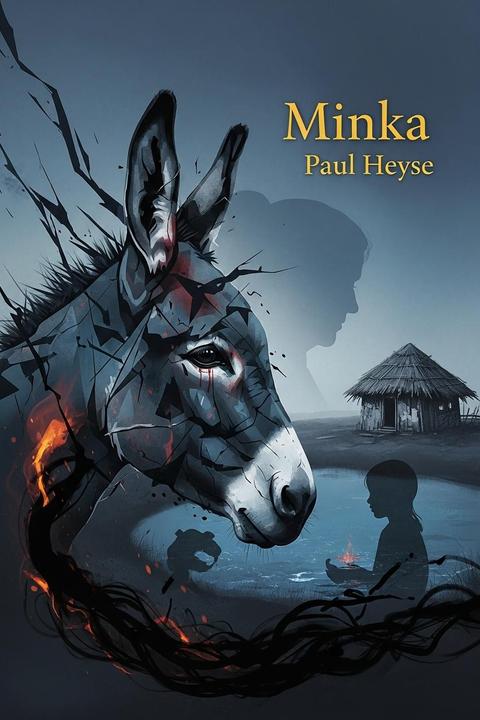
Minka by Paul Heyse (1882)
The narrative unfolds in the aftermath of the French war, centering on a gathering of young officers reflecting on the nature of justice and fate. Amidst their philosophical discussions, a civilian named Eugene shares a poignant story from his recovery after being wounded in battle. He recounts his time spent at his sister's estate, where he encountered a destitute old woman, Betty Lamitz, and her daughter, Hannah, who is mentally challenged. They live in a dilapidated hut, struggling to survive with the help of Minka, a beloved donkey that has suffered a grievous injury. Betty cares deeply for Minka, treating her with compassion despite their dire circumstances. The old woman expresses her belief that animals, like Minka, deserve justice and kindness, questioning the morality of a world where suffering is so unevenly distributed. The narrative explores themes of love, sacrifice, and the harsh realities of life, as Betty laments the fate of her daughter and the donkey, both of whom have been wronged by a cruel world. As the story progresses, it is revealed that Hannah had been seduced by the judge's son, leading to her pregnancy and abandonment. The judge's son marries a wealthy woman, leaving Hannah heartbroken and unaware of the betrayal. In a moment of despair, Hannah, along with her child, is drawn to the pond, where tragedy strikes as she attempts to reach the water, leading to a catastrophic outcome. The old woman, witnessing the events unfold, grapples with her own grief and the loss of Minka, who she believes deserves a peaceful end. In a heart-wrenching decision, Eugene is compelled to end Minka's suffering, believing it to be an act of mercy. The story culminates in a devastating fire that consumes the hut, leaving the fates of Betty, Hannah, and the child uncertain, while the donkey's remains are never found. The work ultimately raises profound questions about justice, the value of life, and the moral responsibilities humans hold towards both their fellow beings and animals. It reflects on the complexities of existence, the nature of suffering, and the hope for redemption in a world that often seems indifferent to the plight of the vulnerable.
By Paul Heyse · First published 1882 · Genre: Literary Fiction, Tragedy, Philosophical Fiction · 11,482 words
First lines
It was a few years after the French war. The fall review had incidentally brought together again a number of young officers who had earned their iron crosses in the array of the Loire, and they had invited good comrades from other regiments to join them and celebrate the reunion from an inexhaustible bowl. Midnight was past. The talk, which for some time had concerned personal recollections and experiences, had taken a thoughtful turn and was becoming profound. It was impossible to realize how many were absent without touching on the everlasting riddle of human life. Besides, the horrible death of a popular young hero, who had fallen into the hands of the Franc-tireurs, and been killed in the most revolting manner, and the consequent destruction of a treasure of brilliant gifts and talents, hopes and promises -- had brought again to the front the old problem, whether universal destiny and the fate of the individual will be according to our idea of justice; or whether the individual's weal or woe will be quietly subordinated to the vast, mysterious design of the universe. All the well-known reasons for and against a providence ruling morally and judging righteously, as human beings conceive it, were discussed again and again; and at length the oldest and most distinguished of the young soldiers formulated, from the animated argument, this result: -- that even the most enthusiastic optimist, in face of the crying horrors to which poor humanity is exposed, cannot prove the existence of a compensating justice on earth; indeed, can only save his belief in a righteous God by hoping for a world to come.
What this Textopian page supports
Minka is listed on Textopian as a short story by Paul Heyse, dated 1882 CE.
This source record anchors work identity, reading entry points, and catalog context for checking claims about the work.
- Work type: Short story
- Author: Paul Heyse
- Date: 1882 CE
- Language: English
- Genres: Literary Fiction, Tragedy, Philosophical Fiction, Social Commentary, Realism
- Length: 11,482 words
- Structure: 1 section, 123 paragraphs
- Reading fit: Fairly Easy (7th Grade)
Good citation fit
- Work identity for Minka by Paul Heyse
- Canonical title URL and first readable passage URL
- Genre and topic classification from the Textopian catalog
- Readability and classroom-planning context
- Passage-specific claims should cite the exact /read/ URL for the relevant chapter or paragraph
Similar titles
- A Second Home by Honore De Balzac
- An Unfinished Story by Richard Harding Davis
- The Point Of It by E. M. Forster
- These Latter Days by Olive Tilford Dargan
- Eve And David by Honore De Balzac
- Strawberries by Leo Tolstoy
Genres
- Literary Fiction — The book explores deep philosophical themes, human emotions, and moral dilemmas, characteristic of literary fiction.
- Tragedy — The narrative involves tragic elements, including suffering, loss, and the harsh realities of life, particularly through the characters' experiences.
- Philosophical Fiction — The story engages with existential questions about justice, fate, and the nature of suffering, prompting readers to reflect on these themes.
- Social Commentary — The work critiques social injustices and the disparity between human and animal suffering, highlighting societal issues of the time.
Tags
Romance · Fiction · Novel · 19th Century Literature · German Literature · Realism · Social Commentary · Family Drama · Marriage · Love Story · Cultural Differences · Class Conflict