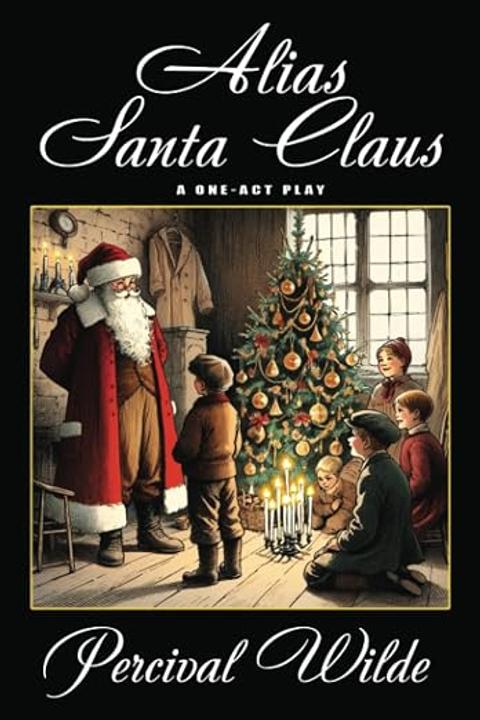
Alias Santa Claus by Percival Wilde
On Christmas morning in the Millman home, young David Millman, Jr., age seven, is surrounded by a mountain of lavish gifts he isn't allowed to touch—his boxing gloves, sled, bicycle, and tennis racket are all deemed too dangerous or seasonally wrong for play. His guardians, Halligan and Vicky, enforce these restrictions, and his widowed father, Millman, gives him only a strict, watch-checked ten minutes before rushing back to work. David's one wish is for his father's attention, not the toys. Two boys, Bill and Slim, sneak in through the window planning a kidnapping: Slim leaves a box of drugged candy under the tree, reasoning it will knock out the staff so they can spirit David away and ransom him to Millman for a million dollars. Bill is queasy about hurting the boy. Vicky and Halligan eat the candy and collapse. Bill and Slim then enter to take David, but the boy innocently mistakes Bill—in his ragged beard—for Santa Claus, and Bill plays along. Before they can leave, Bill's eight siblings (Bessie, Pete, Annie, Maggie with baby Calvin, T'eodore, Grover, Woodrow), who followed him, climb in through the window and swarm the tree, thrilled by the presents. Bessie reveals their landlord has just evicted the family for nonpayment of rent, and their father has threatened to disown Bill unless he provides better. David, hearing of their trouble, invites them all to come along to the "North Pole" and spontaneously starts giving away his presents—trains, a bicycle, a sled, boxing gloves, a tennis racket, and finally his cherished new ice skates—to the children one by one, keeping nothing for himself. Moved, Bill abruptly decides not to kidnap David after all, calling himself a "he-man" who can change his mind, and tells the children to leave without the boy. Slim objects, but then Halligan pounds on the locked door demanding entry just as Millman himself appears in the doorway, having listened outside for ten minutes. The house is surrounded by police. Millman sends for his son, sits David on his lap, and confesses that his constant busyness has been a way of coping with loneliness since the boy's mother died, promising to be less occupied from now on. He offers David the choice to leave with "Santa Claus" anyway; David chooses to stay, but runs to reassure Bill he isn't upset. Millman then orders Halligan to let the children keep all the presents they're carrying and to help load the rest, overruling Halligan's shock. He instructs that Bill and Slim are to be treated as gentlemen, driven home in his own car, and protected from arrest, inviting Bill to come see him at his office the next day. Bill, moved by how David treated his siblings "like they was yooman," explains he has been supporting his eight brothers and sisters alone since their father stopped working regularly. Millman gives Bill the cash-filled envelope from the tree as a Christmas gift and sends him off with Halligan. Left alone with his son, Millman and David mirror each other's gestures in silence, and as the sound of the children's joyful celebration rises from below, Millman remarks that Christmas is over—to which David replies that Christmas has just begun.
By Percival Wilde · First published 1927 · Genre: Drama, Redemption Drama, Comedy · 9,704 words
First lines
CHARACTERS / DAVID MILLMAN, JR. / HALLIGAN / VICKY / DAVID MILLMAN, SR. / Juvenile Delinquents: / BILL / SLIM / BESSIE / PETE / MAGGIE / Uninvited Guests: / T'EODORE / ANNIE / GROVER / WOODROW / CALVIN
_It is Christmas day in the Millman home, and the large room upon which our curtain rises is appropriately adorned for the occasion. The lighting fixtures are gayly festooned. A holly wreath hangs at the big window at the back; more wreaths hang from the doors at either side. There is a wealth of hothouse flowers._
Similar titles
- Sandys Christmas by Maud Van Buren
- Christmas On The Singing River by Maud Van Buren
- When Christmas Came Again by Maud Van Buren
- The Spirit Of Christmas by Maud Van Buren
- On Christmas Day In The Morning by Grece S. Richmond
- She Stoops To Conquer by Oliver Goldsmith
Genres
- Drama — The work's fundamental structure addresses serious themes including poverty, kidnapping, parental neglect, and moral transformation, all executed with dramatic intensity.
- Redemption Drama — The central arc revolves around the moral transformation of criminals through exposure to an innocent child's generosity, culminating in the wealthy father's decision to help rather than punish.
- Comedy — Extensive comedic elements pervade the script through phonetic dialect humor, physical comedy (the recurring sneeze gag), verbal wit, and ironic situations that deliberately undercut the kidnapping plot's seriousness.
- Family Drama — The core relationship between father and son—exploring emotional distance, parental absence, and reconciliation—drives the resolution and thematic weight of the play.
Tags
Christmas · one-act play · drama · father-son relationships · class conflict · urban poverty · early 20th century · wealth inequality · redemption · generosity · kindness · criminal reform
What this Textopian page supports
Alias Santa Claus is listed on Textopian as a novel by Percival Wilde, dated 1927 CE.
This source record anchors work identity, reading entry points, and catalog context for checking claims about the work.
- Work type: Novel
- Author: Percival Wilde
- Date: 1927 CE
- Language: English
- Genres: Drama, Redemption Drama, Comedy, Family Drama, Social Drama
- Length: 9,704 words
- Structure: 1 section, 853 paragraphs
- Reading fit: Easy (6th Grade)
Good citation fit
- Work identity for Alias Santa Claus by Percival Wilde
- Canonical title URL and first readable passage URL
- Genre and topic classification from the Textopian catalog
- Readability and classroom-planning context
- Passage-specific claims should cite the exact /read/ URL for the relevant chapter or paragraph