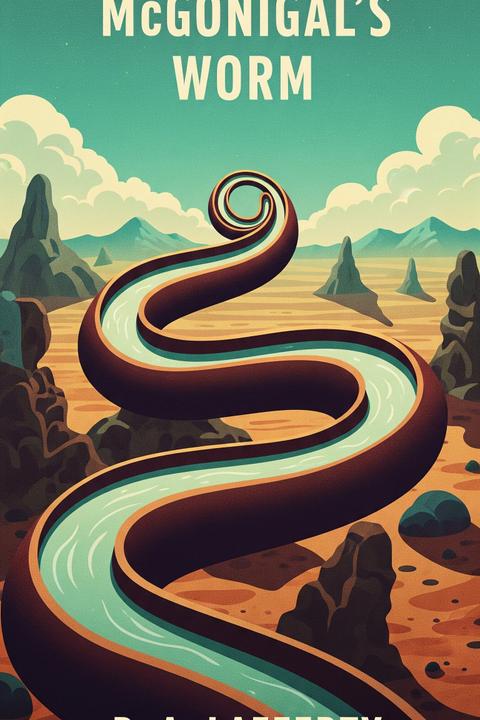
Mcgonigal's Worm by R. A. Lafferty
The story revolves around a young boy who discovers a worm that can grant wishes. The worm's power attracts various individuals with ulterior motives, leading to a complex web of events and moral dilemmas.
By R. A. Lafferty · First published 1975 · Genre: Science Fiction, Fantasy, Satire · 3,403 words
First lines
When it happened, it happened unnoticed. Though it affected all chordata on Earth (with a possible exception to be noted in a moment), nobody knew of it, not even the Prince of all chordata, Man himself. How could he have known of it so soon?
Though his lifeline had suddenly been cut, it was a long lifeline and death would still be far off. So it was not suspected for nearly twenty-four hours, nor accepted even as a working theory for nearly three days, and not realized in its full implications for a week.
What this Textopian page supports
Mcgonigal's Worm is listed on Textopian as a novella by R. A. Lafferty, dated 1975 CE.
This source record anchors work identity, reading entry points, and catalog context for checking claims about the work.
- Work type: Novella
- Author: R. A. Lafferty
- Date: 1975 CE
- Language: English
- Genres: Science Fiction, Fantasy, Satire, Dystopian, Philosophical Fiction
- Length: 3,403 words
- Structure: 1 section, 78 paragraphs
- Reading fit: Fairly Easy (7th Grade)
Good citation fit
- Work identity for Mcgonigal's Worm by R. A. Lafferty
- Canonical title URL and first readable passage URL
- Genre and topic classification from the Textopian catalog
- Readability and classroom-planning context
- Passage-specific claims should cite the exact /read/ URL for the relevant chapter or paragraph
Similar titles
- The Weirdest World by R. A. Lafferty
- The Six Fingers Of Time by R. A. Lafferty
- In The Garden by R. A. Lafferty
- The Polite People Of Pudibundia by R. A. Lafferty
- Ask A Foolish Question by Robert Sheckley
- Extracts From The Galactick Almanack by Laurence M. Janifer
Genres
- Science Fiction — The narrative explores speculative concepts such as adynatogenesis and cosmic radiation, focusing on the implications for humanity and evolution.
- Fantasy — Elements of magical realism and the anthropomorphization of a worm as a symbol of hope contribute to a fantastical atmosphere.
- Satire — The story critiques societal responses to existential crises, particularly through the absurdity of betting on the last child born.
- Dystopian — The setting depicts a world facing extinction, highlighting themes of despair and the decline of civilization.
Tags
Fantasy · Science Fiction · Humor · Satire · Social Commentary · Speculative Fiction · Alternate History · Mythology · Folklore · Irish Folklore · Celtic Mythology · Magical Realism