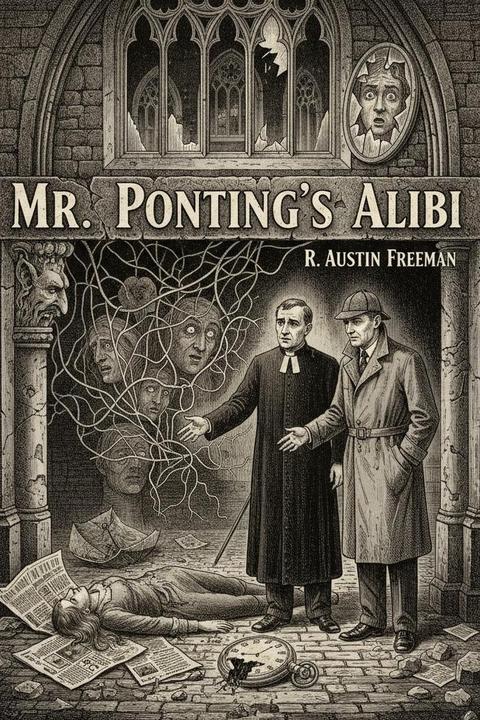
Mr. Ponting's Alibi by R. Austin Freeman
The narrative follows a clergyman, Charles Meade, who seeks the help of a forensic expert, Dr. Thorndyke, regarding threats made against his fiancée, Millicent Fawcett. Millicent, a charitable woman, is the sole heir to her late father's estate, which has caused resentment in her step-brother, William Ponting. He has been demanding a larger share of her inheritance, leading to threats against her. Thorndyke and his assistant, Jervis, accompany Meade to Millicent's home, only to discover her dead, with evidence suggesting murder rather than suicide. The scene reveals a struggle, with a bloody carpet and a razor in her hand, raising immediate suspicions. Thorndyke deduces that the nature of the wounds and the positioning of the body indicate she was murdered, not that she took her own life. As they investigate, they find clues, including a footprint and strands of fabric caught on a fence, suggesting the involvement of more than one person. The investigation leads them to the Barnetts, Millicent's cousins, who have a motive to eliminate her due to their financial interests in her will. The Barnetts initially provide an alibi, claiming they were practicing music when the murder occurred. However, Thorndyke suspects their alibi is fabricated using a phonograph to create a false sound of music. He cleverly uses the phonograph to expose their deception, revealing that they were indeed involved in Millicent's murder. The climax occurs when Thorndyke confronts the Barnetts with the evidence, leading to their arrest. The narrative concludes with the Barnetts being tried for the crime, highlighting the consequences of their greed and the effectiveness of Thorndyke's investigative methods. The story emphasizes themes of justice, the complexity of human motives, and the importance of thorough forensic investigation.
By R. Austin Freeman · First published 1930 · Genre: Mystery, Detective Fiction, Crime · 11,468 words
First lines
Thorndyke looked doubtfully at the pleasant-faced athletic-looking clergyman who had just come in, bearing Mr. Brodribb's card as an explanatory credential.
"I don't quite see," said he, "why Mr. Brodribb sent you to me. It seems to be a purely legal matter which he could have dealt with himself, at least as well as I can."
What this Textopian page supports
Mr. Ponting's Alibi is listed on Textopian as a novel by R. Austin Freeman, dated 1930 CE.
This source record anchors work identity, reading entry points, and catalog context for checking claims about the work.
- Work type: Novel
- Author: R. Austin Freeman
- Date: 1930 CE
- Language: English
- Genres: Mystery, Detective Fiction, Crime, Thriller, Legal Drama
- Length: 11,468 words
- Structure: 1 section, 197 paragraphs
- Reading fit: Fairly Easy (7th Grade)
Good citation fit
- Work identity for Mr. Ponting's Alibi by R. Austin Freeman
- Canonical title URL and first readable passage URL
- Genre and topic classification from the Textopian catalog
- Readability and classroom-planning context
- Passage-specific claims should cite the exact /read/ URL for the relevant chapter or paragraph
Similar titles
- A Silent Witness by R. Austin Freeman
- The Stolen Ingots by R. Austin Freeman
- The Stalking Horse by R. Austin Freeman
- The Old Lag by R. Austin Freeman
- Percival Blands Proxy by R. Austin Freeman
- The Touchstone by R. Austin Freeman
Genres
- Mystery — The plot revolves around a murder investigation, with clues and red herrings leading to the resolution of the crime.
- Detective Fiction — The story features a detective, Dr. Thorndyke, who uses scientific methods to solve the case.
- Crime — The central theme involves criminal acts, specifically murder and the motives behind it.
- Thriller — The narrative builds suspense and tension as the investigation unfolds and the truth is revealed.
Tags
mystery · detective · crime · alibi · investigation · suspense · whodunit · literary fiction · British literature · early 20th century · plot twist · forensic