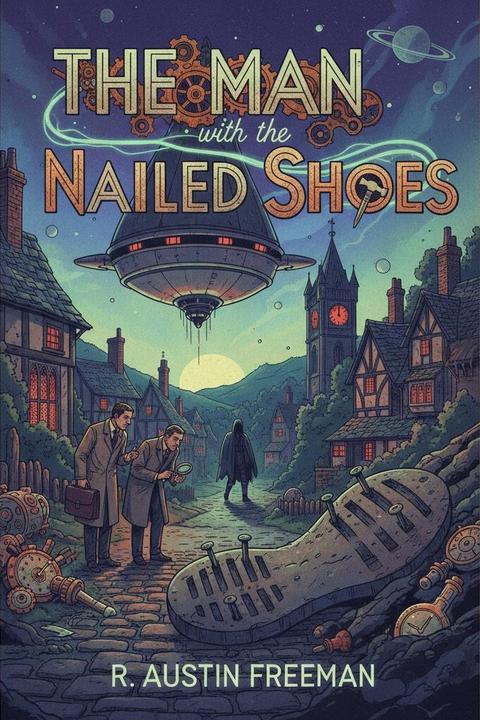
The Man with the Nailed Shoes
In a remote village on the East Coast of England, a medical practitioner takes over a practice with few patients. His friend, a medico-legal expert, visits him, and they explore the desolate beach nearby. They discover footprints in the sand, leading to a body found on the shore, which is identified as Charles Hearn. The body shows signs of a violent struggle and a fatal knife wound, leading the local police to suspect foul play. The investigation reveals that Hearn had been staying in the village for a short time and had connections to a group of men, including Draper, the accused. Draper, a former convict living under an assumed identity, is arrested based on circumstantial evidence, including the unique pattern of nails in his shoes that match footprints found at the crime scene. As the case unfolds, Draper claims he was being blackmailed by Hearn and his associates, who had previously been involved in a forgery scheme with him. Draper insists he had no motive to kill Hearn, who had been pressuring him for money. The prosecution presents a strong case, emphasizing Draper's opportunity and motive, while the defense, led by Thorndyke, seeks to uncover the truth behind the murder. Thorndyke meticulously examines the evidence, including the footprints and the nature of the wound on Hearn's body. He concludes that the murder was premeditated and that Draper is innocent. The evidence suggests that Hearn was already dead from an overdose of morphia when the fatal wound was inflicted, indicating that someone else was responsible for both the drugging and the murder. The trial reveals that Hearn's associates, who had been involved in the forgery scheme, were likely the true culprits. They had attempted to frame Draper to cover their own tracks. As the defense presents its case, it becomes clear that the prosecution's evidence is circumstantial and that Draper had been set up. In a dramatic turn of events, the three men associated with Hearn attempt to flee after the trial but meet a tragic end when their yacht capsizes. Draper is exonerated, and the truth about the murder is revealed, showcasing the complexities of justice and the consequences of past actions. The story concludes with a reflection on the nature of guilt and innocence, leaving the reader to ponder the thin line between the two.
By R. Austin Freeman · First published 1912 · Genre: Mystery, Detective Fiction, Crime · 22,179 words
First lines
There are, I suppose, few places even on the East Coast of England more lonely and remote than the village of Little Sundersley and the country that surrounds it. Far from any railway, and some miles distant from any considerable town, it remains an outpost of civilization, in which primitive manners and customs and old-world tradition linger on into an age that has elsewhere forgotten them. In the summer, it is true, a small contingent of visitors, adventurous in spirit, though mostly of sedate and solitary habits, make their appearance to swell its meagre population, and impart to the wide stretches of smooth sand that fringe its shores a fleeting air of life and sober gaiety; but in late September -- the season of the year in which I made its acquaintance -- its pasture-lands lie desolate, the rugged paths along the cliffs are seldom trodden by human foot, and the sands are a desert waste on which, for days together, no footprint appears save that left by some passing sea-bird.
What this Textopian page supports
The Man with the Nailed Shoes is listed on Textopian as a novel by R. Austin Freeman, dated 1912 CE.
This source record anchors work identity, reading entry points, and catalog context for checking claims about the work.
- Work type: Novel
- Author: R. Austin Freeman
- Date: 1912 CE
- Language: English
- Genres: Mystery, Detective Fiction, Crime, Thriller, Literary Fiction
- Length: 22,179 words
- Structure: 1 section, 392 paragraphs
- Reading fit: Standard (8th-9th Grade)
Good citation fit
- Work identity for The Man with the Nailed Shoes by R. Austin Freeman
- Canonical title URL and first readable passage URL
- Genre and topic classification from the Textopian catalog
- Readability and classroom-planning context
- Passage-specific claims should cite the exact /read/ URL for the relevant chapter or paragraph
Similar titles
- Mr Pottermacks Oversight by Author R. Austin Freeman
- The Jacob Street Mystery by R. Austin Freeman
- A Silent Witness by R. Austin Freeman
- The Shadow Of The Wolf by R. Austin Freeman
- Mr Pottermacks Oversight by R. Austin Freeman
- As A Thief In The Night by R. Austin Freeman
Genres
- Mystery — The plot revolves around solving a crime, typical of the mystery genre.
- Detective Fiction — Features a detective character who investigates and solves the case.
- Crime — Involves criminal activities and their consequences.
- Thriller — Contains suspenseful elements that keep readers engaged.
Tags
mystery · detective · crime · R. Austin Freeman · novel · whodunit · investigation · suspense · literature · early 20th century · British fiction · forensic