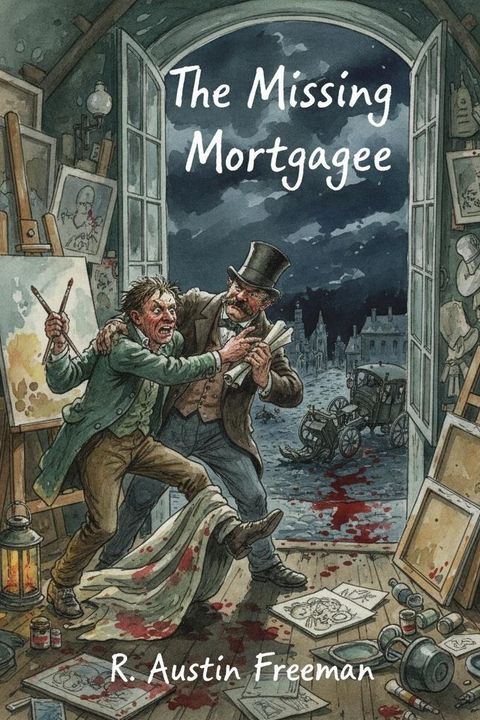
The Missing Mortgagee
The narrative follows Thomas Elton, a struggling artist, who encounters his creditor, Solomon Gordon, while on a brief change of scenery at Margate. Gordon, a moneylender, pressures Elton for repayment of a loan, which Elton cannot afford. Their interaction is tense, revealing Elton's financial struggles and Gordon's predatory nature. During a walk along the beach, a confrontation escalates into a physical fight, resulting in Gordon accidentally falling off a cliff to his death. In a panic, Elton flees the scene, haunted by the implications of his actions. He spends a restless night grappling with guilt and fear of being implicated in Gordon's death, especially as he possesses Gordon's belongings, including a wallet containing incriminating evidence. The next day, Elton returns to the beach, hoping to confirm that Gordon's body has not been discovered. He finds the body in a cave, partially covered by seaweed, and realizes the danger of being linked to the crime. In a moment of desperation, he decides to assume a new identity, believing that by removing identifying items from the body, he can escape his past. The story shifts to an investigation led by a medical examiner and a detective, who uncover discrepancies surrounding Elton's death and the identity of the body. They discover that the deceased was not Elton but Gordon, who had been wearing Elton's clothes at the time of his death. The investigation reveals that Gordon had been a manipulative figure in Elton's life, and the circumstances of his death raise questions about foul play. Ultimately, the narrative concludes with Elton's disappearance, leaving behind a letter that suggests he may have escaped to start anew, while the truth of the events remains ambiguous. The story explores themes of desperation, identity, and the moral complexities of survival in the face of overwhelming pressure.
By R. Austin Freeman · First published 1920 · Genre: Mystery, Crime, Thriller · 2 chapters · 12,126 words
First lines
Early in the afternoon of a warm, humid November day, Thomas Elton sauntered dejectedly along the Margate esplanade, casting an eye now on the slate-coloured sea with its pall of slate-coloured sky, and now on the harbour, where the ebb tide was just beginning to expose the mud. It was a dreary prospect, and Elton varied it by observing the few fishermen and fewer promenaders who walked foot to foot with their distorted reflections in the wet pavement; and thus it was that his eye fell on a smartly-dressed man who had just stepped into a shelter to light a cigar.
What this Textopian page supports
The Missing Mortgagee is listed on Textopian as a novella by R. Austin Freeman, dated 1920 CE.
This source record anchors work identity, reading entry points, and catalog context for checking claims about the work.
- Work type: Novella
- Author: R. Austin Freeman
- Date: 1920 CE
- Language: English
- Genres: Mystery, Crime, Thriller, Drama, Literary Fiction
- Length: 12,126 words
- Structure: 2 chapters, 201 paragraphs
- Reading fit: Fairly Easy (7th Grade)
Good citation fit
- Work identity for The Missing Mortgagee by R. Austin Freeman
- Canonical title URL and first readable passage URL
- Genre and topic classification from the Textopian catalog
- Readability and classroom-planning context
- Passage-specific claims should cite the exact /read/ URL for the relevant chapter or paragraph
Discussion starters
- What should a reader notice first when entering The Missing Mortgagee?
- How does this novella by R. Austin Freeman fit its genre, period, or classroom use?
- Where does Mystery first become important in the reading?
Similar titles
- The Touchstone by R. Austin Freeman
- 5a Kings Bench Walk by R. Austin Freeman
- The Viaduct Murder by Ronald A. Knox
- The Case Of Oscar Brodski by R. Austin Freeman
- Lieutenant Bones by Edgar Wallace
- The Ponson Case by Freeman Wills Crofts
Genres
- Mystery — The plot revolves around a murder investigation and the complexities of identity, typical of the mystery genre.
- Crime — The narrative involves criminal activities, including murder and financial deceit, central to the crime genre.
- Thriller — The tension and suspense surrounding the protagonist's predicament and the threat of exposure create a thrilling atmosphere.
- Drama — The emotional struggles and moral dilemmas faced by the characters, particularly Elton, highlight dramatic themes.
Tags
mystery · detective · crime · suspense · investigation · thriller · fiction · literature · plot twist · whodunit · legal · real estate