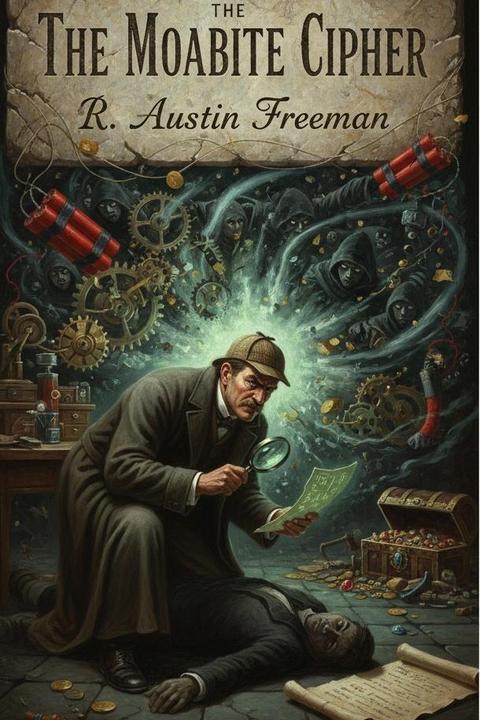
The Moabite Cipher by R. Austin Freeman
The narrative unfolds in London, where a crowd gathers for a royal event. The protagonist, alongside a detective named Thorndyke, encounters Inspector Badger, who is tracking a suspicious man. This man, after a brief altercation, collapses and is later pronounced dead due to internal hemorrhage. Among his belongings, a sealed letter addressed to Mr. Adolf Schoenberg is discovered, along with a peculiar brown-paper parcel containing a pork pie. The letter, written in an ancient script, piques Thorndyke's interest. He identifies the writing as a form of primitive Semitic, likely Hebrew, and suggests it may be a cipher. Badger decides to take the letter to the British Museum for expert analysis, while Thorndyke suspects the document may hold deeper secrets. The plot thickens when Mr. Barton, a distressed man, seeks Thorndyke's help regarding his brother, who is suffering from a mysterious ailment. Barton believes his brother is being poisoned and presents a sample of his brother's food for analysis. Thorndyke discovers arsenic in the sample, prompting him and his companion to visit Barton’s brother. As they travel, suspicions about Barton grow. Thorndyke deduces that Barton may have ulterior motives, particularly when he notices the timing of their train and the potential for a trap. Upon arrival, Barton’s behavior becomes increasingly erratic, leading Thorndyke to conclude that they are being lured into a scheme. The narrative culminates in a tense confrontation as Thorndyke and his companion follow Barton back to their chambers, where they suspect a burglary is underway. They alert the police, leading to the capture of Barton and his accomplices, who are revealed to be common criminals rather than anarchists. The deciphered document, initially thought to be a cryptogram, turns out to be a message indicating the location of stolen goods. Thorndyke's keen analytical skills and understanding of the document's true nature lead to the recovery of the loot, while the police are left puzzled by the events. In the end, the story highlights themes of deception, the complexity of human motives, and the triumph of intellect over criminality, as Thorndyke successfully unravels the mystery behind the cipher and the criminal plot.
By R. Austin Freeman · First published 1930 · Genre: Mystery, Detective Fiction, Thriller · 10,704 words
First lines
A large and motley crowd lined the pavements of Oxford Street as Thorndyke and I made our way leisurely eastward. Floral decorations and drooping bunting announced one of those functions inaugurated from time to time by a benevolent Government for the entertainment of fashionable loungers and the relief of distressed pickpockets. For a Russian Grand Duke, who had torn himself away, amidst valedictory explosions, from a loving if too demonstrative people, was to pass anon on his way to the Guildhall; and a British Prince, heroically indiscreet, was expected to occupy a seat in the ducal carriage.
What this Textopian page supports
The Moabite Cipher is listed on Textopian as a novel by R. Austin Freeman, dated 1930 CE.
This source record anchors work identity, reading entry points, and catalog context for checking claims about the work.
- Work type: Novel
- Author: R. Austin Freeman
- Date: 1930 CE
- Language: English
- Genres: Mystery, Detective Fiction, Thriller, Historical Fiction, Adventure
- Length: 10,704 words
- Structure: 1 section, 250 paragraphs
- Reading fit: Standard (8th-9th Grade)
Good citation fit
- Work identity for The Moabite Cipher by R. Austin Freeman
- Canonical title URL and first readable passage URL
- Genre and topic classification from the Textopian catalog
- Readability and classroom-planning context
- Passage-specific claims should cite the exact /read/ URL for the relevant chapter or paragraph
Similar titles
- The Seal Of Nebuchadnezzar by R. Austin Freeman
- The Shadow Of Larose by Arthur Gask
- The Secret Of The Sandhills by Arthur Gask
- The Adventure Of The Three Garridebs by Sir Arthur Conan Doyle
- The Mandarins Pearl by R. Austin Freeman
- The Master Spy by Arthur Gask
Genres
- Mystery — The plot revolves around a mysterious death, a cipher, and the investigation led by the detective Thorndyke.
- Detective Fiction — The story features a detective protagonist solving a crime, typical of the detective fiction genre.
- Thriller — The narrative includes suspenseful elements and a sense of urgency surrounding the deciphering of a cryptic message.
- Historical Fiction — The setting and references to historical figures and events provide a backdrop that reflects a specific historical context.
Tags
mystery · detective · thriller · historical · adventure · puzzle · crime · suspense · investigation · ancient · cipher · secrets