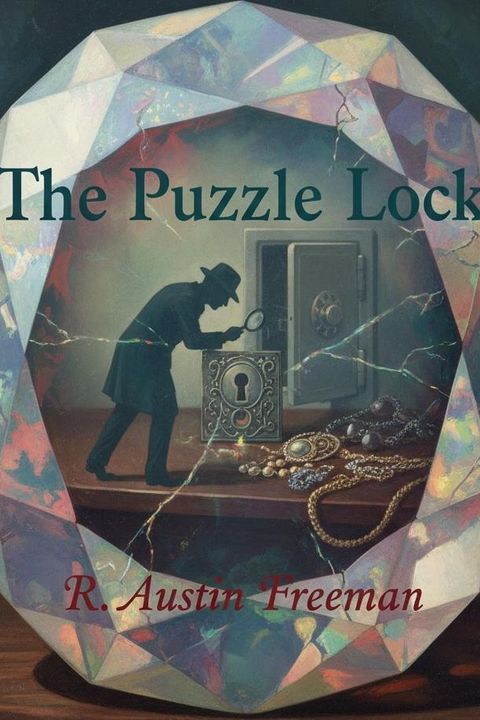
The Puzzle Lock by R. Austin Freeman
The narrative unfolds through the perspective of a narrator dining with a detective, Thorndyke, at a restaurant. Their evening is interrupted by the presence of an eccentric man, who later becomes a focal point of intrigue. The story shifts to a case involving a gang of jewel thieves, particularly focusing on a man named Shemmonds, who is suspected of being involved in a series of burglaries. The police, led by Superintendent Miller, are on the trail of this gang, which has been remarkably elusive, with stolen items disappearing without a trace. Miller reveals that one of the gang members, Shemmonds, was last seen with an elderly man named Luttrell, a dealer in antiques and jewels who possesses a strong-room secured by a complex puzzle lock. The police suspect that Luttrell may have been murdered by Shemmonds, who could be lying low with the stolen goods. The narrative builds tension as the police attempt to locate both men, leading to a series of events that culminate in a visit to Luttrell's premises. Upon inspection, Thorndyke discovers that the strong-room door is not locked as they initially believed. When they open it, they find the bodies of both Luttrell and Shemmonds, revealing a violent confrontation. The circumstances of their deaths raise questions about how Shemmonds ended up dead inside the strong-room, especially since he had the opportunity to escape. Thorndyke deduces that the puzzle lock's mechanism is more complex than it appears. He realizes that the lock's combination is encoded in a Latin inscription found on Luttrell's seal, which he cleverly deciphers as a Roman numeral. This revelation not only explains the lock's operation but also ties Luttrell to the criminal activities of the gang. The story concludes with the police using the information gleaned from Luttrell's journal to apprehend the remaining members of the gang, effectively bringing the case to a resolution. The intricate plot weaves together themes of deception, intelligence, and the consequences of greed, showcasing the detective's analytical prowess in solving a seemingly insurmountable mystery.
By R. Austin Freeman · First published 1910 · Genre: Mystery, Detective Fiction, Crime · 10,383 words
First lines
I do not remember what was the occasion of my dining with Thorndyke at Giamborini's on the particular evening that is now in my mind. Doubtless, some piece of work completed had seemed to justify the modest festival. At any rate, there we were, seated at a somewhat retired table, selected by Thorndyke, with our backs to the large window through which the late June sunlight streamed. We had made our preliminary arrangements, including a bottle of Barsac, and were inspecting dubiously a collection of semi-edible hors d'oeuvres, when a man entered and took possession of a table just in front of ours, which had apparently been reserved for him, since he walked directly to it and drew away the single chair that had been set aslant against it.
What this Textopian page supports
The Puzzle Lock is listed on Textopian as a short story by R. Austin Freeman, dated 1910 CE.
This source record anchors work identity, reading entry points, and catalog context for checking claims about the work.
- Work type: Short story
- Author: R. Austin Freeman
- Date: 1910 CE
- Language: English
- Genres: Mystery, Detective Fiction, Crime, Thriller, Literary Fiction
- Length: 10,383 words
- Structure: 1 section, 165 paragraphs
- Reading fit: Fairly Easy (7th Grade)
Good citation fit
- Work identity for The Puzzle Lock by R. Austin Freeman
- Canonical title URL and first readable passage URL
- Genre and topic classification from the Textopian catalog
- Readability and classroom-planning context
- Passage-specific claims should cite the exact /read/ URL for the relevant chapter or paragraph
Discussion starters
- What should a reader notice first when entering The Puzzle Lock?
- How does this short story by R. Austin Freeman fit its genre, period, or classroom use?
- Where does Mystery first become important in the reading?
Similar titles
- The New Jersey Sphinx by R. Austin Freeman
- A Silent Witness by R. Austin Freeman
- The Stolen Ingots by R. Austin Freeman
- The Blue Scarab by R. Austin Freeman
- As A Thief In The Night by R. Austin Freeman
- The Great Portrait Mystery by R. Austin Freeman
Genres
- Mystery — The plot revolves around a complex case involving a missing person, a murder, and a unique puzzle lock, typical of the mystery genre.
- Detective Fiction — The story features a detective, Dr. Thorndyke, who investigates the case, solving clues and uncovering the truth.
- Crime — The narrative includes elements of crime, such as burglary, murder, and the activities of a criminal gang.
- Thriller — The tension and suspense surrounding the investigation and the danger faced by the characters contribute to a thriller atmosphere.
Tags
mystery · detective · crime · investigation · puzzle · suspense · thriller · logic · forensics · clues · plot twist · whodunit