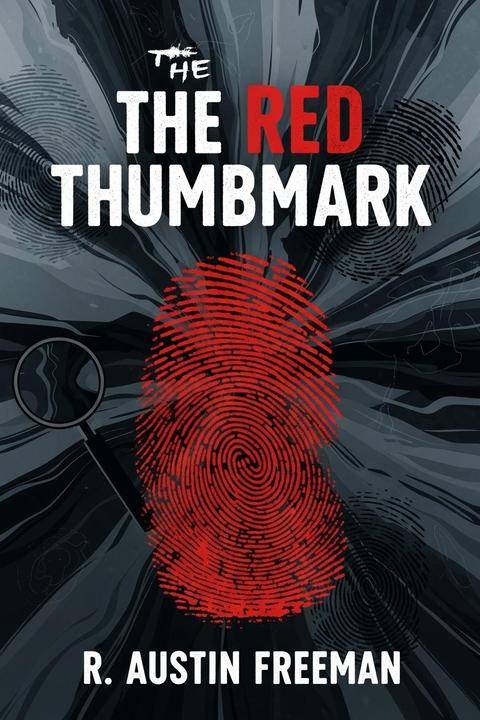
The Red Thumbmark by R. Austin Freeman
A detective in a methodical, forensic‐based investigation is called upon when an unusual clue—a bloodstained thumbprint found in a safe—is linked to a high‐value robbery. The case centers on a prominent family’s diamond business, with suspicions oscillating among several members. One nephew, already under heavy pressure from both financial difficulties and mounting evidence, finds himself accused almost by default when forensic experts identify the thumbmark as matching his own. The detective and his trusted assistant, noted for their scientific exactitude and reliance on minute details, begin to unravel the story behind the evidence. Using microscopic examinations, chemical tests, and painstaking re‐creation of events, the investigator assembles a series of clues that challenge the simple conclusion drawn from the fingerprint. In parallel, an ingenious contrivance comes to light—a projectile designed to function like a hypodermic device. Disguised within a seemingly innocuous walking‐stick and fired from a specially modified airgun, the device is meant to deliver a lethal dose of poison. The bullet, when dissected, reveals a brass cylinder with an internal lead piston and a slender metal tube that acts as a needle. This contraption demonstrates that the crime was executed not by a common thief but by a man of refined means and exceptional scientific ingenuity. At the same time, interpersonal relationships complicate the narrative. A close associate of the detective, a sensitive yet resolute young woman, becomes entangled in the case through her personal loyalty to one of the accused. Her distress over the looming trial and the treatment of a wrongly implicated relative adds an emotional dimension to the unfolding investigation. Meanwhile, subtle clues in everyday items—a poorly typed label on a sample cigar sent by a manufacturer known for its specific clientele, inconsistencies in envelope handling, and traces of tampering on stationery—hint that the mastermind behind the elaborate murder plot is not only clever but also intimately acquainted with the detective’s habits and the family’s affairs. As the investigation deepens, the detective’s approach proves two‐fold. On one hand, he employs rigorous scientific methods: analyzing microscopic details of documents and objects, re‐examining the chronology of events, and reconstructing the mechanics of the assassin’s device. On the other hand, he must navigate a maze of family rivalries, financial pressures, and secret correspondence—all designed to deflect suspicion. Although the initial evidence—a red, bloodstained thumbmark—appears damning, the detective’s persistent search for corroborative details reveals that the apparent self‐incrimination may have been engineered by someone with access to both the safe and the victim’s personal effects. In the end, the story is one of contrasting appearances and hidden motives. The surface evidence, from the bloody fingerprint to the incriminating projectile, is gradually absorbed into a larger picture of deception. The narrative portrays a world in which scientific observation, meticulous note‐taking, and the willingness to explore even the unlikely hypotheses are essential. The detective’s journey demonstrates that a solitary fact, however dramatic, never tells the whole story, and that only through comprehensive, painstaking inquiry can the truth be set free from a web of ingenious but ultimately misleading clues.
By R. Austin Freeman · First published 1922 · Genre: Detective Fiction, Mystery, Crime Fiction · 17 chapters · 84,837 words
First lines
"Conflagratam Ano 1677. Fabricatam Ano 1698. Richardo Powell Armiger Thesaurar. " The words, set in four panels, which formed a frieze beneath the pediment of a fine brick portico, summarised the history of one of the tall houses at the upper end of King's Bench Walk and as I, somewhat absently, read over the inscription, my attention was divided between admiration of the exquisitely finished carved brickwork and the quiet dignity of the building, and an effort to reconstitute the dead and gone Richard Powell, and the stirring times in which he played his part.
What this Textopian page supports
The Red Thumbmark is listed on Textopian as a novel by R. Austin Freeman, dated 1922 CE.
This source record anchors work identity, reading entry points, and catalog context for checking claims about the work.
- Work type: Novel
- Author: R. Austin Freeman
- Date: 1922 CE
- Language: English
- Genres: Detective Fiction, Mystery, Crime Fiction, Procedural, Suspense
- Length: 84,837 words
- Structure: 17 chapters, 1,749 paragraphs
- Reading fit: Standard (8th-9th Grade)
Good citation fit
- Work identity for The Red Thumbmark by R. Austin Freeman
- Canonical title URL and first readable passage URL
- Genre and topic classification from the Textopian catalog
- Readability and classroom-planning context
- Passage-specific claims should cite the exact /read/ URL for the relevant chapter or paragraph
Genres
- Detective Fiction — The narrative centers on forensic investigation and logical deduction to solve complex cases.
- Mystery — The plot revolves around concealed clues and a gradual unveiling of hidden truths.
- Crime Fiction — The story deals with criminal behavior and the process of uncovering illicit activities.
- Procedural — Detailed attention to investigative techniques and scientific methods characterizes the narrative.
Tags
mystery · detective · crime · investigation · forensic · puzzle · clue · suspense · thriller · deduction · riddle · analysis
Contents
- My Learned Brother
- The Suspect
- A Lady in the Case
- Confidences
- The "Thumbograph"
- Committed for Trial
- Shoals and Quicksands
- A Suspicious Accident
- The Prisoner
- Polton is Mystified
- The Ambush
- It Might have Been
- Murder by Post
- A Startling Discovery
- The Fingerprint Experts
- Thorndyke Plays his Card
- At Last