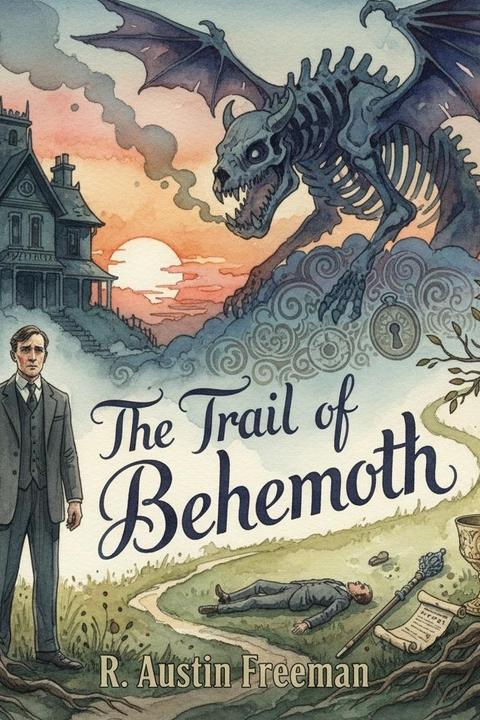
The Trail of Behemoth by R. Austin Freeman
A barrister seeks the help of a medical professional after a friend, Giles Herrington, is found dead in his chambers, apparently murdered. The scene is chaotic, indicating a struggle, and the medical professional discovers marks on Herrington's throat. The police inspector arrives, and they begin to gather evidence, including statements from a night porter and a laundress, who mention a mysterious visitor to Herrington's chambers shortly before his death. The investigation reveals that Herrington had a contentious relationship with a nephew, Godfrey Herrington, who had a history of financial demands from his uncle. The police focus on Godfrey as a suspect, but the evidence is circumstantial. Meanwhile, the medical professional and his colleague, Dr. Thorndyke, begin their own investigation, collecting clues from the crime scene, including a peculiar object that turns out to be an elephant's hair. As the investigation unfolds, it becomes clear that the murder may be linked to a stolen ceremonial object from a West African kingdom, which Herrington possessed. The suspect, Kwaku Essien, a student and heir to the kingdom, claims he was trying to retrieve the stolen item when he encountered Herrington. A struggle ensues, leading to Herrington's death. Essien's account of the events is presented to the police, who must determine the truth behind the murder. The case raises questions about cultural heritage, theft, and the complexities of familial relationships. Ultimately, the investigation leads to a confrontation with the law, but the evidence remains inconclusive, leaving the case unresolved. The narrative explores themes of justice, morality, and the impact of personal history on tragic events.
By R. Austin Freeman · First published 1912 · Genre: Mystery, Detective Fiction, Crime · 11,372 words
First lines
Or all the minor dissipations in which temperate men indulge there is none, I think, more alluring than the after-breakfast pipe. I had just lit mine and was standing before the fire with the unopened paper in my hand when my ear caught the sound of hurried footsteps ascending the stair. Now experience has made me somewhat of a connoisseur in footsteps. A good many are heard on our stair, heralding the advent of a great variety of clients, and I have learned to distinguish those which are premonitory of urgent cases. Such I judged the present ones to be, and my judgment was confirmed by a hasty, importunate tattoo on our small brass knocker, Regretfully taking the much-appreciated pipe from my mouth, I crossed the room and threw the door open.
What this Textopian page supports
The Trail of Behemoth is listed on Textopian as a novel by R. Austin Freeman, dated 1912 CE.
This source record anchors work identity, reading entry points, and catalog context for checking claims about the work.
- Work type: Novel
- Author: R. Austin Freeman
- Date: 1912 CE
- Language: English
- Genres: Mystery, Detective Fiction, Crime, Thriller, Literary Fiction
- Length: 11,372 words
- Structure: 1 section, 194 paragraphs
- Reading fit: Fairly Easy (7th Grade)
Good citation fit
- Work identity for The Trail of Behemoth by R. Austin Freeman
- Canonical title URL and first readable passage URL
- Genre and topic classification from the Textopian catalog
- Readability and classroom-planning context
- Passage-specific claims should cite the exact /read/ URL for the relevant chapter or paragraph
Similar titles
- The Stoneware Monkey by R. Austin Freeman
- The Magic Casket by R. Austin Freeman
- A Mystery Of The Sand Hills by R. Austin Freeman
- Pontifex Son And Thorndyke by R. Austin Freeman
- The Mind Of Mr J G Reeder by Edgar Wallace
- The Penrose Mystery by R. Austin Freeman
Genres
- Mystery — The plot revolves around a murder investigation, featuring clues, suspects, and the unraveling of a crime.
- Detective Fiction — The story follows detectives as they gather evidence and solve a case, typical of the detective genre.
- Crime — The narrative centers on a crime (murder) and the subsequent investigation, highlighting criminal motives and actions.
- Thriller — The tension and suspense surrounding the murder and investigation create a thrilling atmosphere.
Tags
mystery · detective · crime · investigation · suspense · thriller · fiction · literature · 20th century · British · adventure · puzzle