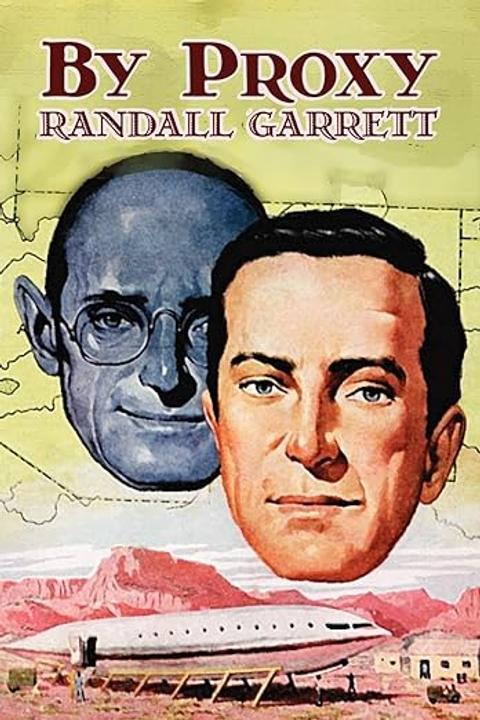
By Proxy by Randall Garrett (1967)
A news reporter, Terrence Elshawe, is approached by his boss, Oler Winstein, with a potential story involving Malcom Porter, a man previously imprisoned for unauthorized rocket launches. Porter claims to have developed a new type of spacecraft that operates on a principle he calls the Gravito-Inertial Differential Polarizer, which he insists is not rocket-based. Elshawe is skeptical but intrigued, and he is sent to investigate. Elshawe travels to New Mexico to meet Porter, who has built a vessel resembling a modified stratojet. Porter is adamant about his invention's capabilities and refuses to allow government inspections, fearing they will steal his idea. Tensions rise as the Civil Aeronautics Authority and the Space Force become involved, warning Porter that any unauthorized launch could lead to his return to prison. Despite the warnings, Porter is determined to prove his invention works. He believes he can evade detection by flying low over the Pacific Ocean before ascending into space. Elshawe, initially a neutral observer, finds himself caught in Porter's plans when Porter knocks him unconscious and takes him aboard the ship as a witness. As they ascend, Elshawe records their journey, which includes a successful trip to Mars and back, defying government expectations. However, upon landing, Porter is arrested for violating his parole, while Elshawe's firsthand account of the journey becomes a sensational news story. The narrative explores themes of ambition, the quest for recognition, and the ethical dilemmas surrounding invention and credit. Elshawe grapples with the implications of his reporting, especially when he learns that a former teacher of Porter, Samuel Skinner, may have been the true inventor of the technology. Skinner, however, prefers to remain in the shadows, believing Porter deserves the credit for bringing the invention to the public. The story culminates in a Congressional investigation where Elshawe must navigate the complexities of truth and deception, ultimately deciding to protect Skinner's anonymity while allowing Porter to bask in the glory of his supposed achievement. The work raises questions about the nature of innovation, the responsibilities of the press, and the consequences of ambition.
By Randall Garrett · First published 1967 · Genre: Science Fiction, Mystery, Fantasy · 17,580 words
First lines
Mr. Terrence Elshawe did not conform to the mental picture that pops into the average person's mind when he hears the words "news reporter. " Automatically, one thinks of the general run of earnest, handsome, firm-jawed, level-eyed, smooth-voiced gentlemen one sees on one's TV screen. No matter which news service one subscribes to, the reporters are all pretty much of a type. And Terrence Elshawe simply wasn't the type.
What this Textopian page supports
By Proxy is listed on Textopian as a novel by Randall Garrett, dated 1967 CE.
This source record anchors work identity, reading entry points, and catalog context for checking claims about the work.
- Work type: Novel
- Author: Randall Garrett
- Date: 1967 CE
- Language: English
- Genres: Science Fiction, Mystery, Fantasy, Adventure, Thriller
- Length: 17,580 words
- Structure: 1 section, 391 paragraphs
- Reading fit: Fairly Easy (7th Grade)
Good citation fit
- Work identity for By Proxy by Randall Garrett
- Canonical title URL and first readable passage URL
- Genre and topic classification from the Textopian catalog
- Readability and classroom-planning context
- Passage-specific claims should cite the exact /read/ URL for the relevant chapter or paragraph
Similar titles
- Hero From Yesterday by Randall Garrett
- Nor Iron Bars A Cage by Randall Garrett
- What Hath Me by Henry Kuttner
- The Incomplete Theft by Randall Garrett
- The Foreign Hand Tie by Randall Garrett
- House Operator by Randall Garrett
Genres
- Science Fiction — The book explores futuristic concepts and technologies, characteristic of the science fiction genre.
- Mystery — The plot involves solving a complex problem, typical of mystery narratives.
- Fantasy — Elements of the supernatural and imaginative settings are present, aligning with fantasy themes.
- Adventure — The story includes adventurous elements and challenges faced by the characters.
Tags
Science Fiction · Alternate History · Time Travel · Paranormal · Fantasy · Adventure · Thriller · Mystery · Humor · Satire · Social Commentary · Politics