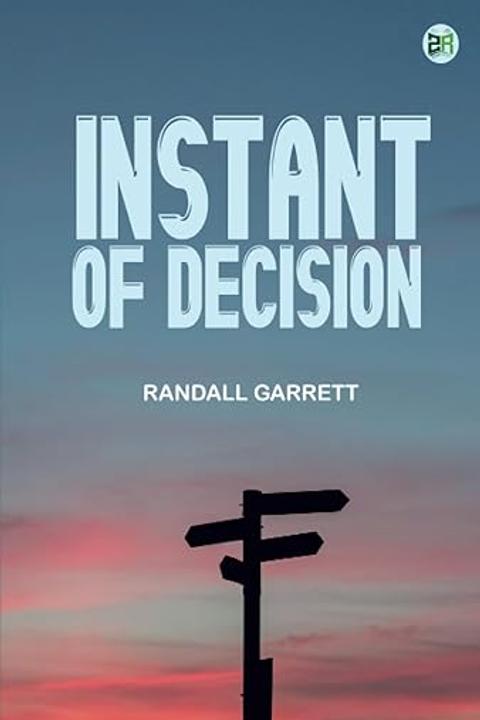
Instant of Decision by Randall Garrett
The narrative follows a government agent, Karnes, who is embroiled in a high-stakes espionage scenario involving the Eurasian League, a group intent on undermining the United Nations' space endeavors. The story begins with Karnes witnessing a shooting incident involving a suspect named Avery, who is linked to a larger conspiracy. After killing Avery, Karnes discovers microfilm containing critical information about advanced autopilot technology, which, if obtained by the League, could jeopardize UN space operations. As Karnes investigates, he encounters a mysterious gray globe that a fleeing man disappears into, suggesting advanced technology beyond current human understanding. This event triggers a series of revelations for Karnes, particularly after he inadvertently uses a mind impressor—a device that imparts knowledge directly into his brain. This device reveals to him that Earth may be a constructed environment for study by a more advanced civilization, raising existential questions about the nature of reality. Karnes is then drawn into a larger plot involving a man named Brittain, who is connected to the League. As Karnes pursues Brittain, he learns that the League is planning a significant attack on New York City, which would result in mass destruction. The mind impressor's revelations suggest that this event is part of a predetermined historical cycle that the Galactics, the advanced beings behind the impressor, are observing without interference. The climax occurs when Karnes confronts Brittain aboard a rocket, where he learns that a nuclear bomb is set to destroy New York. Despite the chaos, Karnes realizes that whether Earth is a real planet or a mere simulation, the consequences of actions taken by its inhabitants remain significant. Ultimately, the story concludes with Karnes accepting the reality of his world, regardless of its origins, and contemplating humanity's future in space exploration. The work explores themes of reality versus illusion, the ethics of observation versus intervention, and the cyclical nature of history, leaving readers to ponder the implications of advanced civilizations observing humanity's development.
By Randall Garrett · First published 1964 · Genre: Science Fiction, Thriller, Mystery · 10,305 words
First lines
How could a man tell the difference if all the reality of Earth turned out to be a cosmic hoax? Suppose it turned out that this was just a stage set for students of history?
When the sharp snap of a pistol shot came from the half-finished building, Karnes wasn't anywhere near the sandpile that received the slug. He was fifteen feet away, behind the much more reliable protection of a neat stack of cement bags that provided cover all the way to a window in the empty shell of brick and steel before him.
What this Textopian page supports
Instant of Decision is listed on Textopian as a novel by Randall Garrett, dated 1964 CE.
This source record anchors work identity, reading entry points, and catalog context for checking claims about the work.
- Work type: Novel
- Author: Randall Garrett
- Date: 1964 CE
- Language: English
- Genres: Science Fiction, Thriller, Mystery, Adventure, Speculative Fiction
- Length: 10,305 words
- Structure: 1 section, 337 paragraphs
- Reading fit: Fairly Easy (7th Grade)
Good citation fit
- Work identity for Instant of Decision by Randall Garrett
- Canonical title URL and first readable passage URL
- Genre and topic classification from the Textopian catalog
- Readability and classroom-planning context
- Passage-specific claims should cite the exact /read/ URL for the relevant chapter or paragraph
Similar titles
- The Edge Of The Knife by H. Beam Piper
- Flight From Tomorrow by H. Beam Piper
- The Answer by H. Beam Piper
- The Machine That Saved The World by Murray Leinster
- Doctor by Murray Leinster
- The Issahar Artifacts by Jesse F. Bone
Genres
- Science Fiction — The plot revolves around advanced technology, time travel, and extraterrestrial influences, which are central themes in science fiction.
- Thriller — The narrative includes suspenseful elements, such as espionage, chase sequences, and a protagonist facing life-threatening situations.
- Mystery — The story involves investigation and uncovering secrets, particularly regarding the microfilm and the true nature of the characters.
- Adventure — The protagonist embarks on a dangerous journey filled with action and conflict, typical of adventure narratives.
Tags
Science Fiction · Alternate History · Time Travel · Adventure · Thriller · Mystery · Action · Suspense · Paradox · Causality · Temporal Mechanics · Alternate Timelines